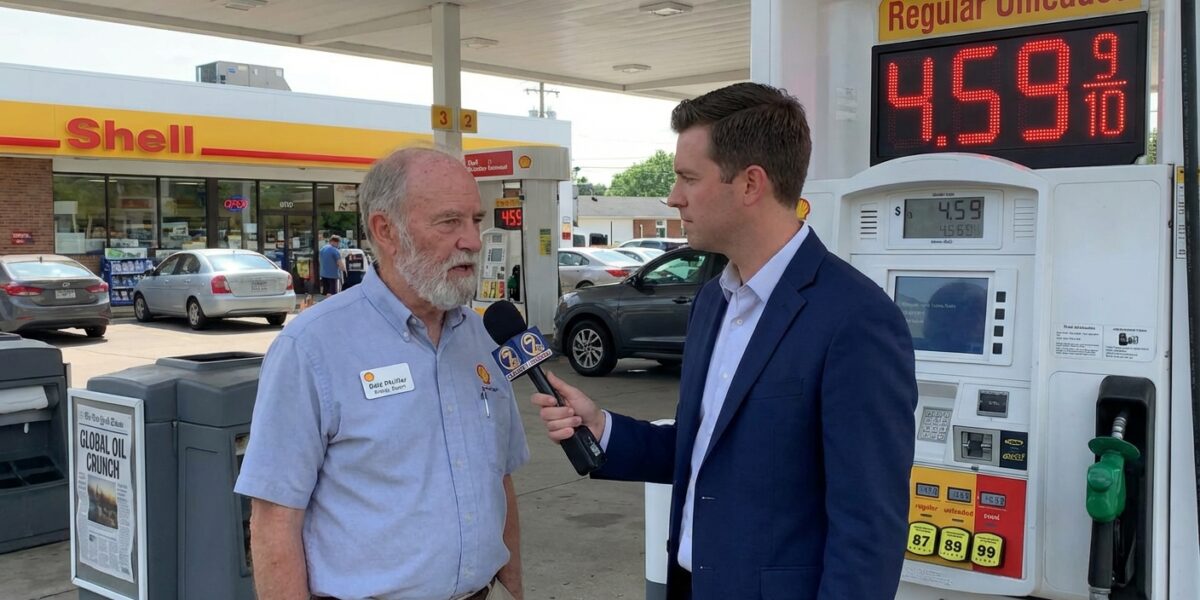
AKRON, OHIO — The Strait of Hormuz, a narrow waterway through which approximately 20% of the world’s oil supply transits daily, has been effectively closed by Iranian military action following the commencement of U.S.-Israeli military operations, causing oil prices to surge past $91 a barrel, shipping giant Maersk to suspend regional operations, oil storage tanks across the Middle East to begin filling to capacity, and Dale Pfeiffer, 58, of Akron, Ohio, to shrug in a way that suggested he had the situation fully assessed.
“They’ll work it out,” said Dale, filling a 2019 Ford F-250 at a Shell station on Route 8, where regular unleaded had that morning jumped to $4.89 per gallon. “They always work it out. And besides — oil’s everywhere over there. They got more than they know what to do with.”
Dale is not an energy economist. Dale is a retired HVAC technician and part-time antique coin dealer who described his primary sources of geopolitical information as “Fox News, mostly, and my brother-in-law Rich who knows a lot about this stuff.”
Rich was not available for comment. His wife said he was at work.
What Is Actually Happening With Oil
The Strait of Hormuz, for those whose geopolitical education has been primarily curated by Dale and Rich, is a 21-mile-wide passage between the Persian Gulf and the Gulf of Oman. It is the world’s most critical oil chokepoint. Saudi Arabia, the UAE, Kuwait, and Iraq all export the vast majority of their oil through it. There is no practical alternative route for most of this production.
With Iran having effectively closed the strait through a combination of mines, naval action, and the suggestion that it might do considerably more if provoked further, approximately 17 million barrels of oil per day are no longer reaching global markets. This has caused Brent crude, the international benchmark, to rise 24% in a single week. U.S. prices are up 31%. Analysts at Goldman Sachs, who are paid considerable sums to describe obvious situations in calm voices, said in a note Thursday that they expected prices to “remain elevated” for as long as the situation persisted, a sentence that contains the information that prices will be high while things are bad.
Some analysts have used the word “shock.” Others have used the phrase “supply disruption.” One analyst at Barclays used the phrase “buckle up,” then apparently realized that was not standard financial communication and deleted the note before it went to clients.
The Gas Station As Policy Forum
Supposedly News spent Thursday morning at the Route 8 Shell station, which functions as an informal community forum on matters of energy policy in the greater Akron area. A diverse range of perspectives was represented.
A woman named Cheryl, 44, a hospital administrator, said she was “extremely concerned” and had already begun tracking regional fuel prices on a spreadsheet. She correctly identified the Strait of Hormuz on an imaginary map she drew on a napkin. She seemed to be the only person at the gas station who had done this.
A man named Travis, 31, said he had switched to a hybrid in 2024 and found the whole thing “interesting from a distance.” He had a smoothie. He seemed fine.
Dale remained at the pump for several minutes after his tank was full, explaining his theory that the U.S. has “secret oil reserves” that would handle the whole situation. The U.S. Strategic Petroleum Reserve, which is real and which Dale is likely referencing, currently holds approximately 350 million barrels. The U.S. consumes approximately 20 million barrels per day. Supposedly News calculated that the reserve would cover approximately 17.5 days of full domestic consumption, or roughly long enough for the situation to not be resolved.
We did not share this calculation with Dale. It seemed unkind.
The Market’s Response
Oil futures markets, which do not have the benefit of Dale’s optimism, closed Thursday at their highest point since 2023. Airline stocks fell. Trucking stocks fell. Consumer goods stocks fell. Defense contractor stocks rose, continuing a streak that investors described as “uncomfortable to profit from but nonetheless profitable.”
Dale said he thought the whole thing would blow over by the weekend.
As of press time, it had not blown over by the weekend.
Supposedly News will continue monitoring fuel prices in the Akron area. Dale has our number. He said he’d call if anything changes. We are cautiously optimistic about this arrangement.