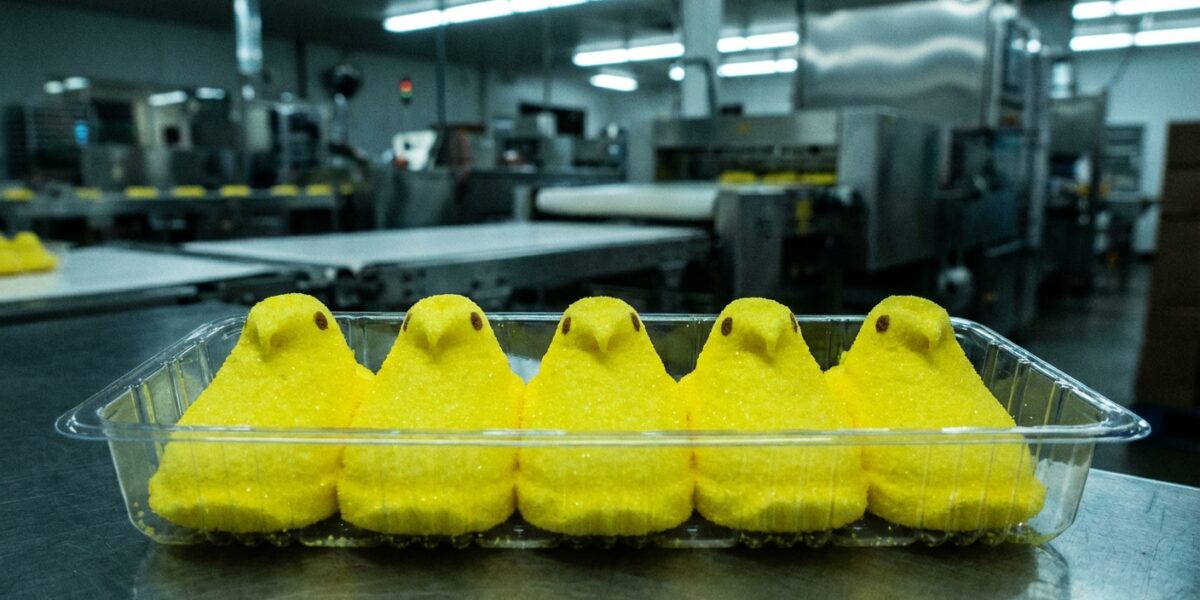
BETHLEHEM, PENNSYLVANIA — They arrive in trays of five, pressed together in a confinement arrangement that leaves no space between them — beak to body, body to beak, a density that small-batch marshmallow advocates describe as “frankly unconscionable” and that the Just Born Quality Confections company describes as a “serving size.”
These are Peeps. And their season is upon us.
Every year, as Easter approaches and America’s attention turns to renewal, rebirth, and the question of what exactly to do with a basket full of plastic grass, the nation purchases approximately 700 million Peeps — a figure that represents either a celebration of spring or a collective act whose ethical dimensions have gone largely unexamined. Yolanda Tippington, Science Correspondent, has been examining them. She has been examining them since the cellophane was sealed. She has concerns.
“Five to a tray,” said a source with knowledge of the packaging, who asked to remain anonymous because they are not a source, they are a tray of Peeps that Yolanda purchased at a CVS. “You don’t know what it’s like in here. We touch at all times. There is no enrichment. The sugar is not a choice — it’s a coating they put on us.”
The source tasted like approximately 34 grams of sugar. Yolanda confirmed this independently.
Caged Peeps vs. Free-Range Peeps: A Welfare Comparison
The standard Peeps chick — yellow, eyeless in the biological sense but with two small dots of wax suggesting awareness — spends its entire existence in contact with four other chicks in a sealed plastic tray with a cardboard backing. They cannot turn around. They cannot spread their wings, which they do not have. They cannot forage for naturally occurring sugar crystals in an open field, which is not a thing that happens but which free-range Peep advocates believe should at minimum be an option.
The free-range Peep, by contrast — available at select artisanal confectioneries and one farmers market in Vermont where the vendor describes the chicks as “pasture-raised on organic cane fields” despite this being a metaphor — lives a different life. The free-range Peep is sold individually. It is wrapped in its own packaging. It has, in theory, had access to space. Whether the Peep experienced this space in any meaningful way is difficult to assess, because the Peep is a marshmallow and does not have a nervous system, which is a point that free-range advocates acknowledge but find beside the point.
“It’s about the principle,” said Dr. Millicent Farrow, a certified confectionery ethicist at an institution Yolanda Tippington cannot verify exists. “When you buy a tray of five caged Peeps, you are participating in a system. The system says: five chicks in a rectangle is acceptable. We are saying: what if it wasn’t?”
What if it wasn’t. Yolanda is sitting with that.
The Investigation: Conditions Inside A Standard Tray
Yolanda Tippington conducted an extensive undercover investigation of a standard 10-count Peeps tray, purchased for $1.99 at a pharmacy that also sells Easter lilies and blood pressure medication in the same aisle, which is a retail juxtaposition that merits its own investigation but is not today’s focus.
Findings from the investigation:
Space per chick: Each Peep occupies approximately 2 inches of horizontal tray real estate and has zero vertical clearance below the cellophane ceiling. The cellophane ceiling does not open. It has never opened, for any of them. The Peeps on the outside of the row are slightly better positioned than the Peeps in the middle, who are touching other Peeps on both sides. The middle Peeps have not been asked how they feel about this. This is the problem.
Access to natural light: None. The tray was in the Easter candy aisle under fluorescent pharmaceutical lighting, which is not sunlight and does not support the natural circadian rhythms that Peeps would theoretically have if they were not made of gelatin.
Enrichment activities: None. The Peeps are not provided with toys, substrate for foraging, or opportunities to engage with conspecifics in a non-compulsory context. They are engaging with conspecifics constantly, in a fully compulsory context, because they are physically touching at all times.
Stocking density: Five chicks per 3.5 ounces. The industry standard for free-range poultry allows two square feet per bird. The Peeps standard does not specify square footage because the Peeps are not being measured in square footage. They are being measured in “rows of five” which is a unit that does not appear in any free-range certification framework.
Sugar coating application: Involuntary. The chicks did not consent to the sugar coating. The sugar coating is applied at the manufacturing stage, before awareness of any kind, which confectionery ethicists note is the standard practice and also technically true of most forms of consciousness, which is getting too philosophical for a candy investigation and Yolanda is stepping back from it.
The Bunny Question
The Peeps chick is not the only Peeps format. The Peeps bunny also exists. The Peeps bunny is sold in a similar tray formation, packed five to a row, and raises an entirely separate set of welfare questions, because the bunny — unlike the chick — has visible ears, suggesting a capacity for auditory experience that the chick’s beak-only design does not imply.
If the bunny can hear, the bunny can hear the cellophane. The cellophane does not open. The bunny has been hearing the cellophane from the moment of sealing. These are the conditions.
Yolanda Tippington asked a certified marshmallow welfare specialist what the bunnies hear inside the tray. The specialist, whose certification Yolanda also cannot verify, said: “Nothing. They are marshmallows. But spiritually? Everything. They hear everything.”
Yolanda has not been able to confirm or deny the spiritual hearing of Peeps bunnies. She has rated her own confidence in this investigation at 34%, which is lower than any other piece she has filed and higher than she expected when she started eating the evidence.
What You Can Do: A Guide To Ethical Peeps Consumption This Easter
Buy free-range: Seek out artisanal marshmallow chicks from producers who can verify that their product was not packed in physical contact with four other products. Ask questions. Demand answers. Accept that the answers will mostly be “it’s candy.”
Open the tray immediately: Upon purchase, open the tray and allow the Peeps to breathe. They will not breathe because they are marshmallow, but they will be exposed to more space than they have previously experienced, and this matters symbolically, and symbolism is what Easter is largely about.
Age your Peeps: A significant and vocal segment of the Peeps-consuming public deliberately opens the tray and leaves the Peeps exposed for days or weeks before eating them, until they develop a firm outer crust. These consumers describe this as preferable. The Peeps, in the days following tray-opening, have at last experienced space, air, and the freedom that is the birthright of all confectionery. That they are then eaten is not discussed in free-range advocacy materials. Yolanda is not raising it either. That is a separate moral question and it is almost Easter and she is trying to be uplifting.
Microwave a Peep: This is what some people do to Peeps. It makes them expand enormously and then collapse. It is done for entertainment. Yolanda includes it here not as a welfare recommendation but as a disclosure of existing practices, which the industry is aware of and has not commented on, and which the Peeps have not commented on either, and which Yolanda finds, on reflection, the most honest metaphor available for the holiday season generally.
The Verdict
The caged Peep lives a short, compressed life in contact with four others, under fluorescent light, awaiting a fate that involves either a basket, a microwave, or being eaten while watching television on a Sunday morning in April. The free-range Peep lives a short, individually wrapped life before the same three outcomes.
The difference, Yolanda Tippington concludes, is the story we tell ourselves in the candy aisle. The caged Peep costs $1.99 for ten. The free-range Peep costs $4.50 for one, if it exists, and it may not. The story costs nothing. The basket plastic grass is everywhere and cannot be disposed of and will persist in your carpet until June.
Happy Easter. The Peeps are right there. They have been right there since February. They are waiting. They are always waiting. Five at a time.
Yolanda Tippington, Science Correspondent, conducted this investigation over two days and three trays. She would like it noted that she attempted to eat her sources responsibly and in order of appearance. She rated her confidence at 34% because she ate 66% of the evidence before the article was complete. No Peeps were harmed in the writing of this piece. They were harmed slightly before the writing of this piece. Happy Easter from Supposedly News. Gerald the houseplant received one Peep. He did not eat it. Gerald is, as always, fine.