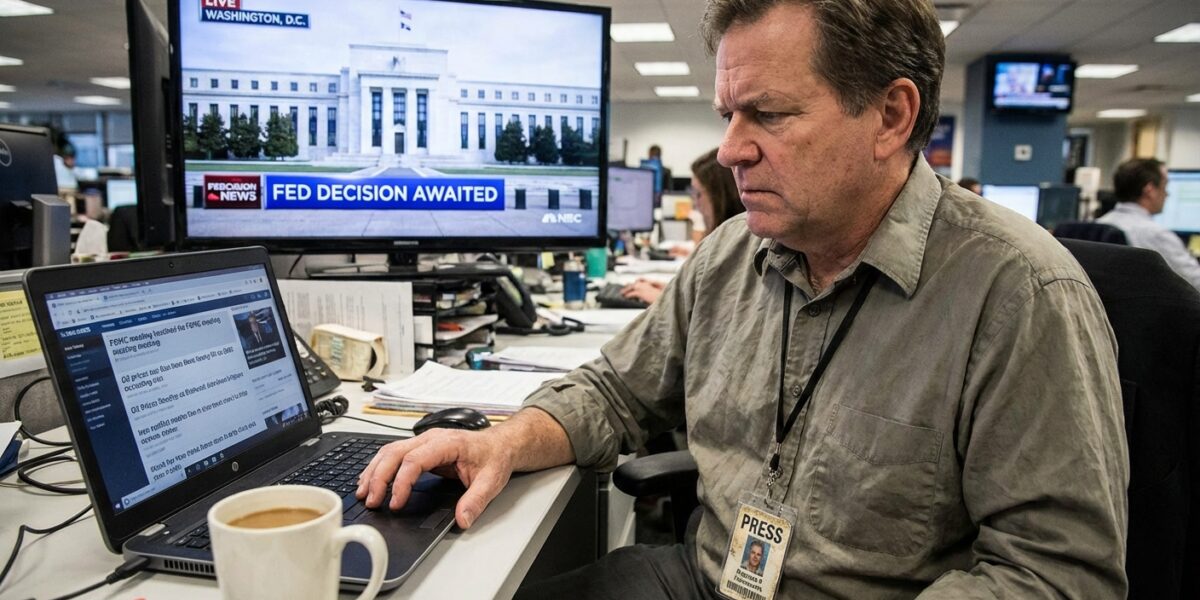
The Federal Reserve’s Federal Open Market Committee meets today, Wednesday, March 18, 2026, to decide what to do with interest rates in the specific economic environment of: an active war whose eighteenth day has brought oil to $103 a barrel; a consumer gas price average of $3.63 per gallon, a 22-month high; a tariff regime that has raised the average tax on imports to approximately 13% and that studies suggest is being paid mostly by U.S. consumers; a president who has repeatedly said he wants lower rates; a Fed chair nominee who has historically favored higher rates; and a stock market valued at its most expensive level since the dot-com crash, which is not a description that has historically preceded good outcomes.
The Fed will hold rates or cut rates or raise rates. These are all of the options. The Fed has been holding at 3.5% to 3.75% since its January meeting. The president has been expressing his preference for lower rates since at least January. The Fed has not lowered them. The president has continued expressing the preference. The Fed has continued holding. This is the dynamic that exists as of Wednesday morning, and it will continue through the morning, and then the decision will be announced, and the dynamic will either change or continue, and the market will either like the decision or not like it, and both are possible outcomes, and Reginald is prepared for both.
What The Fed Is Looking At, According To People Who Look At What The Fed Is Looking At
The FOMC, per analysts, must weigh several competing inputs that do not resolve neatly into a single direction:
The case for cutting rates: The economy is slowing. GDP grew 2.2% last year, the slowest since the pandemic. Jobs growth was the weakest since the Great Recession, excluding the pandemic. Consumer sentiment is declining. A war that has closed the Strait of Hormuz and sent oil to $103 a barrel is adding an energy shock on top of existing tariff pressures. Lower rates would reduce borrowing costs and potentially stimulate a slowing economy.
The case for holding or raising rates: PCE inflation is at 2.9%, above the Fed’s 2% target. The war has produced an oil shock, and oil shocks produce inflation. Cutting rates into an inflationary environment risks making the inflation worse. The tariffs are also inflationary. Goldman Sachs projected that 67% of the tariff burden will fall on consumers by July 2026, which is a number that also arrives into the inflationary environment being described here. The economic inputs are, collectively, pointing in different directions simultaneously, which is either a Gemini situation (as Supposedly News’s astrology correspondent noted last Friday) or a genuine macroeconomic challenge, and it is probably both.
The case for not knowing what to do and saying something careful and noncommittal: This is the case that the Fed has historically been best at making, and which this particular meeting’s unique combination of inputs — war inflation, tariff inflation, demand slowdown, oil shock, and a president who has said publicly that he wants rates lower and that the economy is doing great — seems especially well-suited to produce. The dot plot, which is the Fed’s projection of where rates might go, will be watched closely. The dot plot tends to say “it depends” in a way that requires seventeen paragraphs to translate, which is Reginald’s job on the days when the dot plot speaks, and this is one of those days.
Kevin Warsh Is Still In The Background Of This Story
Kevin Warsh, the president’s expected nominee to succeed Jerome Powell as Fed chair, has a long documented record of hawkish monetary policy — meaning he tends to favor higher rates to combat inflation, not lower ones. The president wants lower rates. The president’s nominee has historically favored higher rates. This dynamic was identified in Supposedly News coverage in early March and has not resolved. It continues to be the background of the rate story in the way that a second tranche continues to be the background of the Mandelson story: present, pending, unresolved, and becoming harder to ignore as the situation develops around it.
One analyst summarized Warsh’s position concisely: “If Trump wants someone easy on inflation, he got the wrong guy in Kevin Warsh.” This summary remains accurate. The situation it describes remains ongoing.
What The Oil Price Has To Do With All Of This
Oil at $103 a barrel is an inflationary force. Oil at $103 a barrel is also a result of a war that the administration started and describes as going very well. “Very well” and “$103 a barrel” are outcomes of the same operation, which means the Fed is being asked to manage inflation that was partly produced by a decision the executive branch made and cannot undo without also undoing the operation, which the executive branch has described as very complete, pretty much, despite being on its eighteenth day with the Strait of Hormuz still closed and Iran’s parliament speaker having stated on Tuesday that the strait “won’t return to its pre-war status.”
If the strait does not return to its pre-war status, oil does not return to its pre-war price. If oil does not return to its pre-war price, inflation does not return to the Fed’s 2% target on the timeline the Fed was working from before the war started eighteen days ago. The Fed is meeting today. The war started eighteen days ago. The FOMC meeting is the first one since the war started. The meeting will produce a decision. The decision will not end the war. The war will continue to affect the oil price. The oil price will continue to affect the inflation rate. The inflation rate will affect the next meeting’s decision. Reginald P. Farnsworth has drawn this diagram. The diagram is also a circle. Today is March 18. Pi Day was four days ago. The diagram was always going to be a circle.
The decision will be announced this afternoon. Reginald will cover it. The dot plot will be released. Reginald will cover that too. The conference will happen. Jerome Powell will speak carefully. The market will react. Reginald will note the reaction. Everything is fine. It is all just a series of circles. The shamrocks are on a table at the White House. The crystal bowl is from the House of Waterford. The rate decision is coming. Gerald is fine.
Reginald P. Farnsworth, Senior Correspondent, has been covering the economy since the publication launched and has now used the phrase “the economy is a little glitch” in three articles and the word “equanimity” in four, and considers both counts a testament to the consistency of the situation rather than his own limitations. Confidence: 18% — the date, and his honest assessment of the Fed’s ability to navigate all of the above without at least one carefully worded phrase that leaves everyone more uncertain than before. Fake sources: 5. The coffee helped. The circle was always going to be a circle. Gerald, who also does not pay borrowing costs, is fine.