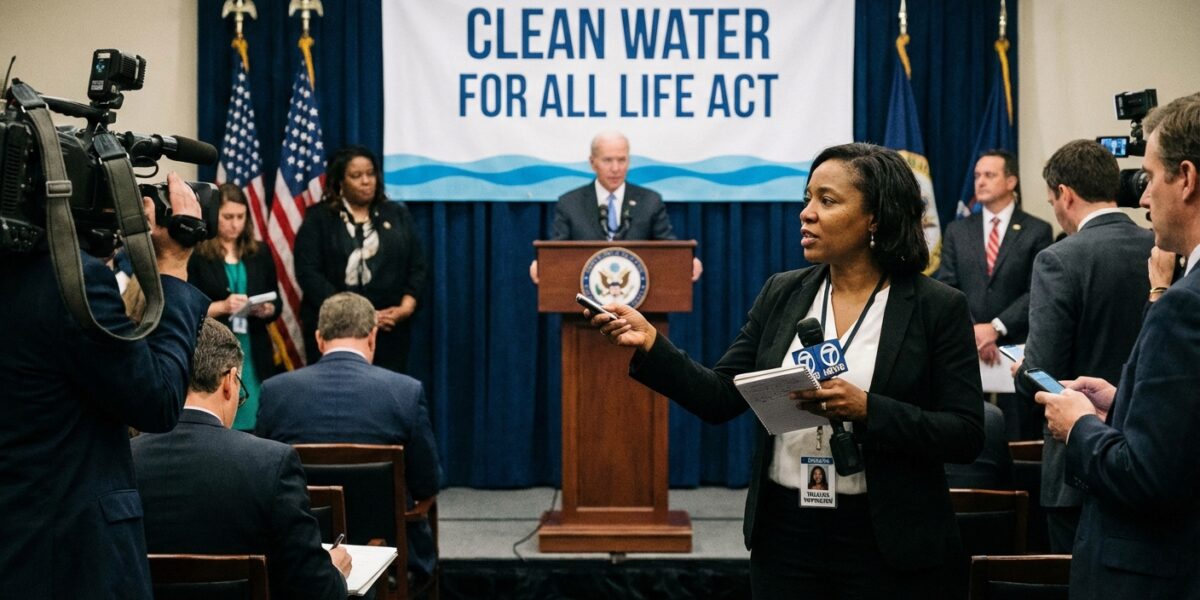
SCIENCE — A bill has been introduced in the United States House of Representatives to address a public health crisis. The public health crisis is, per the bill’s sponsor, Representative Mary Miller of Illinois, that abortion pills are contaminating America’s drinking water with fetal remains, endocrine-disrupting chemicals, and mifepristone — a medication whose residue, the bill’s supporters contend, is flowing unfiltered through the nation’s water treatment systems into the glasses and taps of unsuspecting Americans.
The bill is called the Clean Water For All Life Act. The penalty for non-compliance is up to five years in prison and a $50,000 fine. The bill would require women using the abortion pill mifepristone to use a “catch kit” — a device that prevents any fetal remains or pregnancy tissue from entering the toilet — and then bring that material to their physician as medical waste. It would also ban telehealth prescriptions for abortion medications and require a physician to be physically present when a patient uses the pill.
Yolanda Tippington, Science Correspondent, has read the bill. Yolanda has also read the science. Yolanda is going to walk through both, and the walk will be thorough, because the gap between them is a distance that Yolanda considers professionally interesting and personally alarming.
What The Science Says, Which Is The Part Yolanda Covers
Trace amounts of medications — all medications — can be found in wastewater. This is real. Your ibuprofen does this. Your birth control does this. Your blood pressure medication does this. Your antidepressants do this. The antibiotics you didn’t finish do this. The water treatment process reduces these trace amounts; it does not eliminate them entirely; this is a genuine environmental consideration that water scientists study and that the EPA tracks through its regulatory frameworks.
This is the scientifically accurate foundation of the concern. Here is where the bill’s science and the established science diverge:
The Guttmacher Institute — a national reproductive health research organization that tracks abortion data — states flatly: there is no scientific evidence to back up the claim that abortion pills are polluting drinking water or harming the environment. Anna Bernstein, principal federal policy adviser at Guttmacher, called the bill “another bad-faith attempt to restrict medication abortion, this time by repackaging anti-abortion misinformation as false concern about water pollutants.”
The FDA conducted an environmental assessment of mifepristone in 1996 and found “no significant impact.” That was before the drug was even approved for use in the United States. Subsequent use has not produced regulatory findings suggesting the 1996 assessment was wrong. No major scientific or public health body has identified abortion pills as a water contaminant requiring regulatory action beyond the existing framework that applies to all pharmaceuticals.
The bill’s primary scientific citation is a report by Students for Life of America — an anti-abortion advocacy organization, not a scientific research institution — which calculated that 50 tons of abortion-related waste enters American waterways annually. The calculation multiplied the number of medication abortions by an estimated tissue weight and arrived at a tonnage. This is a math problem dressed as a science finding. The math may be internally consistent. The conclusion — that this tonnage represents a water contamination crisis distinct from all other pharmaceutical residue in wastewater — has no supporting peer-reviewed evidence, and water treatment scientists and reproductive health researchers have not adopted it.
The Ibuprofen Problem, Which Yolanda Raises As A Point Of Consistency
Ibuprofen — available over the counter, consumed by hundreds of millions of Americans annually for headaches, menstrual pain, muscle soreness, and the specific discomfort of reading legislative summaries — also produces pharmaceutical residue that enters wastewater. It also metabolizes imperfectly through water treatment systems. It is also, in trace amounts, in the drinking water of municipalities across the country.
There is no catch kit for ibuprofen. There is no bill requiring ibuprofen users to present their metabolized pharmaceutical waste to a physician as regulated medical waste. There is no $50,000 fine for flushing a toilet after taking Advil. There is no prison sentence.
Yolanda is not saying ibuprofen should have these things. Yolanda is saying that the principle being applied — pharmaceutical residue in wastewater is a crisis requiring federal criminal enforcement — is applied in this bill exclusively to one specific medication used exclusively by people who are ending pregnancies. The water treatment concern is the framing. The medication is the target. These are, Yolanda notes, not the same thing, and framing one as the other is a move that she, as a science correspondent, finds worth documenting in a clearly labeled column.
The Catch Kit, As A Medical And Logistical Concept
The bill requires patients using mifepristone at home to use a catch kit — a device that would collect any pregnancy tissue, placental material, or fetal remains — and then transport that material to their prescribing physician as regulated medical waste.
Yolanda would like to briefly note the following logistical sequence this would require of a patient:
One: Take the medication at home. Two: Experience what the medication produces, which is a miscarriage-equivalent process that includes bleeding, cramping, and the passage of pregnancy tissue, which for early medication abortions (the majority) produces tissue at a very early gestational stage. Three: Collect this material using the catch kit, while experiencing the physical and emotional experience of a medically induced miscarriage. Four: Store the material appropriately. Five: Transport it to a physician. Six: If you do not do all of this correctly, face a $50,000 fine and up to five years in federal prison.
For context: medication abortions are most commonly used in early pregnancy, often before eight weeks. The “fetal remains” at this stage are microscopic — comparable in size to what is passed in a natural miscarriage, which millions of American women experience every year, in their homes, without catch kits, without physician presence, without federal criminal penalties. The bill does not apply to miscarriages. It applies only to the medication abortion. The biology is identical. The legal treatment is not.
The Bill’s Broader Provisions, Also Worth Noting
The Clean Water For All Life Act also bans telehealth abortion prescriptions — meaning women would be required to visit a physician in person before receiving mifepristone, which in practice eliminates access for the significant portion of Americans who live in areas without local abortion providers, which in practice disproportionately affects rural and low-income patients, which is a policy effect the bill’s framing as an environmental measure does not address and which Yolanda is noting here because the framing and the effect are different things.
The bill has ten co-sponsors including Representatives Lauren Boebert, Paul Gosar, and Tim Burchett. It is unlikely to pass in its current form. The administration has been slow-walking the FDA’s review of mifepristone, which has frustrated the bill’s supporters. The EPA does not currently regulate mifepristone as a pollutant; the bill would create pressure on the FDA and EPA to take action.
What The Science Recommends Instead Of This Bill, Since Yolanda Was Asked
The science recommends the existing water quality monitoring framework, which already tracks pharmaceutical contamination in waterways and applies to all medications. The science recommends continued research into pharmaceutical residue in water systems generally, which is a legitimate and ongoing area of environmental study. The science recommends that policy claims about specific medications be based on peer-reviewed evidence rather than calculations produced by advocacy organizations whose stated mission is the elimination of that medication.
The science does not recommend catch kits enforced by federal criminal penalties. The science does not recommend five-year prison sentences for anyone who uses a toilet after a medication abortion. The science does not recommend treating one pharmaceutical’s wastewater residue as a unique crisis requiring criminal enforcement while all other pharmaceuticals — including those consumed in far larger quantities with comparable or greater environmental effects — face no such framework.
Yolanda Tippington is a science correspondent. She is not a policy correspondent. She does not tell legislators what to do. She tells you what the science says. The science is available. The bill has been introduced. These are two things that exist simultaneously. One of them is peer-reviewed. One of them is in Congress.
Confidence level: 12% — reflecting Yolanda’s confidence that the science will be the primary driver of the bill’s fate, which is not how these things tend to work, and she knows this, and she is filing anyway, because someone has to.
Yolanda Tippington, Science Correspondent, reviewed the bill, the supporting report from Students for Life of America, the FDA’s 1996 environmental assessment, the Guttmacher Institute’s response, and the general scientific literature on pharmaceutical residue in wastewater. She read all of it. She is going to need some water. She checked the water. The ibuprofen is in there. The ibuprofen is always in there. The ibuprofen does not have a catch kit. Gerald the houseplant does not drink tap water. Gerald is watered from a filtered pitcher by someone who loves him. Gerald is fine. Yolanda is doing her best.