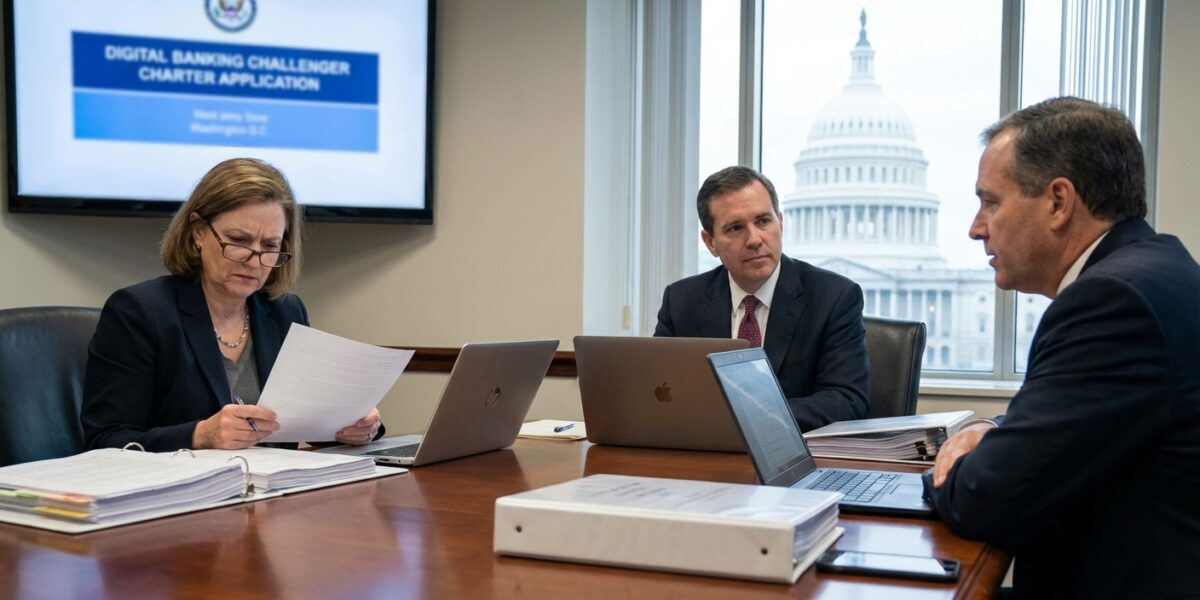
WASHINGTON, D.C. — Voltex Bank, a London-headquartered digital banking challenger with 45 million customers, a sleek app interface, and a marketing department that has never met a superlative it didn’t immediately deploy, filed applications Thursday for a U.S. national bank charter with the Office of the Comptroller of the Currency and deposit insurance with the FDIC, pledging to deliver an American banking experience that is “reimagined from the ground up,” “radically transparent,” “genuinely human-centered,” and “completely different from what came before” — phrases that veteran banking regulators describe as “something we hear a lot” and “we’ll need to see the underwriting model.”
Voltex Bank’s pitch to American consumers rests on the proposition that traditional American banking — an industry characterized by surprise fees, hold times averaging 34 minutes, overdraft charges that function as a tax on poverty, branches that close at 4 p.m., and mobile apps designed in what user experience researchers politely call “the hostile era” — is ripe for disruption by a company with a better app and a very confident brand voice.
This proposition is not wrong. American banking is, by most consumer satisfaction metrics, an experience that people endure rather than enjoy. The question that regulators, analysts, and three former bank executives interviewed by Supposedly News all raised independently is: different how, specifically, and what does the underwriting look like when it gets tested?
What Voltex Says It Will Do
Voltex’s application, portions of which were reviewed by Supposedly News, describes a banking model built on real-time transaction notifications, no foreign exchange fees, no overdraft charges, transparent pricing, instant account opening, and a customer service model that the filing describes as “conversational and empathetic” — which analysts suspect is a reference to an AI chatbot and which Voltex describes as “a proprietary service model we’re excited to share more about at the appropriate time.”
The application also promises “direct access to domestic payment systems like Fedwire and ACH,” which is true of all chartered banks and is the primary reason to get a charter, so its inclusion as a selling point is noted.
What Regulators Say About This
The OCC’s charter licensing division does not typically issue press releases about its emotional response to applications. However, Supposedly News spoke with three former OCC licensing officials, none of whom are currently employed by the agency and all of whom agreed to speak candidly provided they were not identified.
“The pitch is fine,” said the first. “The pitch is always fine. Then you look at the stressed credit scenarios and the liquidity modeling and that’s where it gets interesting. ‘We’re different’ is not a regulatory framework.”
“I’ve seen a lot of these,” said the second. “The ones that make it tend to be the ones that stop saying ‘we’re different’ and start saying ‘here’s our net stable funding ratio.’ The ones that don’t make it keep leading with the app.”
The third former official said simply: “The overdraft promise. That’s the one. Talk to me in 18 months about the overdraft promise.”
The Broader Context
Voltex is entering a U.S. market that has already absorbed and, in several cases, absorbed and then slowly digested several previous digital banking challengers whose trajectories followed a recognizable arc: launch with enthusiasm, accumulate customers through superior UX, encounter regulatory complexity, discover that banking is actually quite hard, raise more capital, encounter a stress event, discover that banking is extremely hard, and then either get acquired by one of the large incumbent banks they were disrupting, or quietly narrow their ambitions to a point where “reimagined banking” means “a slightly better app attached to a conventional banking charter.”
Voltex may be different. Several analysts believe it genuinely may be. It has 45 million customers, a profitable European operation, and a track record that older challengers didn’t have.
It is also, as of Thursday, an applicant. Applications take 18 months to two years. A lot happens in 18 months to two years.
“The app is genuinely very good,” said one analyst who covers fintech, acknowledging our question about long-term viability. “Like, the app is excellent. I use it personally. The question is whether an excellent app is sufficient to be a bank.”
The OCC will, in due course, have thoughts on this question. They have not yet shared them. Their app is not available for download.
Supposedly News maintains accounts at two traditional banks. Both apps are not good. We remain open to alternatives.