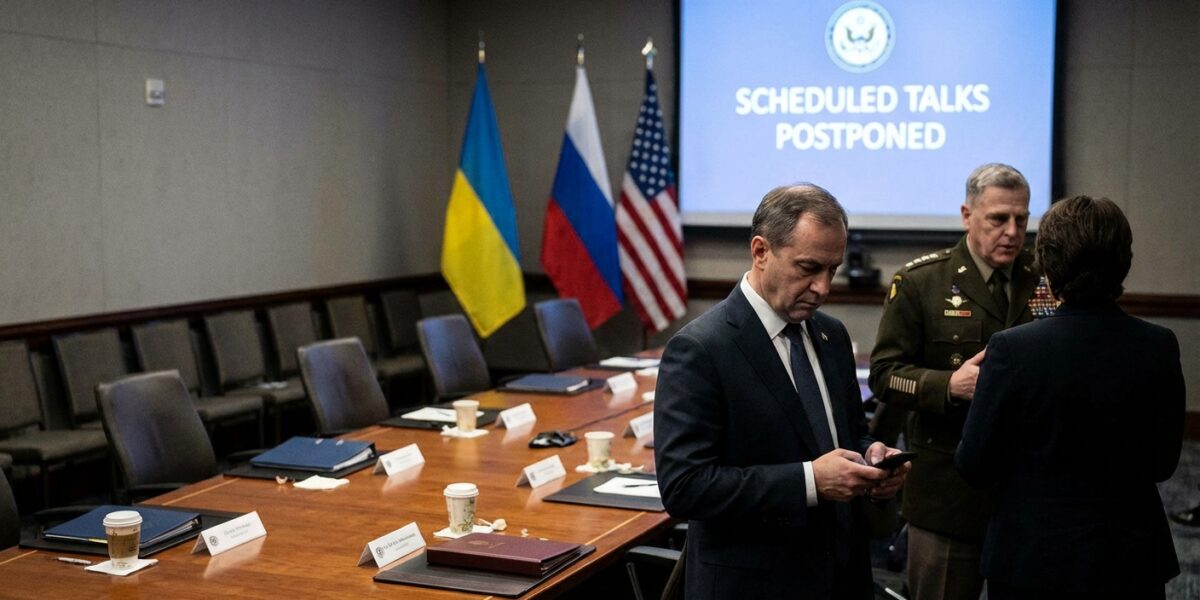
The third attempted round of Ukraine-Russia peace negotiations in six months has been postponed, Ukrainian President Volodymyr Zelensky confirmed Thursday, citing circumstances that he described as “well known” and that diplomatic analysts described as “the circumstances that have been complicating these talks since the talks began, which is to say the war.”
The talks, which had been scheduled for Abu Dhabi — a choice of venue that in hindsight appears to have been made before the regional situation became what diplomats are now calling “a factor” — have been rescheduled for a date and location to be determined, a phrase that veteran conflict negotiators recognize as meaning “we will try again when things are less complicated,” itself a phrase that veteran conflict negotiators recognize as meaning “we don’t know when that is.”
The postponement comes after a previous session in Geneva produced, according to official readouts, “a productive exchange of perspectives” and the release of 400 prisoners of war on each side — a genuine, tangible, human outcome that was nonetheless described by outside analysts as “not a framework agreement,” “not a ceasefire,” and “not what was hoped for but not nothing, and right now not nothing is doing significant work.”
What Has Been Agreed
Over the course of six months and three attempted negotiating sessions, the parties have agreed to the following:
The prisoner exchanges. These are real and ongoing and have returned hundreds of people to their families. They represent the most concrete output of the negotiating process and are not, presumably, going to be satirized by anyone with a conscience, so this publication will note them sincerely: they are good and they should continue.
The shape of the table. Sources with knowledge of the negotiations report that the negotiating table in Geneva was round, a choice described in diplomatic circles as “intentional” and in practice as “the most substantive area of consensus reached.” A round table implies no head, no hierarchy, no party seated in a position of apparent superiority. It is a centuries-old diplomatic device. Both parties sat at it. Both parties then disagreed about everything else.
The existence of the talks. All parties agree that the talks are occurring. This is less trivial than it sounds: in the early stages of the conflict, the idea of formal negotiations involving the U.S., Ukraine, and Russia at the same table was considered by many analysts to be implausible. That the table exists and people sit at it is, in the accounting system available, logged as progress.
What Has Not Been Agreed
Territory. Sovereignty. Security guarantees. Ceasefire terms. The status of occupied regions. The sequencing of any potential withdrawal. The question of war crimes accountability. The future of NATO membership. The economic reconstruction framework. The role of international monitors. The definition of “peace” as it applies to a situation in which one party invaded the other and the other is asking for that to stop.
“We’re making progress,” said a spokesperson for the U.S. negotiating team, who asked not to be identified because they are a person who has to sleep at night.
The Analysts Weigh In
Supposedly News reached out to seven diplomatic analysts. Their assessments formed a spectrum from “cautiously pessimistic” to “I have been studying conflict negotiation for 30 years and what I will tell you is that I genuinely don’t know, which is itself information” to one analyst who had apparently reached a kind of professional serenity about the situation and spent most of the call describing a hiking trail in Colorado that she recommended highly.
“The talks not collapsing is meaningful,” said Dr. Patrick Osei of the Carnegie Endowment. “Collapsed talks are much worse than postponed talks. Postponed talks mean someone thinks there’s something to come back to. I’m going to hold onto that for now.”
He sounded like a man holding onto something very carefully.
The next session will occur at a time and place to be determined. The prisoner exchanges will continue in the meantime. The round table is reportedly still available.
This opinion column is brought to you by Douglas Allegedly, who would like to note that he finds diplomacy genuinely fascinating and genuinely exhausting and that these two things are not in conflict.