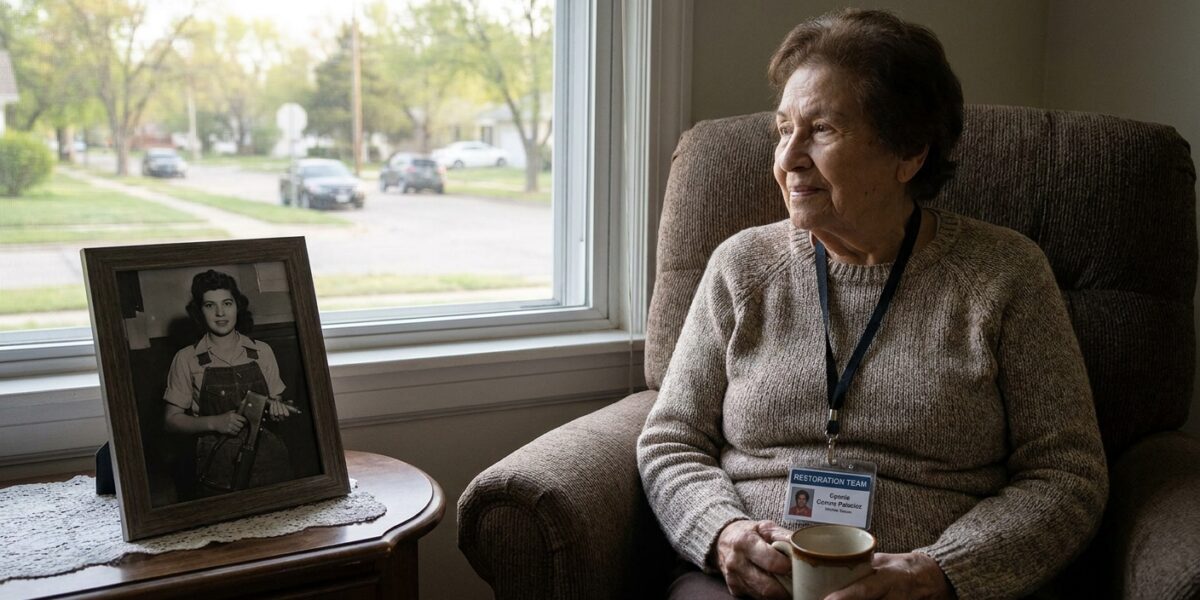
WICHITA, KANSAS — Connie Palacioz was 17 years old in 1943. The country was at war. The Boeing plant in Wichita was building B-29 Superfortress bombers — the largest and most technologically advanced aircraft of the war, the plane that would carry the atomic bombs to Hiroshima and Nagasaki, the plane that required approximately 85,000 parts per airframe, the plane that required rivets. Connie went to work at the plant and became one of the people who put the rivets in.
She worked on the B-29 production line from 1943 to 1945. The Wichita factory built 1,644 B-29 Superfortress bombers during the war. The B-29 was the most expensive weapons system of World War II — more expensive, in total program cost, than the Manhattan Project. More than six million women entered the American workforce during the war, filling roles in factories, shipyards, and arsenals that had previously been occupied exclusively by men. They were called Rosie the Riveters. The name came from a song, then a poster, then a cultural identity that has endured for 80 years as a symbol of what happens when a country asks its women to do the thing that needs doing and the women say yes.
Connie said yes at 17. She riveted bombers. Then the war ended. And Connie went home and did not tell anyone.
She Was Just Doing Her Job
For decades — for decades — Connie Palacioz did not tell her family that she had been a wartime riveter on the B-29 production line. Her daughter, Tish Nielsen, did not know. When the story eventually emerged, and when people asked Connie why she had never mentioned that she was Rosie the Riveter, she gave an answer that Millicent considers the most complete sentence ever spoken about service: “I was just doing my job.”
Millicent would like to sit with this. A 17-year-old girl walked into the largest bomber factory in the American Midwest, learned to rivet the fuselage of a four-engine strategic bomber, helped produce 1,644 aircraft over two years, contributed to the industrial effort that turned the tide of a global war, and then went home and classified the entire experience as her job — not her calling, not her sacrifice, not her contribution to the defense of the free world, but her job, which she had done, and which did not require further discussion, and which she did not bring up at dinner for the next fifty years.
This is the generation that built the Arsenal of Democracy. This is what they were like. They did the thing. They did not talk about the thing. They lived for another sixty years and when someone finally asked about the thing they said: I was just doing my job.
The Seven Rivets
In 2000, a B-29 Superfortress designated “DOC” — one of the few surviving airworthy B-29s — was brought to Wichita for restoration. The aircraft had been sitting in the Mojave Desert in California since 1956. It needed work. It needed a lot of work. It needed, among other things, the attention of someone who knew what a B-29 was supposed to look like from the inside.
Connie Palacioz was 75 years old. She joined the restoration team. She volunteered. She kept volunteering. She volunteered for 26 years — from the beginning of the restoration through the aircraft’s return to flight and its subsequent career as a flying museum piece and memorial. She greeted visitors. She told them her story. She told them about the production line. And she told them, specifically, that when DOC arrived from the desert, seven rivets were missing.
Seven. She counted. She looked at the aircraft and she counted the missing rivets and the number was seven. This is a woman who had not talked about her wartime work for half a century, who had raised a family, who had lived an entire life between 1945 and 2000, and who, when she walked up to a B-29 for the first time in 55 years, immediately began counting rivets. The rivets were still her business. The rivets were always her business. She had put them in. She could tell you which ones were gone.
“When visitors come and they ask us, and then I tell them that I worked there and that I did this, and everything is still in order,” she said. “You know, I always tell them there were seven rivets missing when it was in the desert.”
Everything is still in order. Seven rivets missing out of — Millicent does not know the exact rivet count on a B-29, but the aircraft has 85,000 parts and the rivet count is in the hundreds of thousands. Seven rivets missing out of hundreds of thousands after 44 years in a desert. Connie noticed. Connie counted. Connie told every visitor who asked.
The Timing Of This, Which Millicent Cannot Ignore
Connie Palacioz died on April 19, 2026. Three days earlier, the Wall Street Journal reported that the Pentagon had called the CEOs of General Motors and Ford to ask if their assembly lines could pivot to weapons production. The administration invoked the Arsenal of Democracy — the World War II industrial mobilization in which American automakers and manufacturers converted their civilian factories to build the bombers, tanks, and munitions that won the war.
Connie was the Arsenal of Democracy. Connie was a 17-year-old girl on a production line in Wichita putting rivets into B-29s that would fly to the Pacific and end the war. Connie was the person the phrase refers to. And the week she died — the week the last of the women who actually did it are leaving — the Pentagon is on the phone with Mary Barra asking if the Silverado line can make missiles.
Millicent is not drawing a political conclusion. Millicent is drawing a human one. The women who did it the first time did it at 17, in factories they had never seen, with tools they had never used, on aircraft they had never imagined, in a war they did not start, for a country that did not pay them equally, and they did not complain about it and they did not talk about it and when asked about it sixty years later they said they were just doing their job. The Pentagon is now asking whether the next generation of American workers can do something similar, and the answer to that question may depend on whether anyone remembers what the first generation was actually like.
Connie was what they were actually like. Connie counted the rivets.
What She Said At The End
In an interview near the end of her volunteering years, Connie said something that Millicent is going to reproduce and then not comment on, because the words do not need commentary. They need to be read.
“I wish all the others that worked with me could be here, but of course, they are gone. But, I don’t know, it’s been great. It just is something that I can’t tell you exactly how, but I feel wonderful to be here.”
She couldn’t tell you exactly how. She felt wonderful. The others are gone. She was still there, at 101, still counting the rivets, still telling the visitors, still standing next to the plane she helped build when she was seventeen years old and the world was on fire and she walked into the Boeing plant and picked up a rivet gun and did not mention it for fifty years because she was just doing her job.
Her daughter wrote on Facebook: “She was so blessed to end her earthly life with family, many blessings and prayers from our Diocesan priests, and wonderful health care providers. I know she is with the Lord and we will miss her, but she has given us an excellent road map to continue our faith-filled life journey.”
Josh Wells, the Executive Director of Doc’s Friends, the nonprofit that maintains the B-29 DOC, said: “Connie’s life journey was inspiring, and it’s been our great honor to have shared her legacy and life story through B-29 DOC.” He added that it’s important to keep stories like Connie’s alive.
Millicent agrees. Millicent is keeping it alive right now. This is what keeping it alive looks like. It looks like writing the name Connie Palacioz and noting that she was 17 and she riveted bombers and she didn’t tell anyone and she came back at 75 and she counted seven missing rivets and she said she was just doing her job and she was not just doing her job and she died at 101 and the rivets are still in the plane.
Millicent Hearsay, Culture Desk, filed this piece on April 21, 2026, with a confidence level of 100% and zero fake sources, because Connie Palacioz was real and her story is documented by KWCH, KAKE, KSN, and the Doc’s Friends nonprofit. The B-29 production figures are from Boeing historical records. The six million women workforce figure is from the National WWII Museum. Connie’s quotes — “I was just doing my job,” the seven missing rivets, “I feel wonderful to be here,” and “I wish all the others that worked with me could be here” — are verbatim from KWCH reporting. Tish Nielsen’s Facebook tribute is verbatim. Josh Wells’ statement is from KAKE. Millicent has spoken with no one about this piece. Millicent did not need to speak with anyone. The record spoke for itself. Gerald the houseplant reviewed this article. Gerald did not have notes. Gerald has been in his position, unchanged, for two years, which is not 26 years, and is not 101 years, and is not the length of time between putting a rivet in a bomber and coming back to count the ones that are missing. Gerald is fine. Connie was fine, too. Connie was always fine. That was the whole thing about Connie.