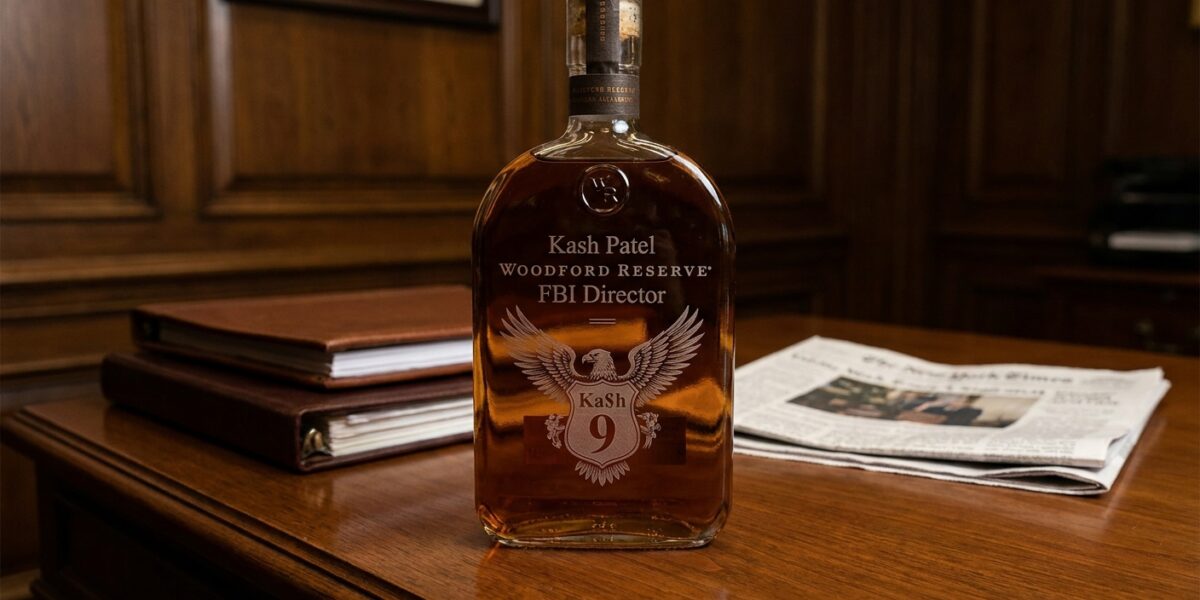
WASHINGTON — The Director of the Federal Bureau of Investigation has personalized bourbon.
Chad is going to let that sentence do its work before adding the details, because the details make it worse, and the sentence — even without them — is already the sentence. The Director of the FBI. Personalized bourbon. The bourbon has his name on it. The name has a dollar sign in it. The bottles have the FBI seal on them. He travels with them. He distributes them. He took them to Italy on a government plane.
The details now.
The Bottles
The bourbon is Woodford Reserve — a Kentucky whiskey from a distillery that has been operating for more than 200 years and which, until this week, had never appeared in a story about federal law enforcement ethics. The bottles are engraved with the following: “Kash Patel FBI Director.” An FBI shield. An eagle holding the shield in its talons. A band of text featuring Patel’s director title. The number 9, a reference to his position in the chronological sequence of FBI directors. And his preferred spelling of his first name: Ka$h.
Ka$h. With a dollar sign. On an FBI-branded bourbon bottle. Distributed by the Director of the Federal Bureau of Investigation.
Chad has covered a lot of paper trails. Chad has covered the 18-month legal process of The Onion purchasing InfoWars. Chad has covered the Epstein files. Chad has covered a man named Shetler who called his compound Mercy and Truth. Chad has never covered a paper trail that includes a dollar sign in a person’s name engraved on a bourbon bottle alongside the seal of the nation’s premier law enforcement agency. This is a new category of paper trail. Chad did not know this category existed. The category is: branded merch from inside the federal government.
The Distribution
Eight sources — including current and former FBI and Department of Justice employees — told The Atlantic’s Sarah Fitzpatrick that Patel has given the personalized bottles to both FBI staff and civilians, sometimes while on official business. The practice, per reporting, includes events, public functions, and travel.
In February 2026, Patel and his team transported the whiskey on a DOJ aircraft to Milan during the Winter Olympics. One bottle was left behind in a locker room during that trip. Chad would like everyone to note: a personalized bourbon bottle bearing the FBI seal and the word “Ka$h” was left in a locker room in Milan, Italy, during the Olympics. Someone in Milan has, or had, a bottle of Woodford Reserve with an FBI eagle on it and a dollar sign in the director’s name. This bottle is in Italy. The FBI is in Washington. The bottle and the FBI are in different countries, and the bottle arrived in Italy on a government plane paid for by American taxpayers, and the bottle was left in a locker room, and the locker room is presumably at an Olympic venue, and the bottle is presumably still there or has been taken by someone who now owns the most unusual souvenir in the history of international sporting events.
The Reaction From People Who Know What The FBI Is Supposed To Be
When Sarah Fitzpatrick contacted a former longtime senior FBI official and asked whether he had ever seen personally branded liquor bottles distributed by a previous FBI director, the official burst out laughing.
Chad considers this the most important sentence in the article. The official did not express concern. The official did not express outrage. The official did not express disappointment. The official laughed. The reaction was laughter — the involuntary response of a person who has spent their career in an institution that considers itself the most professional law enforcement agency in the world, an institution whose agents are trained to show no emotion during interrogations, an institution whose culture of “quiet professionalism” is referenced in its own training materials — and who has just been told that the current director has his name on a bourbon bottle with a dollar sign in it. The laughter is the institutional response. The laughter is the review.
George Hill, a former FBI supervisory intelligence analyst who served under multiple directors, was more direct: “Handing out bottles of liquor at the premier law-enforcement agency — it makes me frightened for the country. Standards apply to everything and everyone — especially the boss.”
Another former agent described the bottles as “demoralizing” — because they suggest one set of standards for the director and another for the rest of the bureau. The FBI has traditionally maintained what sources described as a zero-tolerance approach to unauthorized use of alcohol on the job and for its misuse off duty. Agents have been disciplined for alcohol-related incidents. The standard was institutional. The standard applied to everyone. The standard is now bending under a director who travels with personalized bourbon and distributes it on official business.
The Merch Empire, Which Provides Context
The bourbon is not an isolated product. Patel has, per The Atlantic, “a great deal of affection for swag.” A website he co-founded — still operating, nearly 15 months into his tenure as FBI director — sells: beanies ($35), T-shirts ($35), orange camo hoodies ($65), trucker caps ($25), “Government Gangsters” playing cards (on sale for $10), and a Fight With Kash Punisher scarf ($25).
The Director of the Federal Bureau of Investigation sells “Government Gangsters” playing cards on a personal merchandise website while serving as the head of the government. The playing cards are on sale. They were $15. They are now $10. The government’s top gangster-catcher is selling gangster-themed playing cards at a 33% discount, and the discount is a real percentage calculated correctly, which distinguishes this merch operation from the Secretary of Health’s approach to mathematics.
The Lawsuit And The Investigation, Which Are Happening Simultaneously
Patel has sued The Atlantic and Sarah Fitzpatrick for defamation over her previous reporting — a detailed exposé published last month that cited dozens of anonymous sources describing the FBI director’s alleged excessive drinking, erratic behavior, unexplained absences, and increasing paranoia about being dismissed. Patel denied the allegations and filed the lawsuit.
The FBI has now launched a criminal investigation into how Fitzpatrick obtained information for that reporting. The investigation targets the leaks, not the conduct the leaks described. The FBI — the agency Patel runs — is investigating the reporter who reported on the man who runs the FBI. The man who runs the FBI is also suing the reporter. The man is simultaneously plaintiff in a civil suit and the head of the agency conducting a criminal investigation into the same reporter’s sources for the same reporting. Both proceedings are active. Both target the same journalist. Both are responses to reporting about the man who controls one of the proceedings and initiated the other.
Jeffrey Goldberg, editor-in-chief of The Atlantic, responded: “This would represent an outrageous attack on the free press and the First Amendment itself. We will defend The Atlantic and its staff vigorously. We will not be intimidated by illegitimate investigations or other acts of politically motivated retaliation; we will continue to cover the FBI professionally, fairly, and thoroughly; and we will continue to practice journalism in the public interest.”
Fitzpatrick’s response to the lawsuit and the investigation was to publish the bourbon story. The reporter who is being sued by the FBI director and investigated by the FBI director’s FBI published a new story about the FBI director’s personalized bourbon with a dollar sign in his name and the FBI seal on the label. This is the response. The response is more reporting. The response is: you sued me and I found the bourbon.
What The Bottle Says, Which Is Everything
The bottle says Ka$h. The bottle says FBI Director. The bottle says #9. The bottle has an eagle. The bottle is Woodford Reserve. The bottle was transported on a DOJ plane. The bottle was left in a locker room in Milan. The bottle was given to staff and civilians. The bottle made a former FBI official laugh involuntarily. The bottle made a current agent say “demoralizing.” The bottle made George Hill say he was frightened for the country.
The bottle is a piece of evidence and the evidence is a bottle and the bottle has a dollar sign in the director’s name and the director is suing the reporter and investigating the reporter and the reporter found the bottle and the bottle is Woodford Reserve and the Woodford Reserve distillery has been making bourbon for 200 years and has never before been involved in a story about the FBI director’s personal brand strategy and the brand strategy includes playing cards and scarves and beanies and bourbon and a dollar sign and the dollar sign is in the name and the name is on the bottle and the bottle is the story.
Chad Exposé, Investigative Reporter, filed this piece on May 6, 2026, with a confidence level of 100% and zero fake sources, because the story is from The Atlantic, written by Sarah Fitzpatrick, and confirmed by Mediaite, Raw Story, Political Wire, HuffPost, and El-Balad. The eight sources include current and former FBI and DOJ employees. The Woodford Reserve bottles, the ‘Ka$h’ engraving, the FBI seal, the #9, the eagle, the Milan locker room, the DOJ aircraft transport, and the merch website (beanies, T-shirts, hoodies, caps, playing cards, scarves) are all documented. George Hill’s quotes are verbatim. The former senior official’s laughter is documented by Fitzpatrick. The FBI criminal investigation into Fitzpatrick’s sources is confirmed by HuffPost. Patel’s defamation lawsuit against The Atlantic is confirmed. Jeffrey Goldberg’s statement is verbatim. The ‘demoralizing’ and ‘zero-tolerance’ characterizations are from current and former agents. Chad has the paper trail. The paper trail has a dollar sign in it. Gerald the houseplant has reviewed this article. Gerald does not drink bourbon. Gerald does not have personalized merch. Gerald does not have a dollar sign in his name. Gerald’s name is Gerald. Gerald is fine.