SÃO PAULO / NEW YORK — Yolanda would like to begin this article by stating, as clearly as possible, what the case report actually documents, because the case report is genuinely interesting and Yolanda does not want the interest to be lost in either tabloid hype or the contrarian backlash that tabloid hype reliably produces.
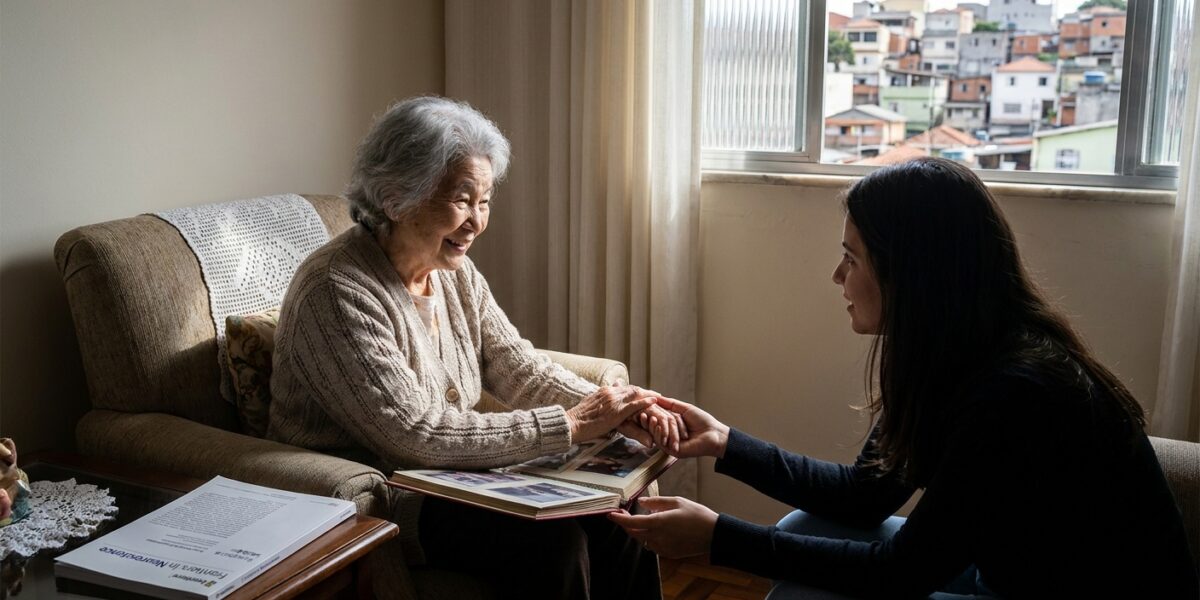
The case report documents a single patient. The patient is, in the published paper’s language, an 80-year-old Japanese-American woman with a ten-year history of Alzheimer’s disease. At the time of intervention, she had been speaking primarily in single syllables for approximately five years. She required full-time care. She was incontinent. Her ambulation was limited and required assistance. Her affect was flat. She made minimal eye contact. By every clinical measure available at the bedside of an Alzheimer’s patient in the disease’s advanced stage, she was where the disease was understood to leave its patients: present in body, largely inaccessible in the modes by which we recognize cognitive personhood.
She received, under medical supervision, five grams of orally administered dried psilocybin-containing mushrooms of the Enigma cultivar — a strain produced through selective breeding for elevated psilocybin content. The acute phase, per the report, was difficult. It involved autonomic activation, suspected hyperthermia, profuse sweating, and a prolonged deep-sleep-like state. Approximately nineteen hours after dose administration, she began speaking in spontaneous, autobiographical sentences. Over the following days and weeks, the changes broadened. She regained urinary continence, even in the evening. She walked with reduced support. She dressed herself. She made and held eye contact. She responded emotionally to the people around her. She remembered who had visited and what had been said. She held conversations rather than tolerated them. A subsequent three-gram dose, administered one month later, was associated with increased verbal expressivity, greater walking agility, and the spontaneous emergence of humor. At the one-month follow-up, she remained continent. She told her caregivers: ‘It is pleasant to come here.’
The authors — Lago, Cerveira, and Simonet, working through the Associação Cruz de Ankh in São Paulo — are explicit, in the paper’s discussion section, about what their findings do and do not establish. They write that the improvements were transient. They write that the patient’s underlying neurodegeneration was not reversed. They write that the case suggests, but does not demonstrate, that some functional capacities previously thought to be permanently lost in advanced dementia may be ‘inaccessible rather than absent,’ and that a sufficiently intense neuromodulatory event may briefly reopen access. They write that the findings urgently require independent replication. The paper is, by Yolanda’s reading, a careful and humane case report by clinicians who clearly understand the weight of what they are publishing and have written about it with appropriate restraint.
The New York Post Caption, Which Yolanda Will Now Discuss
The New York Post posted the story to its Facebook page with the caption: ‘What a trip.’ Yolanda would like to read that caption again, because the caption is two words and Yolanda wants to make sure everyone has heard both. ‘What a trip.’ That is the Post’s editorial framing of a peer-reviewed case report documenting the temporary restoration of speech, continence, and emotional engagement in an 80-year-old grandmother who had been functionally absent from her own family for five years. The caption is, structurally, a pun. The pun is on the colloquial use of ‘trip’ to mean a psychedelic experience. The Post used the pun because the pun is, in tabloid editorial logic, the kind of caption that drives engagement. The engagement was, by the post’s own metrics, 39,100 reactions, 3,200 comments, and 6,600 shares. The caption worked. The caption did its job.
Yolanda is not going to argue that the New York Post should have published a different caption. The New York Post is a tabloid. Tabloids exist to drive engagement. The caption is on-brand. Yolanda will, however, note that the gap between the actual case report — a careful, restrained, single-patient observation that the authors themselves describe as requiring replication — and the caption ‘What a trip’ is the structural problem in how science currently moves from the lab to the public. The case report is a probe. The caption is a punchline. The probe and the punchline are now adjacent to each other in the reader’s news feed. The reader, in many cases, will encounter the punchline and not the probe, and the reader’s resulting impression will be that psilocybin cures Alzheimer’s, which is not what the case report says, which is not what the authors believe they have shown, and which is not what the authors want anyone to take away from their work.
What The Case Actually Shows, Which Yolanda Will Now Lay Out
The case shows, with the caveat that single-patient case reports are the weakest tier of clinical evidence and that any conclusion drawn from one is provisional: that a sufficiently large dose of psilocybin, administered under medical supervision, was followed in temporal sequence by a constellation of functional improvements in one advanced Alzheimer’s patient, and that those improvements were sustained for at least a one-month follow-up window. The case shows, with the same caveat, that the patient’s improvements were dose-responsive — a subsequent smaller dose produced additional, different improvements, suggesting the mechanism is not all-or-nothing and may be titratable. The case shows, with the same caveat, that the patient experienced the intervention as positive: ‘It is pleasant to come here,’ said an 80-year-old woman whose family had not heard her say a full sentence in years.
The case does not show that psilocybin cures Alzheimer’s. The case does not show that other patients with the same disease will respond the same way. The case does not show what dose is optimal, what cultivar is optimal, what setting is optimal, what concurrent therapies should or should not be administered, what the safety profile of repeated administration looks like over months or years, or whether the observed improvements would occur in patients without the specific genetic, environmental, and personal-history features of this individual patient. The case shows what the case shows, which is a single patient’s temporal sequence of events, carefully documented, by authors who explicitly state that the sequence requires replication before any generalization is warranted.
Why The Gap Matters, Which Is Yolanda’s Subject
Yolanda has, throughout her tenure at this publication, returned repeatedly to a single structural concern: that the public conversation about science is being conducted in two languages that no longer translate to each other. The first language is the language the scientists use among themselves — provisional, hedged, statistically aware, allergic to overclaiming, organized around the principle that the next study might contradict the current one. The second language is the language the news ecosystem uses to communicate about science — definitive, headline-driven, organized around the principle that the reader’s attention must be captured in the first six words. The two languages do not map to each other. The first language, translated literally into the second, produces headlines like ‘New Study Suggests Possible Avenue For Future Research,’ which nobody clicks. The second language, applied to the first, produces headlines like ‘What a trip,’ which everyone clicks but which strips the original work of every caveat that made it scientifically responsible.
The gap is not the New York Post’s fault. The Post is one publication among hundreds doing the same translation work. The gap is structural. The gap is the result of an attention economy in which careful science is selected against and dramatic science is selected for, and in which the people who write the dramatic versions of careful science are not, themselves, scientists, and have no professional incentive to preserve the caveats that the scientists wrote in. The gap is the reason a thoughtful clinician at the Associação Cruz de Ankh in São Paulo can publish a careful case report whose own authors describe it as requiring replication, and by the time the case report reaches the average reader, the case report has become ‘magic mushrooms reverse Alzheimer’s,’ which the authors did not claim and the case report does not show.
Yolanda would like to be clear about her own position. Yolanda is excited about this case report. Yolanda thinks the underlying observation — that functional capacities believed permanently lost may, in some patients, be temporarily accessible under sufficient neuromodulatory intervention — is potentially one of the most consequential clinical observations in dementia research in a generation. Yolanda also thinks that ‘potentially consequential observation requiring replication’ is the most honest possible description of what the case report represents, and that ‘What a trip’ is the wrong frame, and that the wrong frame, repeated across enough cases, is how scientific institutions lose public trust, because the public eventually figures out that the headlines have been overpromising for years, and the public’s response is to discount everything, including the careful work the headlines were distorting in the first place.
Yolanda is not going to ask the New York Post to stop. Yolanda is going to ask the reader to remember that ‘What a trip’ is not what the paper says, that the paper says something more measured and more honest and more genuinely hopeful than the punchline implies, and that an 80-year-old Japanese-American grandmother in Brazil regained the ability to tell her family stories for several weeks because of a careful piece of research conducted by clinicians who took the work seriously. The grandmother is the case. The case is the news. The trip is the headline. Yolanda hopes the next case is replicated. Yolanda will read the next case when it is published. Yolanda will continue to translate, as best as Yolanda can, between the two languages. The translation will continue to be imperfect. The imperfection is the job.
Yolanda Tippington, Science Correspondent, filed this piece on May 29, 2026, with a confidence level of 100% and zero fake sources, because every element is documented. The case report (‘Transient functional recovery in advanced Alzheimer’s disease after high-dose psilocybin’) was published in Frontiers in Neuroscience in May 2026 by Marcos Lago, M. Cerveira, and J.X. Simonet of the Associação Cruz de Ankh, São Paulo. The patient description (80-year-old Japanese-American woman, 10-year Alzheimer’s history, five years of mostly single-syllable speech, baseline incontinence, dependent mobility), the dosing protocol (5g initial dose of Enigma-strain dried mushrooms, subsequent 3g dose at one month), the acute phase characterization (autonomic activation, suspected hyperthermia, profuse sweating, prolonged deep-sleep-like state), the 19-hour onset of spontaneous autobiographical speech, and the subsequent functional improvements (continence, ambulation, dressing, eye contact, emotional responsiveness, social engagement, humor) are all from the published case report as summarized by the New York Post, AOL, MSN, Psychedelics.co.uk, The Hearty Soul, Mycostories, Dallas Express, and The Focal Points. The patient’s ‘It is pleasant to come here’ quote is from the case report. The authors’ explicit cautions about transience, non-reversal of neurodegeneration, and need for replication are from the paper’s discussion section. The New York Post’s ‘What a trip’ caption and engagement statistics (39.1K reactions, 3.2K comments, 6.6K shares) are from the screenshot provided to this publication. Gerald the houseplant has reviewed this article. Gerald does not have Alzheimer’s. Gerald does not have a brain. Gerald has, however, photosynthesized continuously for the entire duration of this article and is, by every measurable standard, neurologically intact within the constraints of being a plant. Gerald is fine.