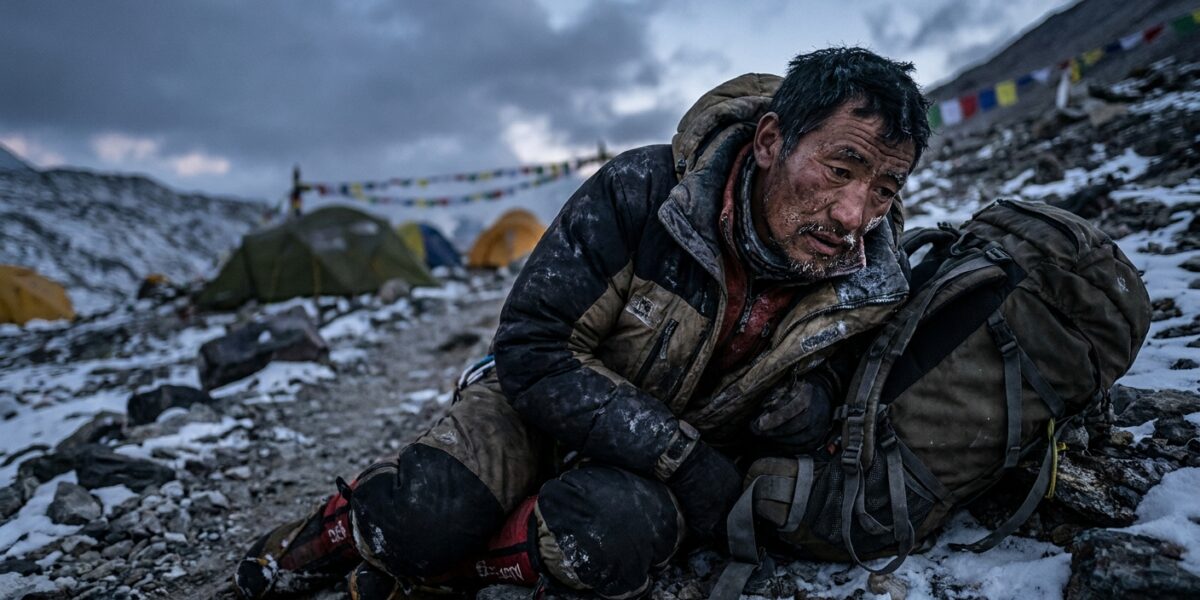
BASE CAMP, MOUNT EVEREST / KATHMANDU, NEPAL — Frank is going to do this one differently, and Frank would like to explain why before Frank starts, because the structure of the article is part of the article’s argument, and Frank does not want anyone to read this piece and miss the structural decision Frank is making at the top of it.
The structural decision is this. The name of the man this article is about is Hillary Dawa. Frank is going to use that name, in full, every time Frank refers to him. Frank is not going to call him ‘the Sherpa’ or ‘the guide’ or ‘the survivor’ or any of the other anonymizing nouns that English-language reporting on Mount Everest has, for decades, used to describe the Nepali high-altitude workers who are the operational backbone of the entire mountaineering industry on that mountain. Their names are knowable. Their names are reportable. Their names get used when they die in numbers large enough to be embarrassing — like in 2014, when a single Khumbu Icefall avalanche killed sixteen of them, and the international press, briefly, learned all sixteen names. The rest of the time, the names get dropped in favor of ‘a Sherpa,’ as if the people doing the work are interchangeable. Frank has read a lot of Everest journalism over the years. Frank has noticed. Frank is going to do it differently here, because the man this article is about did something extraordinary, and his name should be the way the reader leaves this article.
Hillary Dawa, And What He Did
Hillary Dawa is 52 years old. He is a working Sherpa guide on Mount Everest. On the evening of May 28, 2026, he was descending the mountain with a client who had summited late in the day — late enough, per Angela Benavides of the mountaineering publication Explorer’s Web, that the summit attempt occurred ‘at a very dangerous time, when there was no one there to help.’ Frank is going to note that the phrase ‘no one there to help’ is, in the context of an Everest summit attempt, a phrase that should make any reasonable person turn around and not summit. The client did not turn around. The client summited. The client and Hillary Dawa then began the descent.
They had problems on the way down. The problems were not specified in the available reporting, but at altitude in the late season, the universe of problems is well-known: exhaustion, hypothermia, hypoxia, navigational error, equipment failure, the weather closing in, the legs simply refusing to continue. Hillary Dawa, at approximately 25,000 feet — an altitude where the human body is actively dying from oxygen starvation even with supplemental oxygen, and where unsupplemented breathing produces, per altitude physiology, cognitive decline that resembles intoxication — stopped to rest. The client kept moving. The client descended without him. Hillary Dawa was left, at 25,000 feet, on Mount Everest, on the last day of the climbing season, alone.
Frank is going to be specific about what ‘the last day of the climbing season’ means, because it is structurally critical. The Everest climbing season is defined by the weather window — typically late April through the end of May — during which the jet stream lifts off the summit and the wind is climbable. On the last day of the season, the expeditions are breaking camp. The fixed ropes are being pulled. The high camps are being dismantled. The infrastructure that makes Everest climbable is, by design, being removed from the mountain in the hours and days after Hillary Dawa was left at 25,000 feet. Two days after he was last seen, the Sherpas were already dismantling the camps. Meanwhile, the expedition leaders and the clients were in Kathmandu. The expedition community was celebrating what they were describing, per Benavides, as ‘the most successful Everest season ever.’
It was June 1 — three days after Hillary Dawa was last seen alive — before anyone realized he was missing.
What ‘No One Knew He Was Missing’ Means, Which Frank Would Like To Make Sure Everyone Registers
Frank would like to read that sentence again, because the sentence is too quiet for what it contains. For three days, on Mount Everest, the highest place on Earth, a 52-year-old man named Hillary Dawa was alone, abandoned, fighting for his life, without any awareness, anywhere below him, that he was even there to look for. The professional infrastructure that exists to monitor the mountain — the expedition logistics coordinators, the base camp managers, the satellite communications, the helicopter rescue services that Nepali authorities deploy when climbers are reported in distress — was not looking for him. It was not looking for him because nobody had told it to look. Nobody had told it to look because the people responsible for telling it to look were in Kathmandu. The people in Kathmandu were celebrating.
Frank would like everyone to picture this. A man is alone on a mountain. He has no food. He has no supplemental oxygen. He is in his fifties. He is at an altitude where the human body, even fully equipped and fully supported, is in measurable physiological decline by the hour. He is, in the available reporting, dealing with a crevasse fall and an avalanche that nearly buried him. He has, by any reasonable accounting of mountain rescue probabilities, zero people coming for him. Below him, at sea level, in the city, where the air is breathable and the food is plentiful and the people are warm, his employers and his clients are toasting the season’s success. The success is being measured in summits. Hillary Dawa was a Sherpa who delivered a summit. Hillary Dawa is, by the metric his employers were using to celebrate, a unit of success. The unit was, at that moment, freezing alone in a crevasse on the world’s tallest mountain, and the celebration did not pause to count him because the celebration did not yet know he was missing.
What Hillary Dawa Did Next, Which Frank Will Now Describe With The Reverence It Requires
Hillary Dawa got out of the crevasse. Frank does not know how. Frank does not know if there is, on file with any of the reporting outlets carrying this story, a detailed account of how a 52-year-old man, alone, oxygen-deprived, food-deprived, and presumably injured from the fall, extracted himself from a crack in the glacial ice on Mount Everest. Frank suspects that no such detailed account exists yet, because Hillary Dawa has presumably had other priorities since being recovered — like, for example, being alive in a warm room with a hot meal. Frank will read the detailed account when it is published. Frank is going to assume, in the meantime, that the extraction involved everything Hillary Dawa had — every reserve of training, every reserve of physical conditioning, every reserve of will, every reserve of the specific high-altitude adaptation that the Sherpa population has, over generations, evolved in their bodies through the EPAS1 gene variant that allows them to function at oxygen levels that would incapacitate a non-adapted human. He used what he had. What he had was enough. He got out.
Then he survived an avalanche that nearly buried him. Frank is going to leave that sentence as one sentence, because the sentence is enormous and Frank does not want to dilute it with subordinate clauses.
Then, for six days — Frank counted, then Frank counted again, then Frank read the available reporting a third time to be absolutely sure — Hillary Dawa, alone, without food, without supplemental oxygen, dragged himself down Mount Everest. Frank is going to define ‘dragged himself down’ as comprehensively as Frank can with the available reporting, because the verb is important. The verb is not ‘walked.’ The verb is not ‘descended.’ The verb is ‘dragged himself,’ and the available reporting uses that verb deliberately. Hillary Dawa was, in the relevant period, sufficiently injured or sufficiently weakened that the means of descent involved his hands and his arms and his torso and whatever combination of mobility he had remaining, and he used it for six days. He used it without food. He used it without supplemental oxygen. He used it at an altitude where the air is, depending on the elevation at each step, between one-quarter and one-third the oxygen density of sea-level air. He used it through whatever wind, snow, cold, and additional weather events the late-May Himalayan atmosphere chose to provide. He used it without sleep, or with whatever sleep is available to a man dragging himself across a mountainside expecting to die. He used it for one hundred and forty-four hours. He arrived at the bottom alive.
What ‘The Most Successful Everest Season Ever’ Actually Measures, Which Frank Has Some Notes On
Frank is now going to address the phrase ‘the most successful Everest season ever,’ because the phrase is in the available reporting, and the phrase, Frank would argue, is the structural target of this article alongside Frank’s celebration of Hillary Dawa.
‘Most successful Everest season ever’ is a phrase that, on its face, sounds like a neutral descriptive measurement. It is not. It is an industry self-assessment that depends entirely on what is being measured. If the measurement is total summits, then the season may indeed have been the most successful. If the measurement is revenue generated by the Nepali permit office and by the Western expedition companies and by the Sherpa cooperatives — all real, all part of the economy that Hillary Dawa is part of — then the season may indeed have been the most successful. If the measurement is operational safety, casualty rates, or the proportion of climbers who returned home with all their fingers and toes and lungs intact, then the measurement is harder, and ‘most successful ever’ becomes a phrase that the expedition community uses anyway because the expedition community is the entity that decides what ‘success’ is allowed to mean.
Frank would like to note that, in the version of ‘success’ that the Kathmandu celebrations were operating under on June 1, Hillary Dawa was still officially part of that success — because his client had summited, and the summit had been logged, and the logging is what the industry counts. Hillary Dawa being lost above 25,000 feet was not, on the relevant ledger, a debit. He had delivered the unit of success. He had then, in the industry’s bookkeeping, ceased to be relevant. He was relevant again, briefly, on June 1, when someone finally realized he was missing — and he is relevant now, in the available reporting, because he survived. If he had not survived, Frank suspects that the eventual report would have included his name in a sentence and then moved on to the season’s summit totals, and the season would still have been described, by the entities doing the describing, as the most successful ever. The metric was the metric. The metric did not include him.
What This Publication Is Going To Do Differently
This publication is going to do one thing differently, and Frank is going to do it now: this publication is going to declare, on the record, that the 2026 Everest climbing season was not the most successful Everest season ever. It was a season in which a 52-year-old Sherpa named Hillary Dawa was abandoned by his client at 25,000 feet on the final summit day, was not noticed missing for three days, was forced to extract himself from a crevasse and survive an avalanche and descend the world’s tallest mountain alone, on his hands and torso, without food or supplemental oxygen, for one hundred and forty-four hours, and the system that should have noticed and the people who should have come for him did not, until it was too late for it to matter, because by the time anyone realized he was missing he had already saved himself. The season was a failure. The failure was structural. The failure was not on Hillary Dawa. The failure was on every layer of human institution above him on the chain of responsibility, beginning with the client who left him and ending with the celebration in Kathmandu that proceeded for three days without registering his absence. Hillary Dawa was the season’s only success. Hillary Dawa was the season’s only hero. Frank counted twice. The count is one. The one is Hillary Dawa.
Hillary Dawa is 52 years old. He is a Sherpa. He is alive. The mountain did not kill him. The system tried to. He won. Frank would like every reader of this article to remember his name. The name is Hillary Dawa. Frank is going to write it once more, because once more cannot be too many. Hillary Dawa. Frank is going to be reading the news for the rest of this man’s life, and Frank hopes very much that he gets to write about him again. Frank hopes the next time will be a quieter story. Frank hopes there will be a next time. Hillary Dawa has earned the rest of his life. Frank would like the world to give it to him.
Frank Misquote, Sports & Leisure, filed this piece on June 6, 2026, with a confidence level of 100% and zero fake sources, because every element is documented. The Hillary Dawa survival story is confirmed by Fox 26 Houston, Fox 9 Minneapolis-St. Paul, Fox 5 DC, Fox 5 New York, and LiveNOW from FOX, all carrying Angela Benavides’s reporting from Explorer’s Web, the mountaineering specialist publication that broke the story. Hillary Dawa’s age (52), profession (Sherpa guide), last-seen date (May 29, 2026), last-seen altitude (~25,000 feet), the client’s late-day May 28 summit, the abandonment during descent, the crevasse fall, the near-avalanche burial, the six-day solo survival without food or supplemental oxygen, the dismantling of camps two days after his disappearance, the three-day gap before anyone realized he was missing, and the Kathmandu ‘most successful Everest season ever’ celebrations are all from Benavides’s reporting via the Fox affiliates. The EPAS1 gene variant that confers Sherpa high-altitude adaptation is documented in the peer-reviewed literature on human population genetics. The 2014 Khumbu Icefall avalanche fatalities (16 Sherpas killed) is historical record. Frank counted twice. The count is six days. The count is one hundred and forty-four hours. The man is Hillary Dawa. Gerald the houseplant has reviewed this article. Gerald cannot survive at 25,000 feet. Gerald is in a pot, at sea level, where he photosynthesizes safely. Gerald would like to acknowledge Hillary Dawa. Gerald is, in his own botanical way, in awe.