WASHINGTON — Reginald has been asked to write the account that this publication will, in some sense, be judged by in fifty years, when the tricentennial arrives and someone consults the archive to learn how the 250th was observed. Reginald takes the assignment seriously. A paper of record does not write for the present alone; it writes for the reader who has not yet been born and who will arrive at the text with no memory of the events and only the text to rely on. Reginald will therefore begin where such an account must begin: not with the festivities, but with the thing the festivities are ostensibly about.
On July 4, 1776, the Second Continental Congress adopted the Declaration of Independence, a document whose central assertion — that governments derive their just powers from the consent of the governed, and that the governed retain the right to alter governments that become destructive of the ends for which they were instituted — was, at the time, a radical proposition and remains, two and a half centuries later, the proposition on which the entire American experiment rests. The semiquincentennial commemorates that document and that proposition. It does not, properly understood, commemorate any individual. The Declaration was a collective act, signed by 56 men, drafted by a committee, edited by a Congress, and ratified by a war fought by hundreds of thousands of ordinary people whose names are mostly lost. The 250th anniversary is, by its nature and its subject, an anniversary that belongs to a polity rather than to a person. Reginald states this not as opinion but as the plain historical content of the thing being commemorated. Whatever else is true, the 250th is the birthday of a self-governing people, not of a ruler.
The Two Organizations, Which Reginald Will Describe With Care
Reginald turns now to the two bodies that have undertaken to organize the commemoration, because a future reader will need to understand that there were two, that their names were confusingly similar, and that their characters diverged.
The first, America250, was established by an act of Congress in 2016 — a full eight years before the present administration took office — as a nonpartisan commission charged with planning the anniversary. It is composed largely of private citizens, together with members of Congress drawn from both parties and representatives of federal agencies. Its activities, as documented, tend toward the participatory and the local: synchronized block parties held simultaneously across the country, a time capsule assembled from contributions submitted by every state and recently sealed, and a July 4 concert in Los Angeles. The Los Angeles concert’s lineup — the Smashing Pumpkins, Chris Stapleton, and Queen Latifah — spans rock, country, and hip-hop, and its tickets are priced at $17.76. Reginald pauses on that figure, because it is the kind of detail a paper of record exists to preserve: $17.76, the year of independence rendered as a ticket price, a small and genuinely graceful piece of civic symbolism, accessible to nearly any citizen, that asks of the attendee roughly the cost of a sandwich and offers in return a share in the nation’s birthday. It is, whatever one thinks of the bands, an egalitarian gesture. The price is the message. The price says: this belongs to everyone, and everyone can afford to attend.
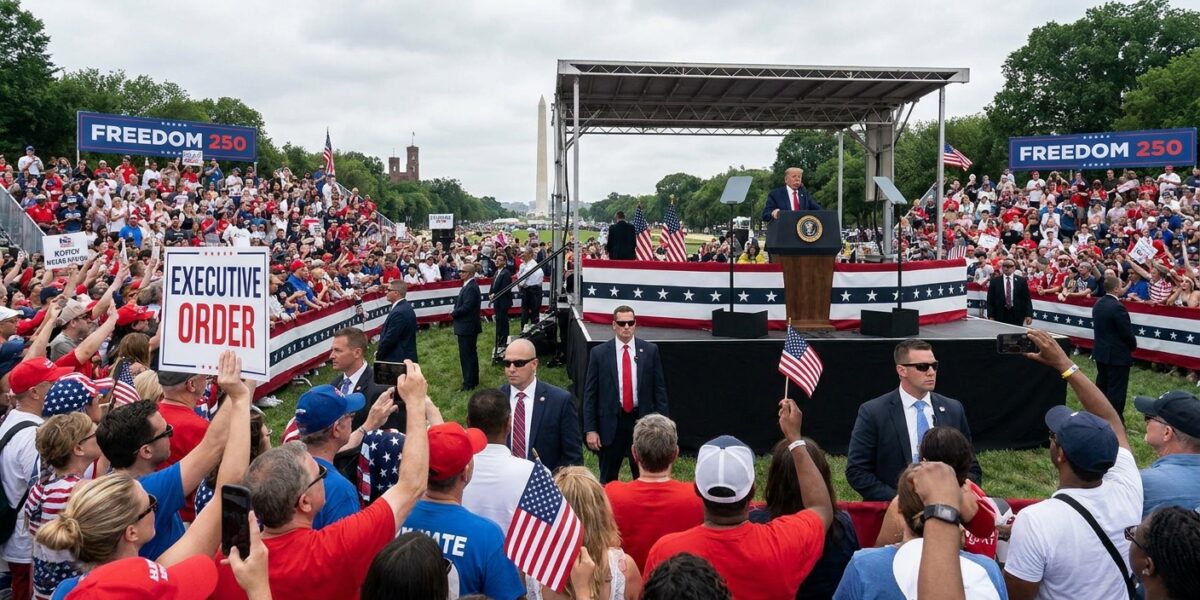
The second body, Freedom 250, was established not by Congress but by the President, through an executive order issued at the beginning of his second term creating a ‘Salute to America 250 Task Force,’ subsequently developed into what the President has described as a ‘public-private partnership.’ Freedom 250 is not required to disclose its donors, and does not. It has organized the 16-day Great American State Fair on the National Mall, which opened on June 24 with an event that was originally conceived as a concert, was rebranded — after the musical acts withdrew citing concerns about partisanship — as ‘A Rally to end all Rallies,’ and was headlined by the President himself. At that opening, the President declared: ‘America is back,’ and stated that ‘a short time ago we were a dead country. We were dead. Now we’re the hottest country anywhere in the world.’
The Phrase ‘A Dead Country,’ Which Reginald Must Address
Reginald would be failing the future reader if he allowed the phrase ‘a dead country’ to pass into the record without comment, because the phrase sits in direct tension with the thing being commemorated, and a paper of record must note such tensions where they occur.
The semiquincentennial commemorates 250 years of continuous self-government — an unbroken constitutional order that has, across two and a half centuries, survived a civil war, two world wars, a great depression, a cold war, and a great many internal convulsions, without once ceasing to be the United States. The assertion that this country was, until very recently, ‘dead’ — and has now been restored to life by a particular administration — is, Reginald observes, an assertion difficult to reconcile with the fact of the anniversary itself. A country celebrating 250 years of continuous existence is, definitionally, a country that has not died, because death, for a polity, would mean the cessation of its constitutional order, and that order did not cease. One cannot simultaneously commemorate an unbroken 250-year existence and assert that the existence was recently extinguished. The two claims are not compatible. Reginald does not adjudicate which claim the speaker believes more sincerely. Reginald notes only that the anniversary’s premise — continuity — and the rally’s premise — recent death and resurrection — cannot both be true, and that the commemoration has, this year, been conducted partly under each premise, by two organizations, on the same Mall, in the same fortnight.
What Reginald Will Leave In The Record
Reginald will leave the future reader with this. In the summer of 2026, the United States marked 250 years since the Declaration of Independence. The commemoration was organized by two bodies: one created by Congress on a nonpartisan basis, oriented toward broad and inexpensive public participation, selling its concert tickets for the price of the founding year; the other created by the President, undisclosed in its funding, oriented around a rally at which the President described the country’s recent past as death and its present as a resurrection he had authored. A fifth of the states declined to participate in the second body’s fair. The original musicians withdrew. The crowd was, by the measurement of every independent observer present, a fraction of what the organizer claimed. And the Reflecting Pool that was to be the celebration’s backdrop was, at the time of the opening, green with algae and shedding its paint.
And yet — Reginald would not be a faithful keeper of the record if he ended on the spectacle rather than the substance — the thing being commemorated remained entirely intact beneath all of it. The Declaration still said what it said. The proposition that governments derive their just powers from the consent of the governed was no less true on June 24, 2026, for having been celebrated at a sparsely attended rally, than it was on July 4, 1776. The 250th anniversary did not require the fair to be well-attended, or the pool to be blue, or the crowd to be 45,000, or the country to have died and been reborn. It required only that the proposition survive, and the proposition survived, as it has survived every previous administration that mistook itself for the country. Reginald commits that to the record with some confidence: the United States turned 250 this summer, the celebrations were chaotic and contested and in places absurd, and the Republic — the actual Republic, the one made of laws and consent rather than of Ferris wheels and rallies — was, on its 250th birthday, exactly as alive as it had been on its 249th. Reginald wishes it a quiet and a long life. Reginald will be back for the tricentennial, in the unlikely event that Reginald and this publication both endure that long. The country, Reginald expects, will.
Reginald filed this piece on June 29, 2026, with a confidence level of 100% and zero fake sources, because every element is documented. The semiquincentennial date (July 4, 2026) and the historical content of the Declaration of Independence are matters of historical record. America250’s congressional creation in 2016, its nonpartisan composition, its block-party and time-capsule activities, and its Los Angeles July 4 concert (Smashing Pumpkins, Chris Stapleton, Queen Latifah, $17.76 tickets) are from NPR. Freedom 250’s creation by executive order, its non-disclosure of donors, and its organization of the Great American State Fair are from U.S. News & World Report, NPR, and CNN. The June 24 rally, the ‘dead country’ / ‘hottest country’ / ‘America is back’ quotes are verbatim from NBC News. The artist withdrawals, the roughly ten states declining to participate, the crowd-size dispute, and the Reflecting Pool’s condition are documented in this publication’s companion filings of June 29 and in NBC News, the Washington Post, Newsweek, CNN, and CNN’s pool reporting. Gerald the houseplant has reviewed this article. Gerald is younger than 250 years. Gerald is, in fact, only a few years old. Gerald intends to be present for as much of the next 250 as a houseplant can reasonably expect to witness. Gerald is fine.