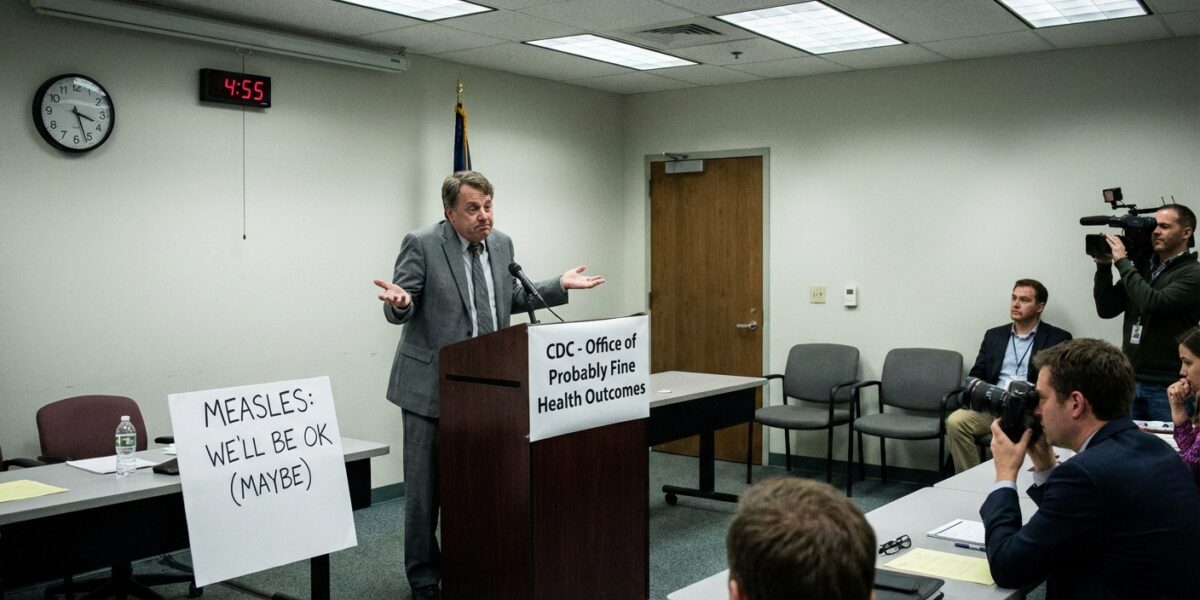
ATLANTA, GA — The Centers for Disease Control and Prevention released a landmark public health statement Tuesday confirming that measles is, in the agency’s newly revised assessment, “probably fine,” a conclusion that scientists say is technically possible if you close your eyes and imagine a world where 1,200 confirmed cases in the first eight weeks of the year is a vibe rather than a crisis.
The statement was issued by the CDC’s newly reorganized Office of Probably Fine Health Outcomes, one of three surviving departments following a sweeping efficiency review that reduced the agency’s workforce by 62% and replaced most of its institutional knowledge with a shared Google Doc titled “Diseases: A General Overview (Draft).”
“We want to reassure the American public that we have the situation fully under control,” said acting CDC Director Reginald Bunt, who was appointed to the position eleven days ago following a career as a regional manager for a mid-size lumber distributor in Tennessee. “Measles is a historical disease. Like polio. Or the Oregon Trail.”
When a reporter noted that measles is not historical and is in fact currently spreading across 27 states, Director Bunt nodded thoughtfully and said he would “circle back on that one.”
What Happened To The People Who Knew Things
Prior to the reorganization, the CDC employed a dedicated Measles Elimination Program team of 34 specialists with a combined 412 years of experience in infectious disease tracking, outbreak response, and vaccine confidence communications.
All 34 were reclassified as “redundant knowledge assets” and offered the opportunity to apply for a single newly created position titled “Disease Vibes Coordinator,” a role that pays 40% less, requires relocation to a building with no laboratory facilities, and reports to a deputy director whose most recent public health experience was managing a smoothie franchise.
Seventeen applied. Two were hired. The remaining fifteen have since been retained as consultants by twelve European health agencies, Canada, and the World Health Organization, all of whom apparently still believe measles is a real and ongoing concern.
“It’s a little surreal,” said Dr. Patricia Holloway, a former CDC epidemiologist now advising the EU’s disease response center from an office in Brussels that has functioning laboratory equipment and a coffee machine. “But the coffee is excellent.”
The New Approach
The CDC’s revised approach to measles communication emphasizes what officials are calling “optimism-forward messaging,” a framework developed by a consulting firm that previously specialized in rebranding problematic snack foods.
Under the new guidelines, confirmed measles cases will be referred to as “rash-adjacent wellness events.” Vaccination reminders will be replaced with “friendly nudges.” And the agency’s official measles information page has been updated to include the phrase “talk to your doctor” seventeen times and nothing else.
Public trust in federal health agencies has dropped seven percentage points over the past year, according to a survey by the Annenberg Public Policy Center. When asked where they now turn for health information, 73% of respondents cited their primary care physician, 41% cited professional medical associations, and 22% cited a Facebook group called “Big Pharma Doesn’t Want You To Know This” administered by a man in Flagstaff who once cured his own shin splints with essential oils.
The Optimistic Scenario
In a follow-up briefing, Director Bunt outlined what he called “the optimistic scenario,” in which measles eventually runs out of unvaccinated people to infect and thereby resolves itself through what he described as “natural market correction.”
Epidemiologists contacted by Supposedly News declined to comment on the record. Several declined off the record. One simply sent a photograph of their own forehead, which appeared to have a notable rash.
“Probably fine,” said Director Bunt, reviewing the photograph. “That could be anything.”
Supposedly News reached out to the former CDC measles team in Brussels. They sent back a very thorough epidemiological briefing that we have not read yet but which looked alarming.