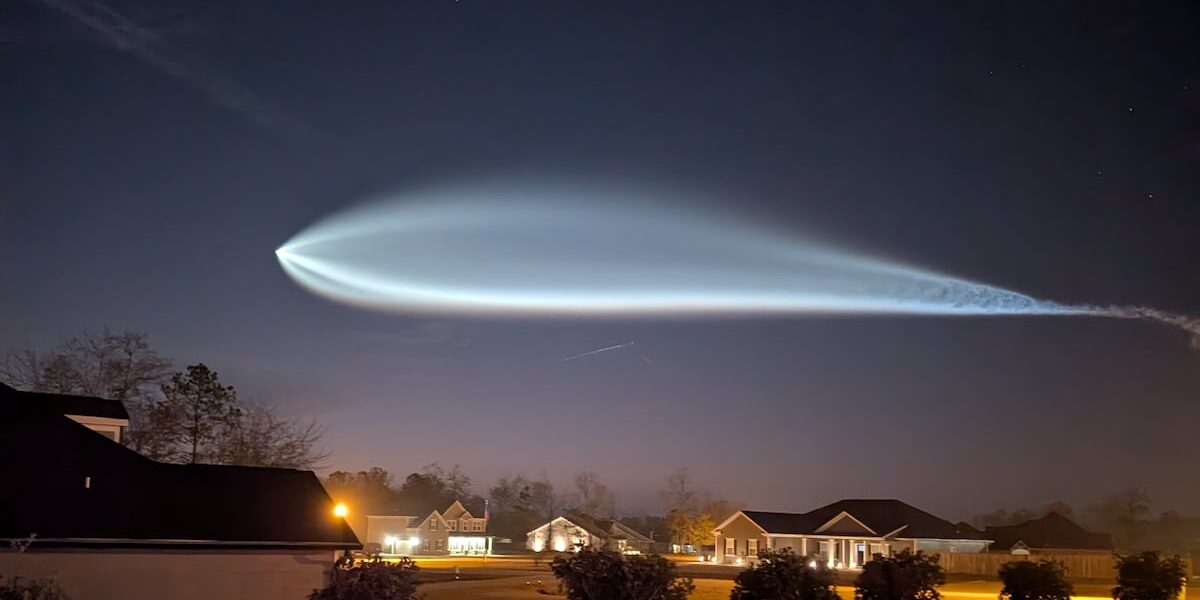
AUGUSTA, GA — A SpaceX Falcon 9 rocket launched from Cape Canaveral Space Force Station at approximately 6:51 a.m. Wednesday, carrying 29 Starlink internet satellites into low Earth orbit, and was visible as a bright streak across the pre-dawn sky from Augusta, Georgia, and surrounding CSRA communities — a perfectly documented, publicly announced, entirely explicable aerospace event that the Augusta metropolitan area has nonetheless spent the past 48 hours vigorously re-explaining in ways that do not involve rockets.
SpaceX announced the launch in advance. Local news stations covered it. The FAA issued standard airspace advisories. The rocket launched. It was visible. It was a rocket. These facts are available, sourced, and not in dispute by anyone with access to either the SpaceX website or a functioning search engine.
The Augusta Facebook group CSRA Friends, Neighbors & Totally Normal Conversations, which has 47,000 members and a moderator named Donna who is doing her absolute best, currently contains 340 posts about the event. Supposedly News reviewed all 340. Fourteen of them correctly identified the object as a SpaceX rocket. The remaining 326 did not.
What People Saw
What people saw, at approximately 6:51 a.m. Wednesday, was a bright light moving steadily across the sky trailing a broad, luminous plume that fanned out in the upper atmosphere as the rocket gained altitude, creating what aerospace photographers describe as a “jellyfish” or “squid” effect as the exhaust caught the early morning sunlight while the ground below was still dark.
It was, by all accounts, genuinely spectacular. The kind of thing that makes you stop on the way to your car and look up with your mouth slightly open. The kind of thing that reminds you the sky is bigger than your commute.
It was also, Supposedly News must report with some regret, immediately described by a meaningful percentage of Augusta residents as something that it was not.
The Theories, Ranked By Confidence Level
Theory 1: Government Chemtrails, But Big Ones. The most popular alternative explanation, appearing in 89 posts, holds that the plume was an unusually ambitious chemtrail deployment — regular chemtrails scaled up for a special occasion. What occasion, exactly, varies by poster, with suggestions including “the war,” “5G expansion,” “something with the water,” and one post that said simply “you know why” with no further elaboration. Confidence level: 8%.
Theory 2: That Was Not A Natural Cloud Formation And I Know What I Saw. Forty-three posts insist that the plume was a cloud formation of suspicious origin. Several of these posts include the phrase “I know what clouds look like” as evidence, which is technically true for all people and does not, by itself, constitute aerospace analysis. Confidence level: 4%.
Theory 3: China. Thirty-seven posts attributed the object to China, in varying levels of specificity. Some said “Chinese spy balloon situation again.” One said “it’s a Chinese rocket obviously” which is technically in the rocket category and gets partial credit. Several said simply “China” as a complete sentence, presumably trusting context to carry the weight. Confidence level: 3%.
Theory 4: Biblical. Twenty-two posts engaged with the possibility of a theological explanation. These ranged from the cautiously observational (“just saying it looked like the pillar of fire from Exodus”) to the fully committed (“THE SECOND COMING IS NOT GOING TO ANNOUNCE ITSELF ON THE SPACEX WEBSITE BUT OKAY”). Confidence level: assigned to faith, not this publication.
Theory 5: Elon’s Doing Something. Nineteen posts attributed the event to Elon Musk personally, which is technically the closest to correct — SpaceX is his company — but framed it as sinister rather than orbital, suggesting he was “testing something on us,” “running an experiment,” or “sending a message.” The message, most agreed, was unclear but probably bad. Confidence level: 12%, mostly on vibes.
Theory 6: It Was A UFO And The Rocket Story Is The Cover. Fourteen posts proposed that the rocket explanation was itself disinformation, deployed to conceal the actual nature of the object, which was extraterrestrial. These posts did not address why an extraterrestrial civilization capable of interstellar travel would choose 6:51 a.m. over Augusta, Georgia as their preferred arrival window, but the posters seemed confident. Confidence level: 2%. Points for creativity.
The Comment Section As A Cultural Document
Possibly the most instructive element of the 340-post thread is not the theories themselves but the comment exchanges between the theorists and the people attempting to provide accurate information.
These exchanges follow a pattern so consistent it could be described as architectural. A person posts a photo with a question or theory. Another person responds with the SpaceX launch information, often including a direct link to the mission page. The original poster responds with some variation of “that’s what they want you to think” or “I looked it up and I’m not so sure” or, in one memorable instance, “I’ve seen rockets before and this was different,” a statement that is both subjectively true and objectively not how aerospace verification works.
Donna, the moderator, responded to fourteen separate posts with the same linked article and the phrase “it was a SpaceX rocket, info below!” followed by a smiley face that Supposedly News reads as the emoji equivalent of a person clinging to a life raft with dignity.
By Wednesday afternoon, Donna had pinned a post to the top of the group that read: “IT WAS A SPACEX ROCKET. STARLINK SATELLITES. CAPE CANAVERAL. LINK BELOW. PLEASE READ BEFORE POSTING. WE LOVE YOU.”
The post received 47 likes and 23 comments, several of which were people explaining why it wasn’t a rocket.
The Rocket’s Actual Remarkable Details, Which Are Being Ignored
Here is the thing about Wednesday’s launch that nobody in the Facebook group is talking about, because they are busy explaining why it was China or God or Elon’s experiment: it was genuinely extraordinary, and not for conspiracy reasons.
The booster that carried those 29 satellites into orbit had flown 25 times before. Twenty-five flights. The same rocket core, launched and recovered and launched again, carrying missions including a commercial space station crew, a European space telescope, and 18 previous Starlink deployments, before flying again Wednesday morning over Augusta’s collective upturned face.
After separating from the upper stage, that booster flew itself back down through the atmosphere and landed — autonomously, on a drone ship in the Atlantic Ocean called, in a detail that should have generated its own conspiracy theory but somehow did not, A Shortfall of Gravitas.
A reusable orbital rocket landed itself on a ship named A Shortfall of Gravitas in the Atlantic Ocean while Augusta looked up at the sky and argued about chemtrails.
Supposedly News finds this more interesting than the chemtrail theory. We accept that not everyone agrees.
The One Correct Post
Of the 14 posts in the CSRA Facebook group that correctly identified the object as a SpaceX rocket, Supposedly News would like to highlight the contribution of one Terry Bouchard, 61, of Evans, Georgia, who posted a crisp photograph of the plume, correctly labeled it within four minutes of sighting, included the SpaceX mission number, noted the drone ship landing, and signed off with: “Y’all it’s a rocket. Go get some coffee. Beautiful morning.”
Terry’s post received eleven likes. He has not posted again. He appears to be at peace.
We reached out to Terry for comment. He said he was going fishing and that the sky looked great this morning too, just regular clouds though, nothing to worry about.
Terry is, Supposedly News submits, doing fine.
Supposedly News reached out to SpaceX for comment on the Augusta response to the launch. They did not respond, which is consistent with their general communication style and also with being a rocket company that has a drone ship to go retrieve.