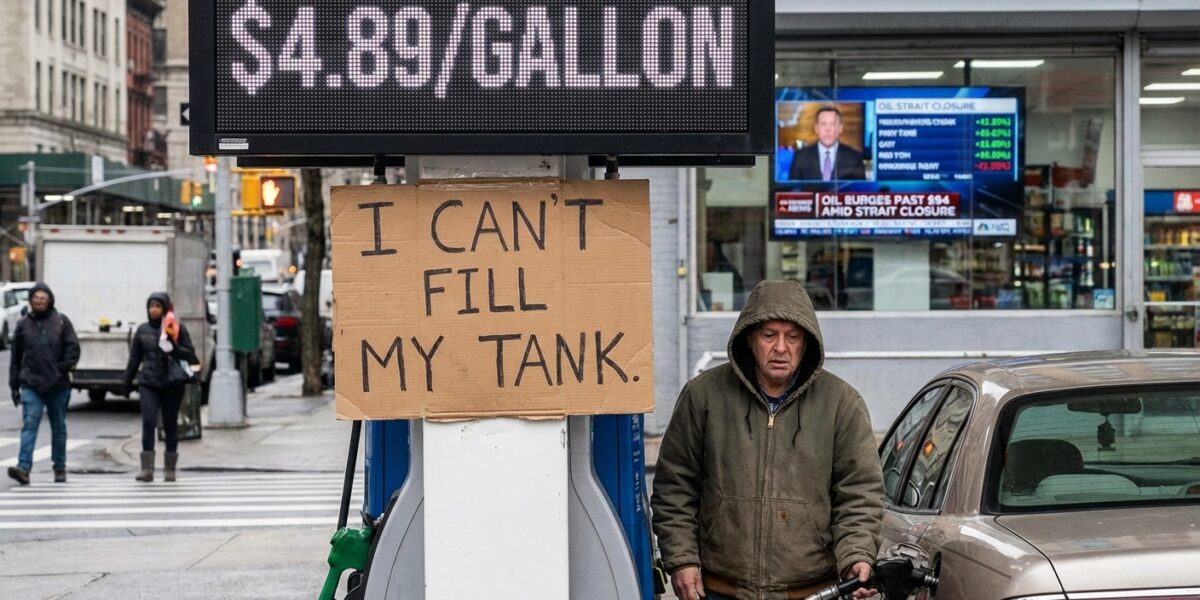
NEW YORK / EVERYWHERE — Oil closed Friday at $94 a barrel, its highest price since 2023, as the ongoing effective closure of the Strait of Hormuz, the continued escalation of U.S.-Israeli operations in Iran, and a weak U.S. jobs report combined to produce Wall Street’s worst week since October — a week that financial analysts described using words like “volatile,” “pressured,” and “a reflection of geopolitical uncertainty,” and that a woman named Patricia Odum, 47, a dental hygienist from Columbus, Ohio, described as “I paid $5.11 for regular unleaded and I had to stop at half a tank because I had sixty dollars in my account and I needed to eat this week too.”
Patricia’s framing and the financial analysts’ framing describe the same underlying event. They are not the same framing.
The $94 barrel price represents a 31% increase in U.S. crude prices since the conflict began eight days ago. Brent crude, the international benchmark, is up 24%. Airlines have begun implementing fuel surcharges. Trucking companies have begun passing costs to shippers. Shippers have begun passing costs to retailers. Retailers are in the process of passing costs to consumers, a process that takes approximately two weeks to complete and that Patricia, checking her gas app daily, has begun to observe with what she describes as “a kind of resigned attentiveness.”
The Strait Of Hormuz Situation, Explained For The Eighth Time This Week
The Strait of Hormuz remains effectively closed. Twenty percent of the world’s daily oil supply, which previously transited this 21-mile waterway on its way to global markets, is not transiting it. Shipping giant Maersk has suspended operations. Oil storage tanks in the region are filling. When storage fills, production slows. When production slows, supply drops. When supply drops, prices rise. This is the sentence that energy economists have been saying since day one and that oil futures markets have been pricing in for eight days and that the news cycle, occupied with the more immediate and dramatic aspects of the conflict, has somewhat undersold as an independent story.
“The Strait situation is going to outlast the news cycle by a meaningful margin,” said Dr. Harrison Cole, an energy economist at Rice University’s Baker Institute. “Even if hostilities ended tomorrow, the Strait doesn’t just reopen. Shipping companies reassess. Insurance rates reset. Tanker routing changes. The market disruption has a tail that goes well beyond the news cycle.”
He was asked to clarify what “meaningful margin” meant in terms of consumer gas prices.
“Spring is coming,” he said, which is when refineries switch to summer-blend fuel, which costs more to produce, which means gas prices typically rise anyway. “It’s going to be a complicated spring at the pump.”
Wall Street’s Week
The S&P 500 closed Friday down 4.1% for the week, its worst performance since October. The Dow fell 3.8%. The Nasdaq fell 4.7%. Energy stocks were the week’s only significant gainers, which is the market’s way of communicating that it has correctly identified who benefits from the current situation and has allocated capital accordingly, a process that is value-neutral as a market function and that feels, as a human experience, like watching a scoreboard update in real time on a game nobody wanted to play.
Defense sector indices, continuing their streak, posted gains for the sixth consecutive day. An analyst at Goldman Sachs issued a note describing the defense sector as “well-positioned for sustained elevated conflict duration” — a sentence that Goldman’s compliance department presumably reviewed and cleared, and that a human being wrote about other human beings’ lives.
The note was rated “neutral” on the sensitivity scale by the Goldman compliance team. Possibly the scale needs more gradations.
Patricia’s Assessment
Patricia Odum, reached by phone Friday afternoon after finishing a shift at the dental office where she works, had one question for Supposedly News: when is it going to come back down?
Supposedly News consulted three energy economists. Their answers ranged from “hard to say” to “depends on the Strait” to “probably not soon” with a side note about summer blend.
We told Patricia that the situation was complex and that multiple factors were involved and that analysts were monitoring developments closely.
She was quiet for a moment.
“I’m going to start biking to work,” she said. “I’ve been meaning to anyway.”
The Strait of Hormuz is still closed. The bike, at least, does not run on crude.
Millicent Hearsay, Culture Desk, has been temporarily reassigned to economic coverage because all of our desks are now covering the same story from different angles. She is fine with this. She is also biking to work.