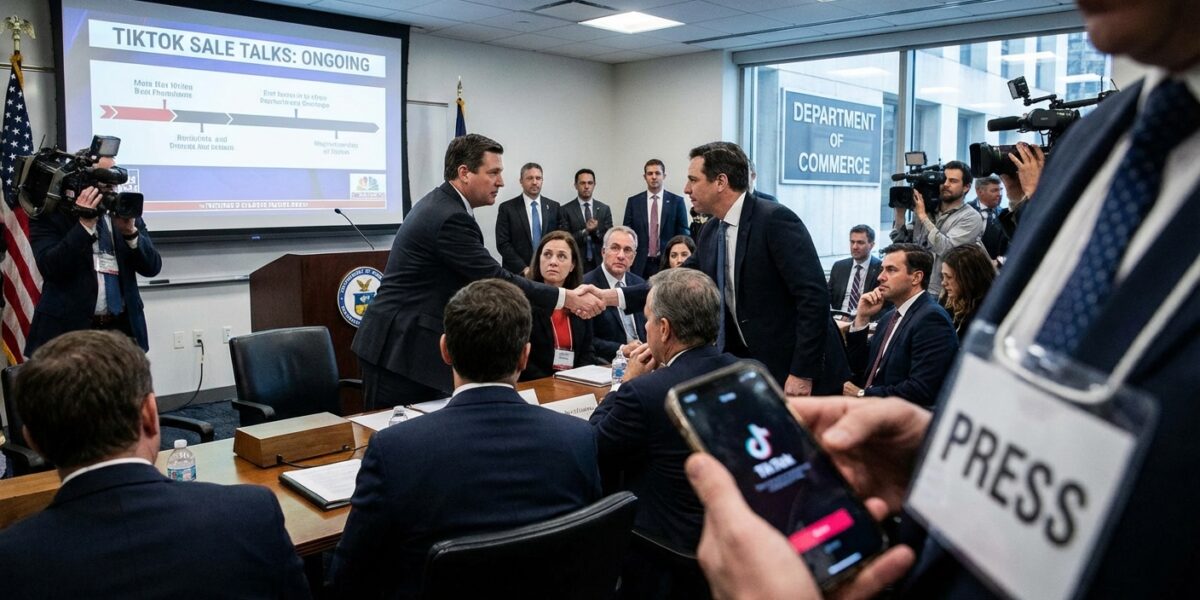
WASHINGTON, D.C. — TikTok, the short-form video application that 170 million Americans use to watch videos of dogs, learn dances, receive mental health advice of variable quality, get news from creators who are technically not journalists, and occasionally interact with content that U.S. intelligence officials describe with words like “influence” and “algorithm” and “data,” remains on your phone this week, the subject of ongoing sale negotiations that have now outlasted two administrations, two legislative bans, two executive reprieves, three proposed buyers, a Supreme Court ruling that the ban was constitutional, a subsequent decision not to enforce the constitutional ban, and a situation that legal scholars describe as “genuinely novel” and that most Americans describe as “I thought that was resolved? Wait, was it resolved?”
It was not resolved.
Here, for readers who have lost the thread — which is reasonable, the thread is long and has been running since 2020 — is where things currently stand:
Congress passed a law requiring ByteDance, TikTok’s Chinese parent company, to sell TikTok’s U.S. operations or face a ban. The Supreme Court upheld the law. The law took effect. The ban was not enforced. The administration issued a reprieve while negotiations for a sale continued. Negotiations have continued. The app is still on your phone. ByteDance has not sold. No buyer has been finalized. The administration is reportedly working to broker a deal involving American investors. Some of those investors are reportedly close to the administration. A lawsuit accuses the administration of helping broker a deal that serves political and financial interests while ignoring the national security concerns the legislation was designed to address. The administration disputes this characterization.
The app is still on your phone.
The National Security Question, Which Has Not Gone Away
The original legislative concern behind the TikTok law was that ByteDance, as a Chinese company, is subject to Chinese law requiring cooperation with Chinese intelligence services, and that TikTok’s access to data on 170 million American users — their locations, their interests, their social graphs, their behavioral patterns, their faces — constitutes a potential intelligence asset whose risks outweigh its entertainment value.
This concern has not been resolved by the ongoing sale negotiations, because a sale has not occurred, because ByteDance has not agreed to sell, because ByteDance has said it will not sell the algorithm, because the algorithm is the product, because a TikTok without the algorithm is a video app that is worse than YouTube and Instagram and three other apps already on your phone.
“The algorithm question is the whole thing,” said Dr. Jonathan Wei, a technology policy researcher at Georgetown. “What’s being negotiated is essentially whether a Chinese company will sell the part of TikTok that makes TikTok work to American investors who are connected to the current administration, in a deal structure that the original legislation’s sponsors say does not actually accomplish what the legislation was designed to accomplish. It’s a complex situation.”
He was asked to simplify it.
“Chinese app, American users, ongoing negotiations, no deal, app still works, national security question unresolved, some people will make money,” he said. “That’s where we are.”
The 170 Million Users
Supposedly News conducted an informal survey of TikTok users — specifically, people who use TikTok and were willing to be asked about TikTok’s legal situation for approximately ninety seconds.
Of fifteen people surveyed, twelve were aware that TikTok had “some kind of ban thing” happening. Eight could correctly identify that the ban was related to the app’s Chinese ownership. Four could describe the basic structure of the legislation. Two could name the Supreme Court case. One launched into a detailed explanation of the algorithmic data collection concern that was more comprehensive than some briefings Supposedly News has received from think tanks.
“I know everything about this,” said that person, a 24-year-old content creator named Jade who has 380,000 TikTok followers and whose income depends on the app continuing to exist. “I also know there’s nothing I can do about it. So I post three times a day and I try not to think about the rest of it.”
She paused.
“It’s kind of the whole vibe of existing right now,” she added.
Jade has 380,000 followers. Her most recent video, posted this morning, has 2.1 million views. It is a video of her dog. The dog does not know about the sale negotiations. The dog seems fine.
Supposedly News is not on TikTok. We are considering it. We have concerns. We also note that the dog video had 2.1 million views, which is a number we find professionally instructive.