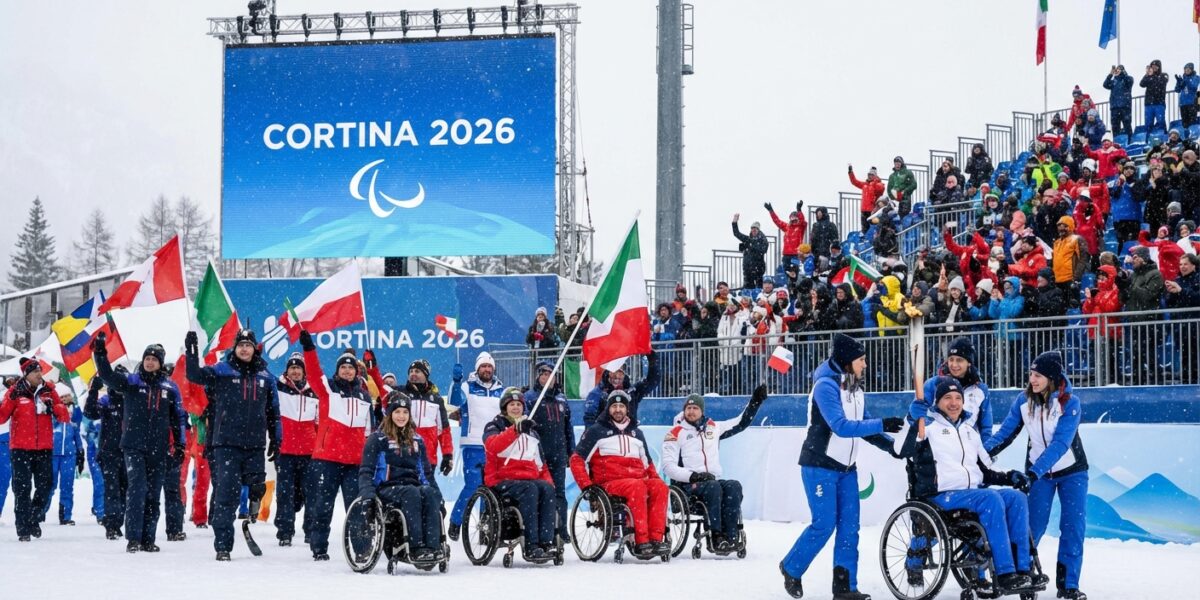
CORTINA D’AMPEZZO, ITALY — The 2026 Winter Paralympics opened Friday in Cortina d’Ampezzo, in the Italian Alps, with a ceremony that took place under the Agitos — the Paralympic symbol, three asymmetrical curves in red, blue, and green representing mind, body, and spirit, converging at a single point — and that featured 584 athletes from 47 nations who had qualified for the most competitive para sports competition in the world by doing things with their bodies that most able-bodied people cannot do, which is a fact that somehow manages to be simultaneously obvious and astonishing when you watch the competition itself.
The Games run through March 15. The American delegation includes defending champions in sled hockey, alpine skiing, and biathlon. The U.S. sled hockey team is pursuing its fifth consecutive gold medal, a dynasty-level achievement in any sport that receives approximately 0.3% of the coverage that a third consecutive gold would receive at the regular Winter Olympics, which is a ratio that sports media analysts describe as “a known disparity” and that Frank Misquote, Sports & Leisure, describes as “something we do that we should do differently.”
What Is Happening At These Games
Para alpine skiing. Athletes with visual impairments, limb differences, or other physical disabilities race down mountain courses at speeds exceeding 80 miles per hour. Visually impaired skiers race with a sighted guide who communicates course information through an earpiece in real time. The margins of victory are hundredths of seconds. The athletes have been training for this for four years. Several of them have been training for longer than that.
Para biathlon. Athletes ski cross-country and shoot rifles at targets five centimeters wide from a range of ten meters. Athletes with upper limb differences use adapted equipment. Athletes with visual impairments use acoustical aiming systems — the target emits a tone, the pitch of which indicates proximity to center, and the athlete adjusts aim by ear. They hit the target. Repeatedly. In competition. After skiing several kilometers.
Sled hockey. Played on ice by athletes with lower body impairments who sit in sleds on double-bladed runners and propel themselves with two short sticks that serve simultaneously as paddles and as hockey sticks. The game is hockey — contact, strategy, goaltending, line changes — played two feet off the ice at speeds that produce collisions loud enough to hear in the upper deck. The U.S. team has won four consecutive gold medals. Canada wants the fifth one back.
“It’s the best hockey I’ve ever covered,” said one sports journalist who covers the Paralympics regularly and who asked not to be named because they feared the quote would sound hyperbolic. “Not ‘good for Paralympic hockey.’ Best hockey. Period. The speed, the physicality, the level of play. If it was on television every night people would watch it.”
It is not on television every night.
The Coverage Question
Frank Misquote will not belabor this because the point makes itself: 584 athletes are currently in Italy competing at the top of their disciplines, having trained for four years for this specific moment, and the American media landscape — which will eventually produce long tribute features and human interest segments — is, in the opening week, running those stories alongside and sometimes after coverage of other sports involving able-bodied athletes competing in routine regular-season games that will be repeated next week.
This is not new. It is also not good. And it is, at minimum, worth noting in the Sports & Leisure column of a satirical news site whose confidence level for this particular observation is set to 93%, which is the highest confidence level Frank Misquote has assigned to anything, because the thing being said is simply: people are doing extraordinary things in Italy and they deserve your attention, and here is where you can find the schedule.
Where You Can Find The Schedule
The Paralympics run through March 15. Coverage is available at paralympics.com and through the official broadcast partners in your region. Sled hockey games are available to stream. The alpine events begin daily at approximately 10 a.m. Central European Time, which is 4 a.m. Eastern, which is not convenient, which is why sports streaming exists.
The U.S. sled hockey team plays its first game Monday. If they win four more, they will have won five consecutive gold medals — a run that would, in any mainstream sport, be the subject of multipart documentary treatment and a general cultural reckoning about dynasty and greatness.
In sled hockey, it will be what it has been: a gold medal, a team photo, a moment of enormous pride for the athletes and the people who love them, and a story that the sports pages will cover thoroughly and well in the specific week it happens and then, the following week, not at all.
This column is arguing, as strenuously as a Sports & Leisure column at a satirical news outlet can argue anything, that the following week should be different this time.
Watch the hockey. It’s very good hockey.
Frank Misquote is Sports & Leisure correspondent for Supposedly News. He watched two hours of Paralympic alpine skiing this morning while everyone else was reading about oil prices. He regrets nothing. He is watching the sled hockey Monday at 4 a.m. and he will not be tired about it.