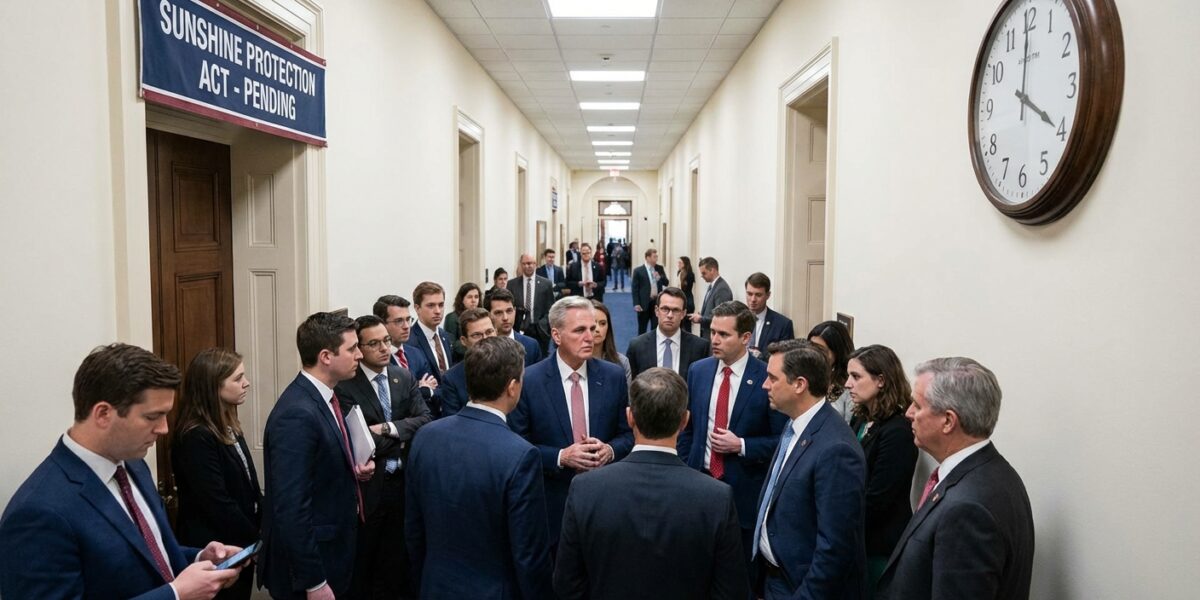
WASHINGTON, D.C. — Congress has again failed to end Daylight Saving Time.
This sentence has now been written, in some form, for five consecutive years. It will be written again next year. The year after that remains uncertain, but available evidence suggests it will be written then too.
The Sunshine Protection Act — a bill requiring, in its entirety, that the United States stop changing its clocks twice a year — has now cleared the Senate three times, each time unanimously or near-unanimously, and has now stalled in the House three times, each time for reasons that House leadership has described variously as “scheduling,” “the legislative calendar,” “other priorities,” and “we’re working on it,” which are four ways of saying the same thing, which is nothing.
The bill’s requirements are these: stop changing the clocks. That is the requirement. No new agency is created. No budget is allocated. No regulation is imposed. No international agreement is required, though several would need to be updated, which is the kind of administrative consequence that a functional legislature manages routinely. The bill’s primary action is the permanent cessation of an action the country already takes twice a year.
It has not passed.
The Case For, Which Does Not Need To Be Made But Will Be Made Again
Public support for ending the clock change has been consistently around 63% for years. There is no significant organized opposition. The American Medical Association supports ending it. The American Academy of Sleep Medicine supports ending it. The American Academy of Pediatrics supports ending it. Retail associations support it. The airline industry has opinions about it. Small business owners have opinions about it. Parents of school-age children who have spent a week coaxing a confused six-year-old to sleep at an hour the six-year-old’s body does not recognize as bedtime have very strong opinions about it.
The opposition, such as it exists, consists primarily of: some agricultural industry voices who have noted implementation complexities, some broadcasting industry concerns about sports scheduling, and a general institutional resistance to changing something that has existed for 108 years even when the reasons for its existence are no longer applicable and the evidence of its harm is extensive.
“It’s not a close call,” said Dr. Jerome Hawkins, a sleep medicine researcher at Stanford who has testified before Congress on this issue twice and who answered the phone Sunday morning with the specific energy of a person who went to bed at his normal time and woke up one hour earlier than his body expected to. “The science is settled. The public wants it. There’s no significant opposition. We just need Congress to do the one thing, which is pass the bill that has already passed the Senate, which they haven’t done.”
He sounded tired. He is a sleep scientist who is tired because of a policy he has spent years trying to help end. Supposedly News acknowledges the poetry of this.
The Permanent Standard Time Question, Which Always Derails Everything
The one genuine disagreement about ending Daylight Saving Time involves which time to make permanent: standard time (the “fall back” position, which aligns better with the sun’s natural position and which sleep scientists uniformly prefer because it better matches human circadian rhythms) or Daylight Saving Time (the “spring forward” position, which provides lighter evenings but darker mornings and which the retail, recreation, and evening economy prefers because people spend money when it is light outside at 6 p.m.).
This disagreement is real and substantive. It does not, however, explain why Congress has also failed to pass a version of the bill selecting either option. The Senate has passed versions selecting Daylight Saving Time permanently. Sleep scientists have asked for standard time. Congress has passed neither. The stalemate between “the lighter evenings one” and “the one the doctors want” has produced the outcome of “the one where we keep changing it twice a year, which everyone agrees is the worst option, indefinitely.”
“It’s genuinely remarkable,” said Dr. Keisha Morris, a political scientist at George Washington University who has been studying the Sunshine Protection Act’s legislative history. “In most policy disputes, the failure to agree produces stasis — nothing changes. Here, the failure to agree between two options that are both better than the status quo has produced… the status quo. Which is the worst option. By consensus. We’re all agreeing it’s bad. We’re disagreeing about which better thing to replace it with. And the result is the bad thing continues. It’s actually very impressive, as legislative failures go.”
This Morning’s Congressional Availability
Supposedly News contacted seventeen congressional offices Sunday morning to request comment on the failure to pass the Sunshine Protection Act and the resulting nationwide sleep disruption.
Three responded. Two sent the same boilerplate statement expressing support for ending the clock change and commitment to working toward a solution in the current session, a statement format that has been issued by various offices for five consecutive years without producing a law.
The third response came from a staff member who picked up the phone, said “oh god, is it already this weekend,” was audibly quiet for several seconds, and then said their office had no comment at this time. Supposedly News appreciated the honesty.
Several members of Congress posted on social media Sunday morning about Daylight Saving Time. The posts uniformly expressed frustration with the clock change and support for ending it. Several tagged the posts with #SunshineProtectionAct. Several of the members who posted have been in Congress during at least three of the five years the bill has failed to pass.
The posts received significant engagement. The bill remains unscheduled for a House floor vote.
What Will Actually Happen
The Sunshine Protection Act will be reintroduced in the current Congress. It will likely pass the Senate again. It will enter the House legislative calendar. The House will address several other legislative priorities. The legislative session will develop competing demands. The bill will not receive a floor vote before the next recess. The recess will end. The legislative calendar will refill. November will arrive. The clocks will fall back. There will be brief national relief. There will be articles about the legislative failure. There will be renewed calls for action. A new version of the bill will be introduced in January.
We will do this again in March.
Supposedly News’s confidence level on this prediction: 99%. We left one percent for the possibility that something unexpected happens, which is the journalistic equivalent of leaving one percent of your glass empty out of respect for the concept of thirst.
Set your clocks forward. Drink your coffee. Congress is on it.
Deborah Shill, Political Analyst, has covered this story for four years. She has changed her microwave clock each of those years. She notes that the microwave clock takes eleven button presses to change. She notes further that this is eleven more button presses than should be required to change the time on a device that exists to heat food. She feels this is related to the broader problem and declines to elaborate.