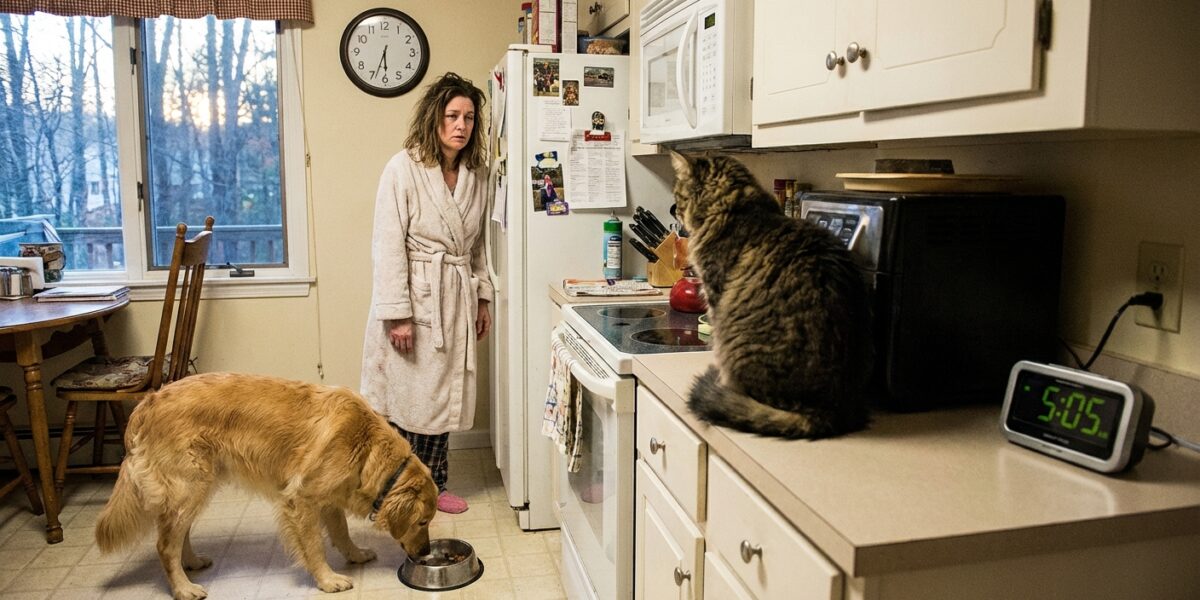
UNITED STATES — America’s pets have had enough.
Not of their owners, necessarily. Not of their beds, their toys, their walks, or their extensive and elaborate inner lives that science has only recently begun to properly acknowledge. What America’s pets have had enough of, as of Sunday morning, is being told by the behavioral rhythms of the humans around them that something is different today in a way that nobody has explained and that does not, from the pet’s perspective, make any sense.
The dog wanted breakfast at what was, by its internal clock, 6:30 a.m. The clock said 7:30. The owner was confused. The dog was at the bowl. The bowl was empty. These are facts the dog understood with complete clarity, and the owner’s attempts to explain Daylight Saving Time were received with the patient, slightly tilted-head attention that dogs deploy when they are listening respectfully to something they cannot process.
“He stood by his bowl for forty-five minutes,” said Christine Palermo, 39, of Denver, Colorado, describing her golden retriever, Max, who is four years old and has now experienced Daylight Saving Time four times without developing any accommodation for it. “Just stood there. Looking at me. Then at the bowl. Then at me. Then at the bowl. Very calmly. Like he was trying to give me an opportunity to fix the situation before things escalated.”
Max did not escalate. Max never escalates. Max is a golden retriever. But Christine reports that “the energy was there.”
The Science Of Pet Time, Which Is Not Our Time
Animals, it turns out, do not observe Daylight Saving Time. This fact, which requires approximately zero scientific expertise to grasp and which nonetheless is apparently not considered during the annual legislative failure to end the clock change, means that every spring and fall, the 184 million pets in American households — plus uncounted rabbits, birds, hamsters, horses, goats, and at least one emotional support iguana in Tempe, Arizona named Senator — experience a sudden, unexplained shift in the behavioral patterns of the large primates who control the food supply.
“From the animal’s perspective, the human has simply started doing everything wrong,” said Dr. Angela Torres, a veterinary behavioral specialist at UC Davis, speaking Sunday from what she described as “an extremely relatable place” because her two cats had been staring at her since what was, by their reckoning, 4:45 a.m. “Their circadian rhythm is tied to light cycles, meal times, and activity patterns. Two of those three things just shifted by an hour with no warning and no explanation. They’re not confused in a distressed way, usually. They’re confused in an ‘I am waiting for you to correct this error’ way.”
She was asked how long it takes for pets to adjust.
“About a week,” she said. “Which is the same amount of time it takes humans to adjust. We are, in this respect, not that different from our animals. They just communicate their dissatisfaction more directly.”
The Cat Situation, Separately
Dogs, by temperament, tend to approach the Daylight Saving disruption with confused patience. They are at the door when the walk should happen. They are at the bowl when the food should come. They look at you. They wait. They are committed to the relationship and willing to see how this resolves.
Cats have a different approach.
“She sat on my face,” reported David Kim, 44, of Austin, Texas, describing the Sunday morning behavior of his six-year-old tabby, Margarethe, who ordinarily receives her breakfast at 7:00 a.m. and who was prepared to receive it at 7:00 a.m. regardless of what time the clock said it was. “Just fully sat on my face. She’s done this before when I’ve slept late, but never with this much purpose. This was a statement. There was intention behind it.”
Margarethe, reached for comment via the interpretation of her subsequent behavior, walked to her bowl, sat beside it, and looked at David with the specific expression that cat owners recognize as neither aggression nor affection but as the face a middle manager makes when waiting for a subordinate to understand something they should already understand.
David fed her. The expression did not change. It lingered through breakfast and into the afternoon, reasserting itself briefly at 4:47 p.m. when dinner was, from Margarethe’s perspective, thirteen minutes overdue.
The Horse Community’s Statement
Horse owners, who operate on schedules of particular rigidity because horses are large animals with specific digestive requirements that make irregular feeding times a genuine health concern rather than a matter of pet preference, have for years noted that Daylight Saving Time creates a week-long process of gradually shifting feeding times by fifteen-minute increments to avoid digestive disruption — a process that requires planning, commitment, and the ability to explain to a horse, using only your behavior, that you’re doing something different this week and you’d like its patience.
“The horse doesn’t know about Congress,” said one equestrian farm owner in Virginia who asked to remain anonymous because she has said this to journalists before and would like to try a different approach. “The horse knows when it eats. It knows when it doesn’t. The rest is between me and the calendar.”
She paused.
“Pass the Sunshine Protection Act,” she added, with the directness of a person who has been adjusting horse feeding schedules twice a year for twenty years.
The Week Ahead
Veterinary behaviorists recommend, for pet owners navigating the DST transition, a gradual shift in feeding and walk times over five to seven days — moving schedules by fifteen-minute increments rather than a sudden one-hour jump. This approach, experts say, reduces behavioral disruption and helps animals recalibrate their internal clocks smoothly.
Most pet owners will not do this. Most pet owners will feed their pets at the new time on day one, observe the confusion, feel guilty, and then do it again on day two until the pets adjust, which takes about a week, which is the same week their owners are also adjusting, meaning the entire household is tired, confused, and slightly behind on everything simultaneously.
Then November comes. Everyone adjusts back. Then March comes again.
Max the golden retriever is, as of Sunday evening, in his usual spot on the couch. He has been fed. He is not holding a grudge, because Max does not hold grudges, because Max is a golden retriever and golden retrievers are better at this than Congress.
Margarethe is also fine. She is sitting in a sunbeam. She appears satisfied. She will reassert her position on the face situation tomorrow morning if the schedule is still incorrect.
The schedule will still be slightly incorrect tomorrow morning.
This is fine. This is all fine. Spring is coming.
This article was filed by Agnes Unnamed. Agnes has two cats. They did not contribute to this piece, though one of them walked across the keyboard during the drafting process and added several characters that were removed before publication. We believe they were trying to help.