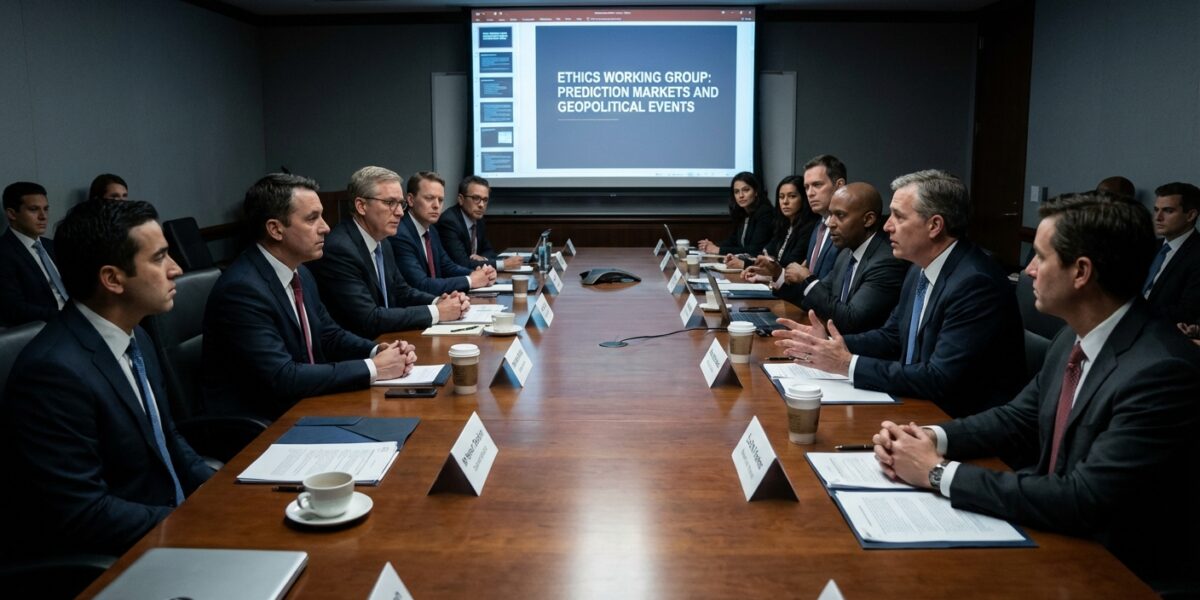
SAN FRANCISCO / NEW YORK — The prediction market industry, which allows traders to place financial bets on the outcomes of real-world events including elections, natural disasters, sporting competitions, and, as of last week, the precise timing of airstrikes on sovereign nations, has convened what it is calling an “ethics dialogue” to address growing public concern about whether markets that enable people to profit financially from accurately anticipating military operations constitute a form of activity that society should think harder about.
The dialogue, which took place via a two-hour Zoom call attended by twelve industry representatives, three academics, one ethicist who said afterward that she found the experience “clarifying in a way I did not enjoy,” and zero people who had lost money in the market in question, because those people do not attend ethics dialogues, produced what participants described as “a productive exchange” and what the ethicist described as “everyone agreeing that the question is complicated and then describing their next product launch.”
The precipitating concern: a single trading account made more than half a million dollars on a prediction market contract tied to the timing of U.S. military strikes on Iran, with the first trade placed approximately one hour before the strikes became public knowledge — a fact pattern that Congress describes as “alarming,” that the Justice Department describes as “under review,” and that the prediction market industry describes as “one data point among many that should be considered in context.”
The Context The Industry Would Like You To Consider
The context, per industry representatives who spoke to Supposedly News on background because several of them are currently involved in fundraising rounds and did not want quotes attached to their names, is as follows:
Prediction markets aggregate information. Information aggregation produces accurate forecasts. Accurate forecasts are socially useful. Restricting prediction markets restricts information aggregation. Restricting information aggregation produces less accurate forecasts. Less accurate forecasts are less socially useful. Therefore, prediction markets are socially useful.
This argument was presented in three variations across four conversations and is technically coherent as an abstraction of market epistemology. It does not directly address the question of whether a specific individual used non-public information about a specific military operation to make half a million dollars betting on when people would start dying, which the ethicist noted was “a slightly different framing than ‘information aggregation.'”
The Half Million Dollar Trade
The account in question — which operates under a username that is not being reproduced here because we have not independently verified its identity and because prediction market usernames are doing a lot of work in this news cycle — made its first purchase on the Iran strike timing contract approximately 63 minutes before news of the strikes became public.
At that time, publicly available information did not indicate imminent strikes. The market probability had not spiked. Standard geopolitical tracking services had not issued alerts. The account bought.
Sixty-three minutes later, the strikes began. The contract resolved. The account profited.
The Department of Justice has opened a review. The Consumer Financial Protection Bureau, which had previously investigated the platform before closing its investigation when the current administration took office, has not reopened its inquiry. The platform’s advisory board includes a prominent figure whose family has financial ties to the company. None of these facts have been directly connected by any investigator. They are adjacent. They exist in proximity to each other. Supposedly News notes their proximity and invites the reader to assess it.
The Ethics Working Group’s Preliminary Findings
After two hours of dialogue, the ethics working group produced a three-page document that Supposedly News has reviewed and that contains the following conclusions, paraphrased:
One: Prediction markets are legal. Two: Insider trading on prediction markets exists in a regulatory gray area that existing securities law was not designed to address. Three: The industry believes self-regulation is preferable to external regulation. Four: The industry is forming a self-regulatory working group to develop self-regulatory standards. Five: The working group will report back in six months. Six: Trading continues in the interim.
The document does not use the phrase “human suffering.” It uses the phrase “sensitive event categories” three times, which is the prediction market industry’s preferred framing for contracts tied to events in which people are harmed.
“Sensitive event categories,” said the ethicist, reading the document over video call. “That’s the one. That’s the phrase I’ll be thinking about.”
She looked tired. It was 11 a.m.
Trading volume on conflict-related contracts rose 8% in the week following the ethics dialogue announcement. Participants called it “interest in the category.”
Douglas Allegedly would like to note that he has never placed a bet on a prediction market. He would also like to note that he checked, and there is apparently a market on whether this article gets shared more than 1,000 times, which he finds both impressive and exhausting.