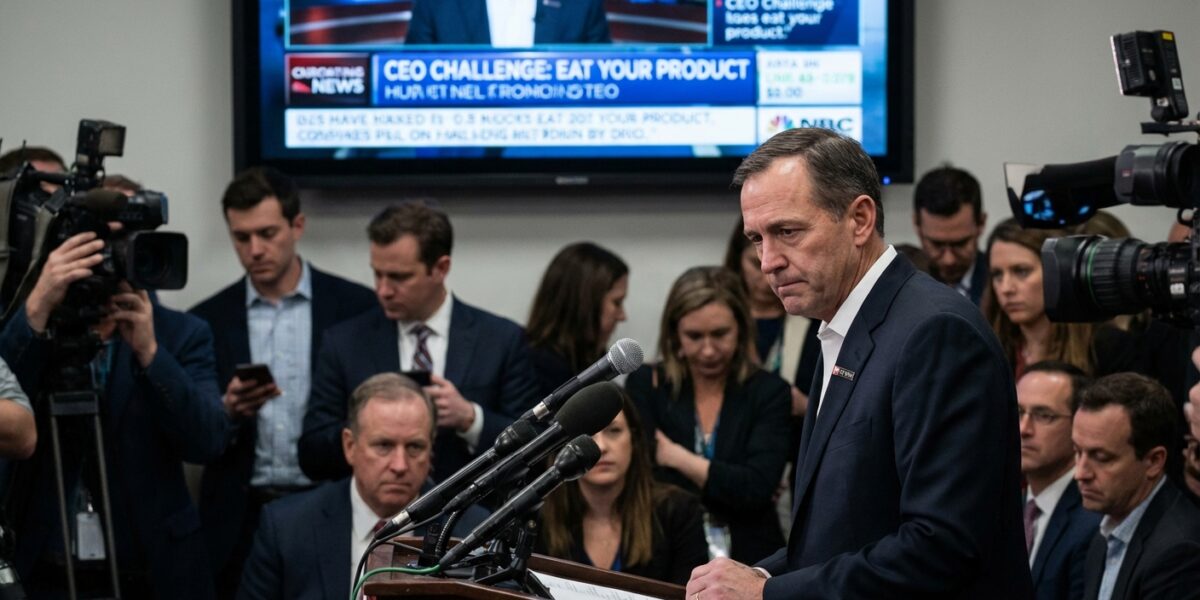
SOMEWHERE IN CORPORATE AMERICA — A precedent has been set. The people have spoken. The standard is now clear: if you are a CEO, you will eat the thing, you will eat it on camera, you will take a real bite, you will not call it “the product,” and you will finish it off-screen in a way that the internet finds credible.
Chris Kempczinski started this. He did not mean to start this. He meant to promote a burger. He has instead ignited a full accountability movement in which the American public, having discovered that corporate food executives can be compelled by social pressure to consume their own output, is now systematically working through the org chart of every food company in the country with the focused energy of a population that has found a new thing.
The movement has arrived, with some speed, at Purina.
“The CEO of Purina dog food is probably getting nervous as hell right now,” observed one Jimmie Ward III on Facebook Sunday, a post that received 3,200 likes, 104 comments, and 972 shares — metrics that suggest the observation resonated, and that the resonance was immediate, and that approximately one thousand people forwarded it to someone they knew would appreciate it, which is the social media equivalent of calling someone specifically to tell them something.
Jimmie Ward III, as author, replied to his own post with the logical endpoint of the premise: “They’re gonna make him eat it for a video.”
155 laughing emojis. Jimmie Ward III knows his audience.
The Situation, Explained For The Purina CEO
The situation is this: McDonald’s CEO Chris Kempczinski posted a video of himself eating a burger. The video went viral because the bite was too small, the word “product” was used too many times, and the overall performance suggested a man who had been briefed on the concept of enthusiasm but was encountering it in practice for the first time. Burger King responded with 13 seconds of confident Whopper consumption. Wendy’s responded with a video and a caption that used the word “pretend.” The industry piled on. The precedent calcified.
The precedent is: eat the thing or explain why you won’t.
Purina makes dog food. Purina also makes cat food. Purina is owned by Nestlé, which also makes Hot Pockets, which one commenter named Camryn Dufrene noted means the Purina CEO is technically adjacent to Hot Pocket ingredients, and that therefore the dog food is probably fine, specifically: “It’s just leftover hot pocket he’ll be fine.” This is either reassuring or not reassuring depending on your feelings about Hot Pockets, which is its own conversation.
Carrina Ritchotte, contributing from a different angle entirely, noted that the food is “consistently infested with moths,” which received 14 likes and represents the most alarming data point in the thread, and which Supposedly News is noting without verification because it is the kind of claim that, true or not, materially affects one’s appetite for a CEO taste test video.
The Comment Section, Classified By Escalating Stakes
The comment section on Jimmie Ward III’s post represents one of the more coherent collective thought experiments Yolanda Tippington, Science Correspondent, has encountered in recent field research. It proceeded as follows:
First, the immediate pivot to the McDonald’s comparison, provided by Shell Lee: “He would definitely enjoy his product more than Mickey D’s dude liked his bite of air.” The phrase “bite of air” is a precise and devastating description of what Kempczinski’s bite contained relative to what a full burger bite should contain. Shell Lee received 13 likes. This is fair.
Second, the lateral expansion to other industries. Marcus Tillery raised the matter of the CEO of Bad Dragon, a company whose products Supposedly News will describe only as “not food” and whose CEO’s theoretical on-camera product consumption was, the comment section agreed, a different category of problem entirely. Paul Looney concurred. The Bad Dragon CEO’s nervousness, the thread established, exceeds Purina’s by a significant margin for reasons that Supposedly News will not enumerate in a family-adjacent publication.
Spencer Fuller then introduced the CEO of Smith & Wesson, which sells firearms, and which represents a third category of on-camera product demonstration with its own distinct set of regulatory and actuarial implications.
Lance Weller, surveying this escalation with the calm of a man who has watched comment sections develop before, simply said: “Look out Fancy Feast.” Two words. No likes at press time. Yolanda Tippington considers this underrated.
Justice Wright connected the thread back to its origin with the simple contribution: “try our new product” — three words, no punctuation, instantly understood by every person in the thread, because the word “product” has been ruined for promotional food content for the foreseeable future and possibly permanently.
The Confused Contingent
As with all viral threads of sufficient size, Jimmie Ward III’s post attracted a significant population of people who arrived late, lacked context, and asked variations of “What happened?” and “Why?” and “Someone fill me in” with the bewildered energy of people who have walked into the third act of a play without a program.
Alli Wesley: “What happened?”
Blake Shields: “What happened?”
Abby Mariee: “why?? Someone fill me in?”
Trinity Gyger: “Why would they?”
Lilith Darko: “What did we miss”
Rachel Ashley Heck: “Why”
These questions went largely unanswered, because the people who understood the situation were busy making jokes, and the people making jokes had no interest in pausing to onboard latecomers, and this is the natural ecosystem of a viral comment thread at scale. The confused contingent will find out eventually. Google exists. Nate Mansions is available for consultation.
The Most Important Comment
Buried between the SpongeBob memes — which appeared twice, posted by different people, both captioned as the immediate visual that came to mind upon contemplating a CEO eating dog food, and which is a level of cultural synchronicity that warrants academic study — was a comment from Veronica Rose that represents the most underappreciated contribution to the thread.
Veronica Rose worked at a pet boarding facility that sold boutique pet foods. A sales representative, she reports, once demonstrated the quality of a brand’s human-grade canned chicken thighs by pulling one out and eating it in front of everyone in the room.
This happened. It was real. It was not a viral moment. It was a sales call. It worked, apparently, because the product was human grade and the demonstration was confident and nobody involved had been briefed on the concept of a “product” as a substitute for the word “food.”
This is the path. This has always been the path. The McDonald’s CEO had one job and it was the same job as the pet food sales rep and the pet food sales rep did it better and probably took a bigger bite.
What Happens Now
Rem Pragma, tagging Purina’s official account directly, posted: “we’re gonna need a taste test.”
Purina has not responded. Purina’s social media team is, presumably, watching the McDonald’s situation with the focused attention of people who make their living in promotional food content and who are currently updating their internal guidance on the word “product” and the minimum acceptable bite size.
Jacob Lovell offered the most optimistic note in the thread: “Hell nah, he eats it all the time.” The implication being that the Purina CEO is ahead of this, has already established a private practice of product consumption, and will come to the camera confident and unafraid and ready to take a real bite of the thing in a way that Chris Kempczinski, in a gray V-neck sweater in his office, did not.
Yolanda Tippington would like to believe Jacob Lovell. The science of corporate promotional video production suggests caution. The comment section suggests the public is ready either way.
The Purina CEO has not posted a video. The clock is running. The SpongeBob meme has already been selected. The comment section knows what it wants.
Eat the kibble, sir. Take a real bite. Do not call it “the product.”
We have learned what happens when you call it the product.
Yolanda Tippington is Supposedly News’s Science Correspondent and covers developments at the intersection of corporate accountability and the nation’s appetite for watching executives eat things. She has reviewed the available dog food nutritional labels. She declines to comment further at this time. She would like to know what moths have to do with any of this and is following up with Carrina Ritchotte separately.