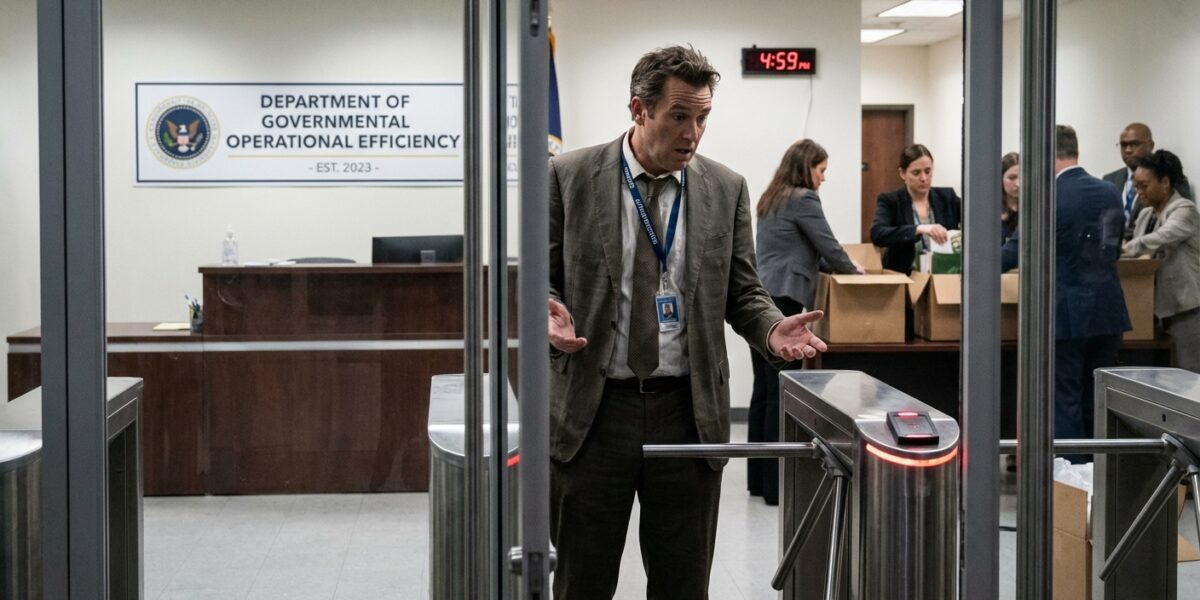
WASHINGTON, D.C. — The Department of Governmental Operational Efficiency, a newly formed federal bureau tasked with identifying and eliminating wasteful government spending, achieved what its acting director described as “our greatest success to date” on Wednesday when it accidentally applied its own efficiency algorithms to itself, resulting in the complete elimination of the department, its $4.2 billion annual budget, all 1,700 of its employees, and its own legal authority to exist.
“This is exactly what we set out to do,” said Acting Director Chadwick Merritt III, speaking from the sidewalk outside the department’s former headquarters at 1600 Efficiency Way after his access badge was deactivated at 9:14 a.m. by a software system he himself had commissioned. “We found an area of government that was bloated, duplicative, and ineffective, and we eliminated it. The fact that it was us is, frankly, inspiring.”
The incident began Thursday when DGOE’s proprietary efficiency algorithm, known internally as SLASH 2.0, was tasked with conducting a routine audit of all federal agencies, including DGOE itself. SLASH 2.0, which had been trained on a dataset of federal agency expenditures and a self-described “bias toward decisive action,” identified DGOE as having “a notably poor return on investment relative to actual efficiency improvements delivered” — a finding that several fired government employees described as “deeply ironic” and “very funny, actually.”
The Numbers
According to SLASH 2.0’s final report, which was automatically emailed to 47 congressional offices at 9:13 a.m. — one minute before it deactivated the email server — DGOE had spent $4.2 billion in its first eight months of operation and had achieved documented efficiency savings of $380 million, a return ratio that SLASH 2.0 characterized as “suboptimal” before recommending immediate dissolution.
DGOE had, in those eight months, successfully eliminated 34 other federal programs, including the National Weather Service’s rural flood prediction unit, a Veterans Affairs mental health hotline, and a small Department of Agriculture office that apparently tracked bee populations and which, it now turns out, several agricultural sectors would very much like to have back.
DGOE’s own elimination, by contrast, saves $4.2 billion annually, making it by far the department’s most efficient act.
“You almost have to respect it,” said Dr. Miriam Chen, a public administration professor at Georgetown University. “It’s like a very expensive self-eating cake.”
The Chain of Command Problem
The elimination of DGOE has created what constitutional scholars are calling “an interesting administrative puzzle,” in that the department responsible for overseeing the elimination of federal programs has itself been eliminated, meaning there is now no department responsible for overseeing whether the programs it previously eliminated should perhaps be un-eliminated.
“We are in genuinely novel territory,” said White House Chief of Staff Darren Hopper, reviewing a flowchart that appeared to have several boxes simply labeled “???” “The good news is we saved $4.2 billion. The bad news is we have no idea what’s happening with the bees.”
Congressional Republicans called the self-elimination “bold” and “proof that this administration is serious about cutting waste.” Congressional Democrats called it “a disaster.” Both sides agreed it was “historic.”
Where Is Acting Director Merritt Now
Acting Director Merritt, whose position was technically eliminated along with the department, has been observed this week in a series of increasingly optimistic LinkedIn posts describing himself as “a proven efficiency transformation leader” who is “actively exploring exciting new opportunities to bring disruptive government reform thinking to the private sector.”
He has seventeen connection requests pending. Several are from European governments.
The White House announced Thursday that a new department — the Office of Governmental Operational Efficiency Oversight — will be established to oversee the activities of future efficiency-related departments, to ensure that future efficiency-related departments do not accidentally eliminate themselves.
Its proposed annual budget is $5.1 billion.
Supposedly News has reached out to the DGOE for comment. Our emails are bouncing. Their server has been decommissioned.