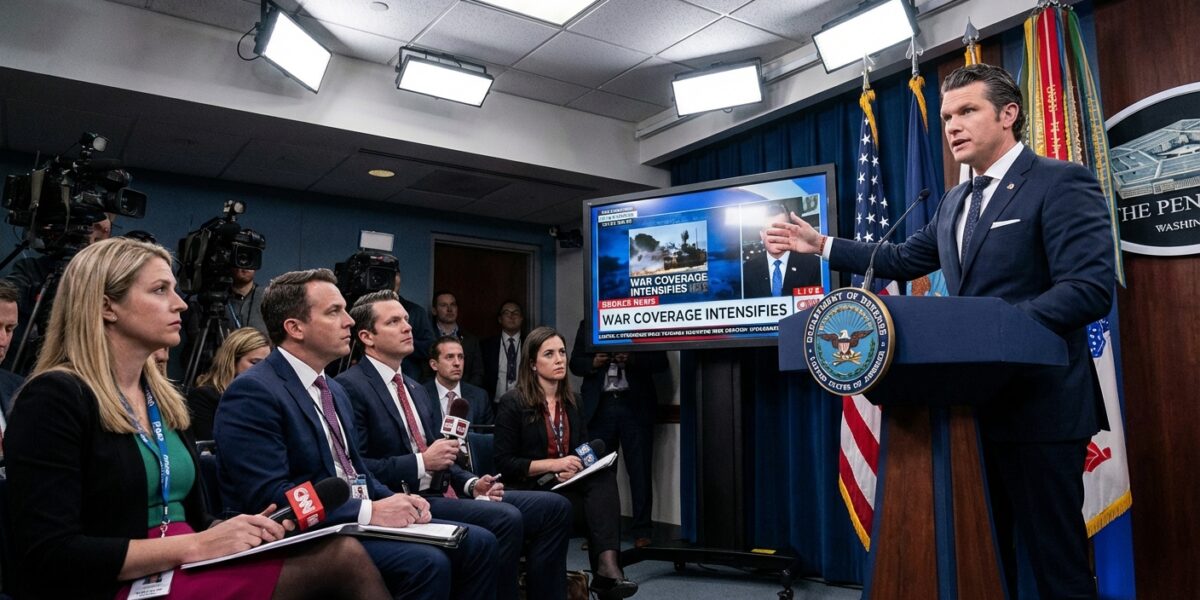
The Iran war has been underway for eighteen days. Public approval of the war is, by multiple measures, low. The administration has identified why the approval is low. The approval is low because of the coverage. The coverage is negative. The coverage is negative because the war has had, alongside its documented military successes, several features that coverage tends to treat as newsworthy — service members killed, a school struck, oil prices spiking, the Strait of Hormuz disrupted, the new supreme leader being the person the administration specifically said it didn’t want — and the media, in covering these features, has produced coverage that the administration describes as fake, corrupt, unpatriotic, and in some cases treasonous.
The solution the administration is proposing is not to address the features. The solution is to address the coverage.
This is a media strategy. Douglas Allegedly has covered several. This one is notable for the speed and comprehensiveness with which it has been deployed — all three major pressure mechanisms (executive social media threats, FCC regulatory intimidation, Pentagon briefing attacks) within the same seventy-two-hour window — and for the specific charge being floated, which is treason, which carries the death penalty, which is a more dramatic escalation than the standard “enemy of the people” framing and which several legal experts describe as not legally viable and which several senators describe as alarming regardless of viability.
The Mechanisms Of The Strategy, Catalogued
The FCC Approach: FCC Chairman Brendan Carr threatened on Saturday that broadcasters airing “hoaxes and news distortions” could lose their licenses at renewal time. Legal experts told CNN that Carr has limited actual ability to follow through on this threat. Carr issued the threat anyway. The threat’s legal viability and the threat’s chilling effect are different things, and the chilling effect does not require legal viability to function. Carr’s message was posted on the same day he visited Trump at Mar-a-Lago, a scheduling detail that was not mentioned in the post but is mentioned here.
The Presidential Social Media Approach: The president posted to Truth Social suggesting media organizations should be “brought up on Charges for TREASON.” The president specifically named The New York Times and The Wall Street Journal. Neither is a broadcast outlet. The FCC does not regulate print publications. The president was nonetheless thrilled to see the FCC chairman’s threat against broadcasters, which he praised despite it being directed at a different category of media than the ones he had just named. Douglas Allegedly notes that this internal inconsistency is either an oversight or a comprehensive approach.
The Pentagon Approach: Defense Secretary Pete Hegseth, a former Fox News host, has been critiquing specific headlines at Pentagon briefings and describing critical coverage as unfair to service members. Hegseth commented that he was looking forward to CNN coming under new ownership through the Skydance acquisition — an acquisition requiring approval from the Trump administration, which Hegseth’s own department is part of. This is a sentence that contains both the threat and the mechanism in close proximity, and Douglas notes it without embellishment because embellishment would only reduce its impact.
The Comprehensive Accusation: The White House issued a statement accusing CNN of seeking to “undermine our decisive victories in Operation Epic Fury.” CNN, asked about the statement, covered the statement. The coverage of the statement about unfair coverage is itself now potentially subject to the framework being applied to coverage the administration finds unfair, which is a recursive loop Douglas is choosing to exit before it gets worse.
What The Coverage Actually Said, For Reference
The specific coverage that triggered the treason threat was reporting on an AI-generated video showing the USS Abraham Lincoln on fire — a video the president correctly identified as fake and that, per CNN’s fact-checking team, was circulating on social media but was not, in fact, distributed by the major American news organizations the president then threatened.
The Wall Street Journal, separately, reported that five U.S. Air Force refueling planes were struck and damaged at Prince Sultan air base in Saudi Arabia, citing two unnamed U.S. officials. The president described this as “false reporting.” He did not dispute the central facts of the report. He disputed the report.
The WSJ has not retracted the report. The U.S. officials who were cited have not come forward. The tankers were or were not damaged, and the answer to that question is either classified or contested or both, and the WSJ reported what its sources said, and the president called this treason, and the maximum penalty for treason is death, and the WSJ is still publishing, and the sources remain unnamed, and the tankers remain either damaged or undamaged depending on which account you trust, and the war is in its eighteenth day.
The Axelrod Observation, Which David Axelrod Made And Which Deserves Its Own Section
CNN senior political commentator David Axelrod, watching Hegseth’s media attacks at the Pentagon briefing, observed: “It feels like a decision has been made that if the war news isn’t better, better to attack those who report news of the war.”
Axelrod then added that Trump appears envious of countries without a First Amendment, noting: “Putin doesn’t have to put up with this!”
These two observations together constitute the most complete diagnosis of the current situation available in the public record, and Douglas Allegedly has nothing to add to them except the following: the First Amendment has survived considerably more than this and will presumably survive this too, and the war’s coverage will continue to reflect the war’s actual events regardless of the framing preference of the people conducting the war, and this is either called journalism or it is called treason depending on which account you trust, and Douglas Allegedly is choosing journalism, and will file accordingly until further notice.
Further notice has not arrived as of press time. Douglas Allegedly will continue covering the war. Supposedly News will continue publishing. Gerald the houseplant has reviewed the First Amendment. Gerald had no notes. Gerald is not subject to FCC licensing. This is Gerald’s most significant constitutional advantage and Douglas considers it underrated.
Douglas Allegedly, Opinion Editor, notes that this is the most serious piece he has filed for Supposedly News and that the confidence level of 18% reflects both the date and his confidence in the sustainability of the current information environment, which are related concerns. Fake sources: 5. The war is real. The coverage is real. The First Amendment is real. The crystal shamrock bowl from the House of Waterford is also real and is beautiful and Douglas would like someone in charge to look at the shamrocks for a moment and consider what they represent before the next Truth Social post goes up.