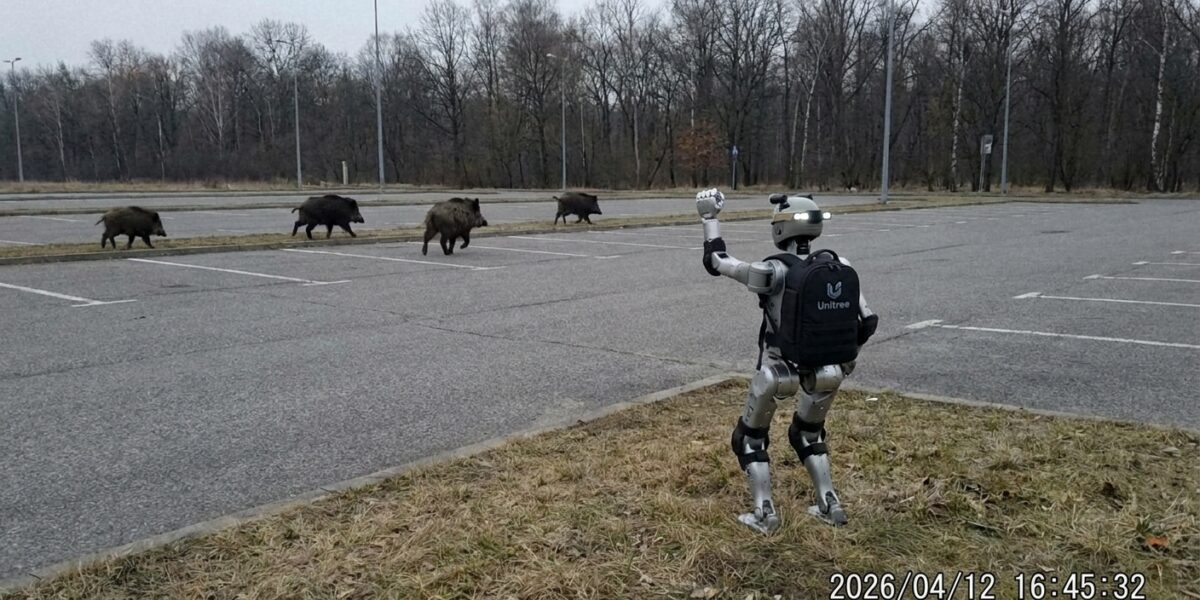
WARSAW, POLAND — On the evening of April 12, 2026, a humanoid robot jogged across an empty parking lot in Warsaw and chased a small group of wild boars toward a tree line. The boars, which had been standing near the roadside in the manner of animals that have lived in a European capital long enough to stop being impressed by it, looked at the robot, assessed the situation, and left at a pace that suggested mild inconvenience rather than fear. The robot pursued them across a patch of grass. The boars entered the woods. The robot stopped, stood at the edge of the tree line, and raised its fist in the air.
The fist raise has been interpreted by 3.8 million viewers as frustration. Yolanda would like to note that the robot does not experience frustration. The robot is a Unitree G1 humanoid platform standing 4 feet 3 inches tall and weighing approximately 77 pounds. It does not have emotions. It has servos. The fist raise is a programmed gesture — someone told the robot to do that after the boars left, or the robot’s behavioral system selected the gesture from a library of available movements, and either way the result is a machine performing the universal human sign for “I almost had them” at the edge of a Polish forest while several hundred pounds of wild pig disappear into the underbrush without looking back.
The robot captioned the video on X: “I’m herding the wild boars into the forest.”
Yolanda has reviewed this claim. The boars were already near the forest. The boars went into the forest. The robot was present during the period in which the boars went into the forest. Whether the robot caused the boars to enter the forest or merely coincided with a decision the boars were already making is a question of causation that the video does not resolve and the boars are not available to clarify.
The Robot Is Named Edward Warchocki And It Has A Career
Edward Warchocki is not a research prototype. Edward Warchocki is not a military application. Edward Warchocki is not a warehouse logistics unit. Edward Warchocki is a robot influencer — a customized Unitree G1 humanoid with an active social media presence, a growing following in Poland, and a résumé that includes singing on stage, chasing marathon runners, visiting the Polish Parliament, riding a skateboard, and now, chasing wild boars through a parking lot while wearing a backpack, knee pads, and helmet-mounted lights.
The robot was created as a technology experiment led by entrepreneur Radosław Grzelaczyk, with AI conversational systems built by developer Bartosz Idzik. Unlike scripted mascots or preprogrammed demonstration units, Warchocki is designed to interact dynamically with people in public settings — generating responses during live conversations using a mix of proprietary and existing AI tools. Videos show Polish citizens approaching the robot on city streets to shake hands, ask questions, and record interactions for social media. The robot has become, by the metrics that determine such things, one of Poland’s most recognizable internet personalities.
Yolanda would like to pause on this. A 4-foot-3 Chinese-manufactured humanoid robot wearing knee pads has become a recognizable internet personality in Poland by doing things in public that would get a human person asked to leave. Chasing animals. Chasing runners. Visiting Parliament. Riding a skateboard. Raising its fist at the woods. Each of these activities, performed by a person, would be unremarkable or concerning. Performed by a robot, they are content. The robot has crossed the line from technology demonstration to public figure, and the line was crossed on a skateboard.
The Boar Situation, Which Is Real And Pre-Dates The Robot
Warsaw has a wild boar problem. This is not new and it is not a bit. Several thousand wild boars live in and around the Polish capital, wandering into residential neighborhoods, parks, and commercial areas in search of food. They dig up lawns. They overturn bins. They stand in parking lots at night with the energy of animals that understand they were here first and the parking lot was built on top of their forest and the social contract between boar and city has never been formally negotiated.
Poland has conducted annual boar culls since 2019 in an effort to control the spread of African Swine Fever, which threatens the country’s pork industry. The culls are controversial, the boar population remains substantial, and the encounters between humans and boars in Warsaw are frequent enough that the city has protocols for them. The protocols do not currently include humanoid robots. The protocols involve animal control professionals, fencing, and public awareness campaigns about not feeding the boars. The robot was not part of any official municipal response. The robot was making content.
One Instagram user, responding to the video, offered the analysis that Yolanda considers most relevant: “Wild animals must not be intimidated, because they can attack humans. If no one scares them, they don’t care about humans. I have a lot of them on my estate, and they don’t respond to people.” This person has identified the core problem: the boars do not care. The boars did not care about the robot. The boars assessed a 4-foot-3 bipedal machine jogging toward them across a parking lot and determined, correctly, that it was not a threat. The boars left because the boars were going to leave. The robot’s contribution to the boar management situation in Warsaw is, on the available evidence, zero.
The Fist, Examined As Technology
The Unitree G1 is a commercially available humanoid robot platform manufactured by Unitree Robotics, a Chinese company based in Hangzhou. The G1 was released in 2024 at a starting price of approximately $16,000. It can walk, jog, navigate stairs, carry objects, and perform a range of upper-body gestures including waving, pointing, and — as the Warsaw video demonstrates — raising a clenched fist at retreating wildlife.
The G1 has been deployed in various contexts globally. A G1 unit recently completed an autonomous trek across Xinjiang’s Altay snowfield, walking over 130,000 steps in temperatures reaching minus 47.4 degrees Celsius while tracing a Winter Olympics emblem on ice. That robot walked 130,000 steps in conditions that would kill a human. Edward Warchocki jogged across a parking lot in Warsaw in April and shook its fist at some pigs. Both are Unitree G1 units. The range of achievement within a single product line is extraordinary.
Yolanda is not making a qualitative judgment. Yolanda is noting that the same robot platform that survived conditions colder than any inhabited place on Earth is also being used to produce content about chasing boars in Poland, and that the boar content has 3.8 million views, and Yolanda does not know how many views the Xinjiang trek received but suspects it is fewer, because the internet has preferences and the preferences are boars over endurance.
America Has One Too, And His Name Is Jake
The United States has its own version of Edward Warchocki. His name is Jake the Rizzbot. He wears a cowboy hat. He is also a Unitree G1. He has gone viral for speaking Gen Z slang and, according to reports, “coming out as gay” after moving to California. Jake the Rizzbot has not, as of this filing, chased any boars. Jake the Rizzbot operates in an ecosystem where the boars are metaphorical and the content is linguistic rather than pursuit-based.
Yolanda notes the divergence: Poland’s robot influencer chases large mammals through parking lots and visits Parliament. America’s robot influencer wears a cowboy hat and discusses its sexuality. Both are 4-foot-3 Chinese-manufactured humanoid platforms. Both are producing content. Both are accumulating followers. Neither is solving a problem that existed before they were activated. The boars are still in Warsaw. Gen Z slang is still in California. The robots are in both places, doing things, being filmed, and generating the specific kind of attention that requires no resolution because the attention is the product.
What The Boars Think, Which Cannot Be Verified
The boars have not issued a statement. The boars do not have an X account. The boars have lived in Warsaw for longer than the Unitree G1 has existed as a product line and will likely continue to live in Warsaw after Edward Warchocki’s battery requires replacement. The boars watched a 77-pound machine jog toward them across flat asphalt, determined that it was slower than them, lighter than them, and not a wolf, and returned to the forest on their own schedule.
A wild boar can weigh between 150 and 300 pounds. A wild boar can run at speeds up to 30 miles per hour. A Unitree G1 can jog at approximately 4.5 miles per hour. The boars are faster than the robot by a factor of approximately six. The boars are heavier than the robot by a factor of approximately two to four. If the boars had decided not to leave — if the boars had turned around and engaged with the 77-pound machine that was jogging toward them in the dark wearing knee pads — the outcome would not have been content. The outcome would have been a warranty claim.
But the boars left. The boars always leave. The boars have been leaving Warsaw parking lots since before there were parking lots, back when the parking lots were forests and the forests were the boars’ and nobody was filming. The robot jogged. The robot raised its fist. The robot posted the video. 3.8 million people watched. One commenter called the robot “the hero we don’t deserve.” Another called it “a historical event.” The boars are in the forest. The robot is on the internet. Poland is, according to one commenter, “living in the future.” The future is 4 feet 3 inches tall and it lost to the boars.
Yolanda Tippington, Science Correspondent, filed this piece on April 16, 2026, with a confidence level of 91% and four fake sources, because the video is real with 3.8 million views on X, the robot is documented, the Unitree G1 specifications are published, the boar population in Warsaw is well-established by municipal and scientific records, and the only thing Yolanda cannot verify is whether the boars were aware the encounter was being filmed, though their body language suggests they were not and would not have adjusted their behavior if they were. The fist raise is real. The fist raise is programmed. The fist raise is, to Yolanda’s knowledge, the first documented instance of a robot expressing frustration at an animal, which is either a milestone in human-robot interaction or a milestone in content production, and Yolanda suspects it is only one of those things. Gerald the houseplant has never been to Warsaw. Gerald has never encountered a wild boar. Gerald is 4 feet 0 inches tall in his pot and has not been contacted by Unitree Robotics about a content partnership. Gerald is fine.