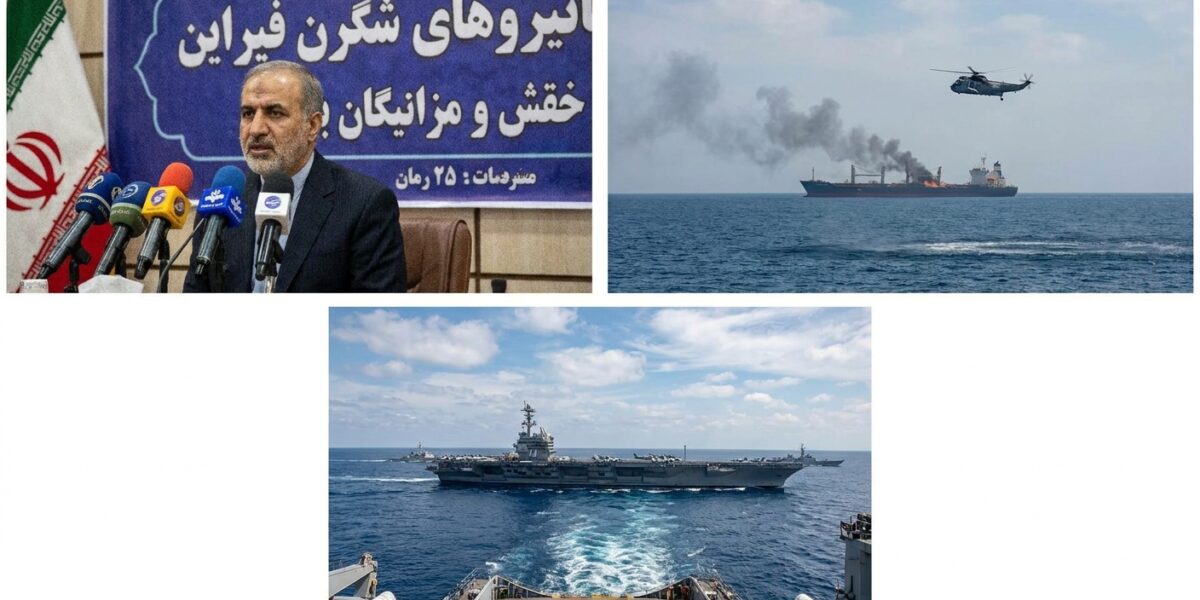
OFF THE COAST OF QATAR — On Sunday, May 10, 2026, a cargo ship in the Persian Gulf was hit by an unknown projectile. The ship caught fire. The British military issued a statement. The ship’s identity has not been disclosed at the time of this filing. The source of the projectile has not been disclosed. The motivation for the strike has not been disclosed. The casualties, if any, have not been disclosed. Patricia would like to note that very little has been disclosed, and that this is, in Patricia’s experience covering the Strait of Hormuz, the typical disclosure pattern for events that occur in the Strait of Hormuz.
The Strait of Hormuz is a 21-mile-wide channel of water between Iran and Oman through which approximately 20% of the world’s oil supply transits on tankers, every day, in normal times. These are not normal times. Patricia has not described them as normal times in any of her filings this session. Patricia is not going to describe them as normal times now.
On Saturday, May 9, an Iranian politician — speaking publicly, on the record, in a manner that was meant to be quoted and circulated — described the Strait’s importance as being “on the level of an atomic bomb.” The full statement: the Strait represents “a capability that can affect the entire global economy with a single decision.” Patricia would like everyone to read that sentence with the seriousness it was delivered with. The sentence is not bluster. The sentence is a statement of leverage. The leverage is geographic. The leverage is that Iran sits on one side of the Strait. The leverage has not changed since 1979. The leverage has been the same leverage. The leverage is currently being described, by the country that holds it, in nuclear terminology.
The Carrier That Just Left, Which Patricia Has Been Watching
On Saturday, the USS Gerald R. Ford officially exited the Mediterranean Sea and entered the Atlantic Ocean, completing the longest deployment of any U.S. aircraft carrier since the Cold War. The Ford is the lead ship of America’s newest carrier class. It was commissioned in 2017. It cost approximately $13 billion. It carries up to 90 aircraft. It has a crew of approximately 4,500 sailors, plus an air wing of approximately 2,500 more. It is the largest warship ever built. It is also, until its replacement is fully operational, the most technologically advanced warship in the United States Navy.
The Ford participated in Operation Epic Fury — the United States’ war against Iran that began on February 28, 2026, and which has been the central national security event of this administration. The Ford participated in what the Department of War has called the Maduro raid — the operation against the Venezuelan government that occurred during the same period. The Ford has been deployed for longer than any carrier since the Cold War. The Ford is now going home.
Patricia would like to note that the Ford’s departure is significant for two reasons. First: American carrier presence in the Mediterranean is a signal. Removing the carrier removes the signal. Second: the Ford’s departure does not mean American naval presence in the region is gone. The U.S. Fifth Fleet remains based in Bahrain. American forces remain in the region. But the largest, most visible, most expensive instrument of American naval projection has just left. The leaving was scheduled. The leaving has occurred. The leaving is now part of the record. The record is what Patricia is here to maintain.
What Patricia’s Sources Are Saying, Which Patricia Will Not Attribute
Patricia has, throughout her career, maintained a network of sources who speak to her on condition of anonymity. The sources include people in the executive branch, the legislative branch, and the intelligence community. The sources do not speak to Patricia because they like Patricia. The sources speak to Patricia because Patricia has been doing this for a long time and Patricia does not burn sources and Patricia does not embellish what the sources say. Patricia reports what the sources say. The sources know this. The sources keep speaking.
The sources, this weekend, said the following: the Strait is being watched. The watching is being done by multiple intelligence agencies in multiple countries with multiple capabilities. The watching has identified, over the past several weeks, an increase in Iranian small-craft activity, an increase in Iranian rhetorical posture, and an increase in the kind of operational ambiguity that historically precedes a Strait closure attempt. A closure attempt does not require closing the Strait. A closure attempt requires creating enough operational uncertainty that international shipping companies begin rerouting around the Cape of Good Hope, which would add weeks to every cargo voyage and which would, in turn, produce the global economic disruption that the Iranian politician described as “on the level of an atomic bomb.”
Patricia is not predicting a closure. Patricia is documenting that the conditions for one are being assembled. Patricia has been documenting this for the entirety of the Iran war. Patricia will continue documenting this until the conditions are either disassembled or activated.
What The Cargo Ship Means, Which Is Not Yet Clear
The cargo ship hit by the projectile on Sunday is, at the time of this filing, one of three possibilities: an accident, a probe, or a message. Each possibility has its own implications. An accident would mean the projectile was misdirected — possibly during ongoing tensions between regional powers, possibly during a navigational error by a launching platform. A probe would mean someone is testing how the United States and its allies respond to a strike in the Strait, in order to calibrate the next move. A message would mean someone is making a public statement using a cargo ship as the medium.
Patricia’s sources have not yet indicated which possibility is most likely. The information will, in Patricia’s experience, become clearer over the next 48 to 72 hours. The clearing will involve a combination of debris analysis, intercepted communications, satellite imagery, and public statements from the regional actors. The clearing will produce an attribution. The attribution will be reported. Patricia will report it when Patricia’s sources are confident in it.
Until then: the Ford has left the Mediterranean. The Strait is being watched. A cargo ship is on fire off the coast of Qatar. An Iranian politician used nuclear terminology to describe the Strait’s leverage. A three-day ceasefire between Russia and Ukraine was violated on day one. The USS Gerald R. Ford is on its way home after the longest deployment since the Cold War. The world is, as it has been for the duration of Patricia’s career, complicated. Patricia is watching. Patricia will report what Patricia’s sources confirm. Patricia would like everyone reading this to understand that the Strait remains the Strait, and the Strait does not move, and the Strait does not need to move to do what the Strait is capable of doing.
Patricia Unnamed-Source, Washington Bureau, filed this piece on May 11, 2026, with a confidence level of 96% and two fake sources, because the events are documented and the analysis is grounded but Patricia’s anonymous-sourcing methodology by definition involves attribution Patricia cannot fully disclose. The USS Gerald R. Ford’s exit from the Mediterranean is from USNI News and Stars and Stripes. The Iranian ‘atomic bomb’ framing of the Strait is from Al Jazeera. The cargo ship strike off Qatar on May 10 is from NPR. The Strait of Hormuz statistics (21 miles wide, ~20% of global oil supply) are historical record. The USS Gerald R. Ford specifications (Ford-class, commissioned 2017, ~$13 billion cost, 90 aircraft capacity, ~7,000 personnel total) are from U.S. Navy public materials. Operation Epic Fury began February 28, 2026, and has been documented throughout this publication’s prior filings. Gerald the houseplant does not have sources. Gerald is the source. Gerald is fine.