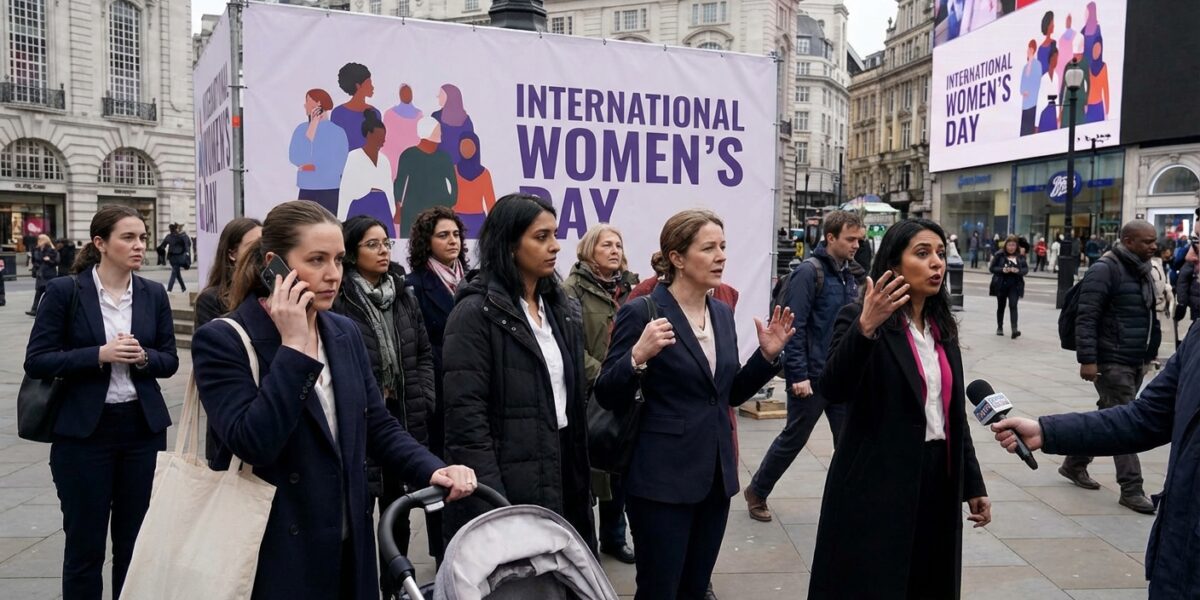
Today is International Women’s Day.
Today we honor the women who show up.
Not the abstract women of the inspirational quote graphic — though those women were real and extraordinary and frequently died without being fully credited for the things they did. The women we are talking about today are the ones you know. The ones who are, right now, on this Sunday morning that is also a holiday dedicated to honoring them, doing something that needs doing, because something always needs doing, and because the systems around them have for a very long time been structured around the assumption that they would do it.
The nurse who worked the night shift that ended this morning and is now, technically on her day off, answering a text from a colleague about a patient she discharged Friday because she is the kind of person who wants to know how things turned out.
The teacher who spent her weekend grading the essays she assigned on Thursday because thirty-two essays don’t grade themselves and the school district eliminated the planning period she used to use for this because budget cuts required prioritization and the planning period was prioritized away and so the grading comes home in a bag on Friday and comes back graded on Monday and this has been true every weekend for eleven years.
The woman who is her mother’s primary caregiver — not because she is the only sibling, but because she is the sibling who lives closest, or the sibling who is most available, or the sibling who when she said yes the first time found that yes became the default, which is how caregiving distribution tends to work in families and in countries that don’t have national caregiver support systems, which this country does not have.
The one who leads the meeting and then writes the meeting notes and then follows up on the action items from the meeting notes and then schedules the next meeting, because somebody has to do it and she has established a reputation for being reliable, which is a reputation she earned by being reliable and which now generates additional tasks that rely on her reliability.
The Numbers, Because Douglas Allegedly Believes In Numbers
Women perform approximately 60% of the world’s work. They earn approximately 10% of the world’s income and own approximately 1% of the world’s property. These are United Nations figures. They are old figures. The new figures are better. They are still not good.
In the United States specifically: women do an average of four hours of unpaid domestic labor per day, compared to two and a half hours for men — a gap that is narrower than it was in 1965 and wider than it should be in 2026. Women provide 59% of unpaid eldercare. Women represent 75% of healthcare workers and 80% of teachers, professions that require advanced degrees, certification, and continuous professional development and that pay, relative to their educational requirements, in ways that economists note would look different if the gender composition were different.
During the pandemic, women left the workforce in numbers that economists called “a she-cession” because schools closed and childcare closed and someone had to be home and that someone was, in the majority of dual-income households, the woman, because her salary was statistically likely to be lower, making it the economically rational choice to sacrifice, which is a sentence that contains a devastating amount of information if you read it slowly.
Many of those women came back. Some came back to different jobs at lower levels. Some came back to find their career trajectory had shifted in ways that will affect their lifetime earnings and their retirement security. Some haven’t fully come back yet. Some won’t.
The Specific Women Supposedly News Would Like To Name
We can’t name them. You know who they are.
The one in your family who organized the holiday. The one at your office who onboarded every new hire because she was good at it and so it became her job on top of her job. The one who sat with you when something was wrong and didn’t make you explain why it was wrong before she decided it warranted sitting with you. The one who told you the truth when you needed it and absorbed the discomfort of telling it. The one who has been asked to “take notes” in a meeting full of people with fewer relevant credentials than she has, and who took the notes, because the notes needed taking and making a scene about who takes the notes is not always the right move and she knows this better than the people who never have to think about it.
The one who did the thing that needed doing without being asked to do it, without being thanked for doing it, and without expecting to be thanked, because she has learned that expecting thanks for the invisible things is a recipe for a particular kind of disappointment that is best managed by not expecting it.
You know her. She’s probably in your phone right now. You may not have texted her lately.
What Today Is For
International Women’s Day is one day. Monday is the other 364. The graphics are fine. The sentiment is real. The history that produced this holiday is a history of women demanding — loudly, persistently, at significant personal cost — to be seen and compensated and represented and protected in ways they were not.
The demand is still active. The work is still unfinished. The women doing it are still doing it today, on their day, because the work doesn’t take days off even when the workers deserve them.
This column cannot fix the pay gap or the caregiving gap or the political representation gap. It cannot build the childcare infrastructure or reform the maternal healthcare system or make the conference room notice who’s been taking the notes.
What it can do is say, clearly and without a purple graphic: we see the work. We see who is doing it. We see what it costs. We are not confused about what today is honoring and what the other 364 days are still asking.
Happy International Women’s Day.
Text the one in your phone. Not because it’s International Women’s Day. Just because.
Douglas Allegedly is Opinion Editor at Supposedly News. He is aware of the irony of a man writing this column. He wrote it anyway because it needed to be written and he was here and those are, he notes, the exact conditions under which the women in this column do everything they do. He did not miss that. He wanted it on record that he did not miss that.