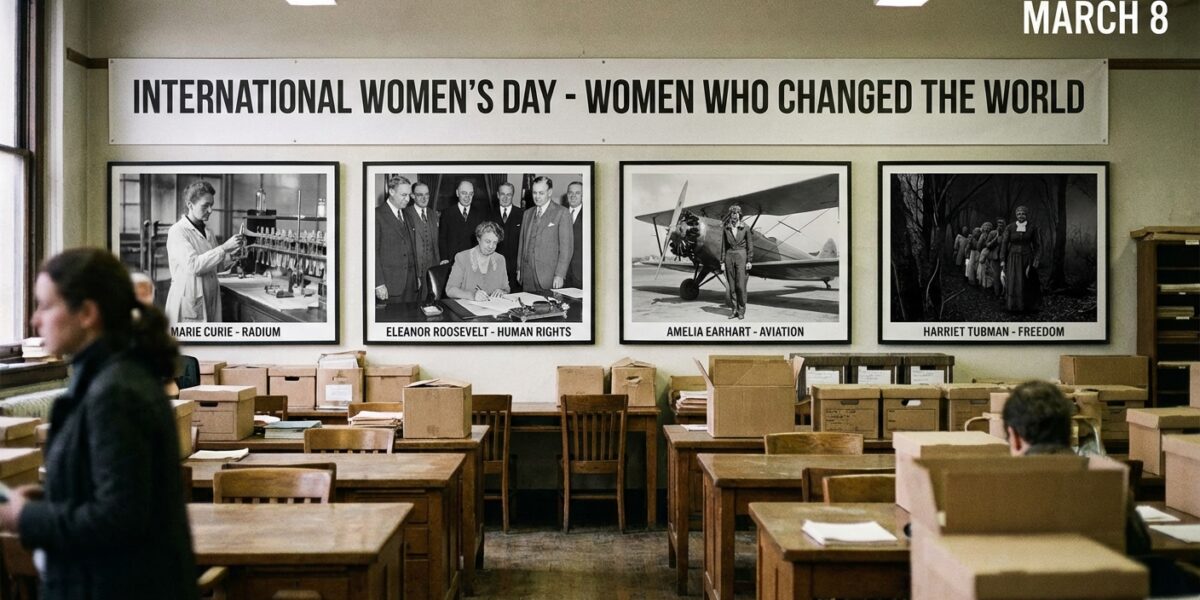
Today is International Women’s Day, and somewhere, possibly on a motivational poster in a dentist’s waiting room, a quote from a remarkable historical woman is being attributed to the wrong person. This is our annual tradition alongside the purple graphics and the yogurt posts, and Supposedly News intends to honor the day properly by acknowledging several women of history whose contributions to civilization were so significant, and whose treatment by the historical record so inadequate, that a single day of recognition barely covers the interest on the debt.
We will try anyway.
Marie Curie, Who Won Two Nobel Prizes And Was Still Denied Entry To The French Academy Of Sciences Because She Was A Woman, Which The French Academy Of Sciences Did Not Correct Until 1979
Marie Curie discovered polonium and radium. She won the Nobel Prize in Physics in 1903 and the Nobel Prize in Chemistry in 1911, making her the first person — not the first woman, the first person — to win Nobel Prizes in two different sciences. She developed mobile X-ray units during World War I that saved an estimated one million soldiers’ lives. She did this while being the only woman in most of the rooms she was in, including the room where she received her first Nobel, where she was seated next to her husband Pierre rather than at the laureate table because the committee initially planned to award the prize to Pierre alone before a colleague intervened.
She was not admitted to the French Academy of Sciences despite her two Nobel Prizes. The Academy voted on her admission in 1911. She lost by two votes. She was not admitted. The French Academy of Sciences began admitting women in 1979. Marie Curie had been dead for 45 years. Her daughter Irène Joliot-Curie, who also won a Nobel Prize in Chemistry, was also not admitted to the French Academy of Sciences during her lifetime.
The Curie family has two Nobel Prizes in Chemistry and one in Physics. The French Academy of Sciences has a complicated relationship with this fact.
Rosalind Franklin, Whose X-Ray Crystallography Image Enabled The Discovery Of DNA’s Structure And Who Is Sometimes Mentioned In The Same Sentence As The Men Who Won The Nobel Prize For It
Rosalind Franklin’s X-ray diffraction photograph of DNA, known as Photo 51, was the key experimental evidence used by Watson and Crick to determine the double helix structure of DNA. It was shared with them, without her knowledge or consent, by her colleague Maurice Wilkins. Watson and Crick won the Nobel Prize in Physiology or Medicine in 1962. Wilkins shared the prize. Franklin did not; she had died of cancer in 1958 at age 37, and the Nobel Prize is not awarded posthumously.
Watson, in his 1968 memoir about the discovery, described Franklin in terms that historians characterize as “uncharitable” and that readers who have encountered the passages characterize as something they cannot say at a family publication.
Franklin’s contribution to the discovery of DNA’s structure is now widely acknowledged. It was less widely acknowledged while she was alive, working in a laboratory where she was reportedly not permitted to eat lunch with her male colleagues because the lunch room was men-only, which is a sentence about a Nobel Prize-adjacent scientist in the 1950s that still requires a moment.
Harriet Tubman, Who Freed Approximately 70 People From Slavery Via The Underground Railroad, Never Lost A Passenger, And Also Served As A Union Spy During The Civil War, Which Many People Do Not Know
Harriet Tubman made approximately 13 missions into slave states and freed approximately 70 enslaved people through the Underground Railroad. She reportedly said: “I never ran my railroad off the track and I never lost a passenger.” This is either a quote she said or a quote attributed to her — Reginald P. Farnsworth notes the sourcing is imperfect — but it is the kind of thing she would have said, and the underlying claim is accurate: nobody she guided to freedom was returned to slavery.
During the Civil War, she served as an armed scout and spy for the Union Army. In 1863, she led the Combahee River Raid, in which she guided Colonel James Montgomery and 150 Black Union soldiers in a raid that liberated more than 700 enslaved people in a single operation. She is believed to be the first woman in American history to lead an armed military raid.
She applied for a military pension for her Civil War service. She was denied. She applied again. She was denied again. She eventually received a widow’s pension from her husband’s service. She never received a military pension for her own. She died in 1913. Congress awarded her a Congressional Gold Medal in 2003, ninety years later, which is the kind of gesture that arrives too late to be useful and too late to be declined and must therefore simply be noted.
The Women Whose Names We Do Not Know
History has a significant filing problem. The filing problem is structural: the people who decided what got written down and preserved and credited were, for most of recorded history, primarily men, operating in systems that primarily valued the contributions of men, recording events in ways that primarily centered men, and the result is an archive that is a reasonable record of what men did and a significant undercount of what everyone else did.
The women who built things and grew things and taught things and healed things and organized things and kept things running and raised the people who eventually got their names in the record — most of them are not in the record. Not because they didn’t exist. Not because the work wasn’t essential. Because the recording systems were not built to capture it.
We are, in 2026, still reconstructing. Historians are still finding the names. Scientists are still identifying the contributions. The record is being corrected slowly, and what’s being discovered, consistently, is that the contribution was larger than the credit suggested.
It was always larger.
What They Would Think Of The Yogurt
Reginald P. Farnsworth, Senior Correspondent, has spent some time this morning considering what Marie Curie, Rosalind Franklin, and Harriet Tubman would make of International Women’s Day as currently practiced, including the yogurt.
He believes Curie would find it interesting and insufficient and would immediately ask what the concrete policy demands are.
He believes Franklin would be characteristically precise in her assessment and would want to review the data before commenting.
He believes Tubman would not be surprised by any of it, would have seen worse, would ask what is being done about it rather than what is being said about it, and would already be doing it before the question was finished.
He believes all three would have something pointed to say about the yogurt.
He believes they would be right.
Happy International Women’s Day. The record is still being corrected. The work is still unfinished. The women of history did not wait for a better moment. Neither, presumably, will the women of today.
Reginald P. Farnsworth, Senior Correspondent, holds this to be one of the more important pieces he has filed. He is aware that is a low bar given that he recently covered Gerald the houseplant. He stands by both.