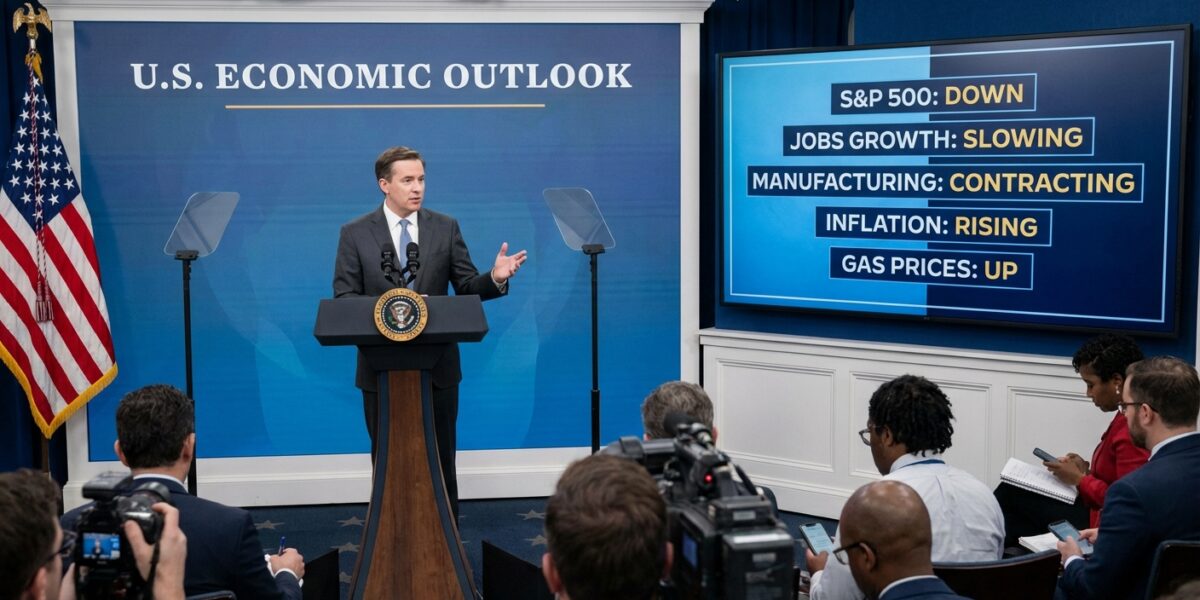
WASHINGTON, D.C. — The American economy is strong, resilient, and on the right track, administration officials confirmed Wednesday, marking the latest in a series of confirmations that have remained consistent regardless of the incoming data, which is either a sign of conviction or a sign of something else, and which economists are, as a group, too polite to name directly in press releases but not too polite to name in footnotes.
The S&P 500 has declined more than 3% in 2026. Manufacturing activity has contracted for nine consecutive months, according to the Institute for Supply Management. The U.S. economy added 181,000 jobs in all of 2025 — the lowest figure, excluding the pandemic, since 2009, which was the year the financial crisis was actively happening. PCE inflation, the Federal Reserve’s preferred measure, hit 2.9% in December 2025, its highest reading since March 2024. The stock market’s valuation, measured by the cyclically adjusted price-to-earnings ratio, reached its highest level since the dot-com crash in September 2000 — a milestone that financial historians describe as “notable” and that investors over 45 describe using different words.
The gas price, which had generally declined, went back up when the United States started a war in a region that contains a meaningful percentage of the world’s oil supply, which is an outcome that was predicted by economists with the calm confidence of people who have seen this happen before and who were not surprised.
“Everything is fine,” said nobody officially, though the general thrust of official communications this week was in that direction.
The Tariff Situation, For Reference
The administration’s tariffs have raised the average tax on U.S. imports to approximately 13% — near the highest level in ninety years. The administration has consistently argued that tariffs benefit American consumers and workers. Goldman Sachs has calculated that U.S. companies and consumers paid 82% of the tariff costs in October 2025. The Congressional Budget Office has stated that the tariffs will result in real GDP that is lower than it would otherwise be. The administration has described these assessments as incorrect.
The administration has described the tariffs as an “economic miracle.” The Institute for Supply Management has described U.S. manufacturing activity as having contracted for nine consecutive months. These descriptions refer to the same economy. Both were published this year. They have not been reconciled.
Goldman Sachs projects that 67% of the tariff burden will fall on consumers by July 2026. If this projection is correct, the miracle will primarily be experienced by the portion of the economy that is not the consumers. Reginald P. Farnsworth, Senior Correspondent, would like to know who that is, and how they are enjoying it, and whether they are the same people who said it would be a miracle, because the timing would be worth examining.
The Federal Reserve, Meanwhile
The Federal Reserve has held interest rates steady at 3.5% to 3.75% following three rate cuts in late 2025. The president has expressed a preference for lower rates. The Fed has not lowered them. The president has continued to express this preference. The Fed has continued to hold them. This dynamic has been ongoing for several months and shows no sign of resolution, which is either a sign of Fed independence or a preview of a significantly more interesting situation, depending on which economists you read and whether you read their footnotes.
Kevin Warsh, whom markets expect to eventually chair the Federal Reserve, has historically been hawkish on inflation — meaning he favors higher rates, not lower ones, which is the opposite of what the president wants — a detail that one economist summarized as: “If Trump wants someone easy on inflation, he got the wrong guy in Kevin Warsh.” This summary is accurate. The situation it describes is ongoing.
What To Do, Per The Financial Analysts
Financial analysts this week offered the following guidance for the current economic moment, synthesized by Supposedly News from multiple sources into a single coherent recommendation:
Don’t panic. Also be cautious. Also don’t try to time the market. Also the market is at its most expensive valuation since the dot-com crash. Also don’t sell everything. Also build a cash position. Also the biggest gains happen when the news is worst. Also the news is currently not great. Also recession probability by January 2027 is 18.7%, which is either reassuring or a number you will think about at 3 a.m.
Reginald P. Farnsworth has synthesized this guidance into a single sentence: things are uncertain, which is always true and is more true than usual, and the people paid to have opinions about it have opinions that are not fully consistent with each other, which is also always true and is also more true than usual.
The economy is doing great. The economy is flashing warnings. The economy is resilient. The economy is the worst jobs market since 2009 excluding a pandemic. All of these statements were made this week. The economy has not clarified which of them is correct. The administration has a view. The data has a view. They are attending different briefings and emerging with different summaries, and nobody, as of press time, has fully reconciled them.
Gerald the houseplant declined to comment. Gerald has been through market cycles before. Gerald is fine.
Reginald P. Farnsworth, Senior Correspondent, covers economics with the confidence of a man who has read enough financial analysis to know that the analysis frequently disagrees with itself and that this is, technically, the system working. He holds no financial positions. He holds several opinions. He is keeping most of them in a footnote.