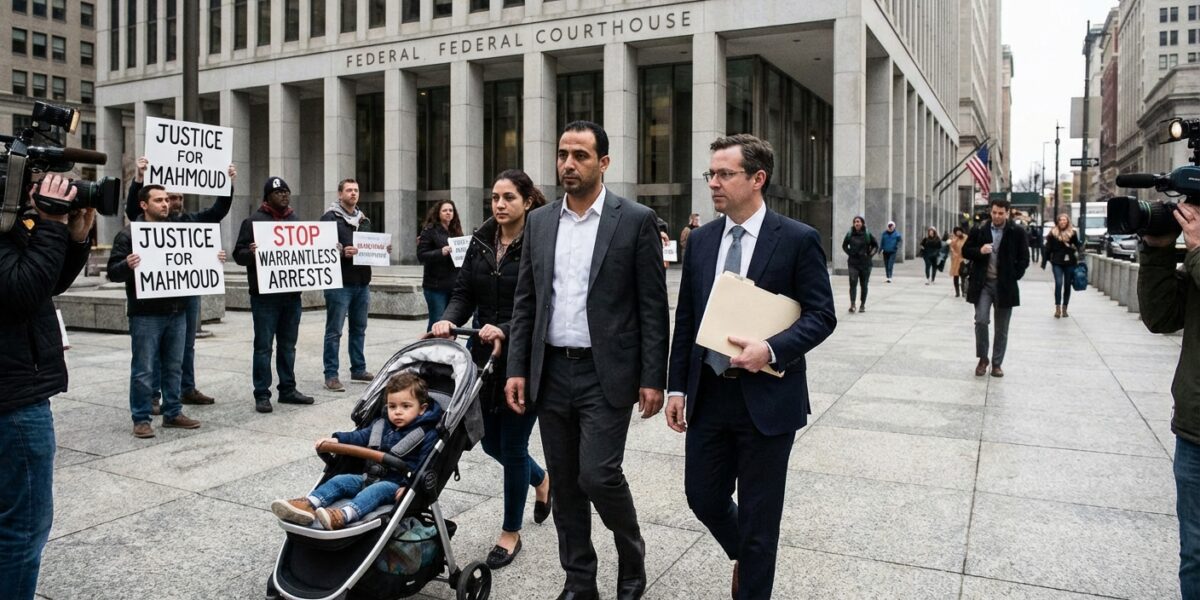
One year ago, federal immigration officers arrived at the New York apartment of Mahmoud Khalil, a legal permanent resident and Columbia University graduate student who had served as a negotiator during campus protests. They placed him in an unmarked car without showing a warrant. His wife — a U.S. citizen, eight months pregnant — ran upstairs to retrieve his green card and papers. The officers were not interested in the papers. They drove him away.
“When this happened, in my head, I was so calm,” Khalil told NPR, “because I knew that maybe an hour or two hours I would be out after they verified everything.”
He was in immigration detention for 104 days. He missed his son’s birth. He helped his wife pick out the baby’s name from a detention facility. The government did not charge him with a crime during those 104 days. The government has not charged him with a crime in the 365 days since his arrest. This is not for lack of trying. The government has tried several other things instead.
The Legal Theories, In Order
Legal Theory One: Secretary of State Marco Rubio deployed a rarely used 1952 statute to declare that Khalil’s presence in the United States had “potentially serious adverse foreign policy consequences.” A federal judge in New Jersey found this likely unconstitutional, concluding that the administration was penalizing Khalil for protected political speech. The judge blocked his deportation on this basis. The administration appealed.
Legal Theory Two: While the appeal was pending, the administration adopted a new justification: Khalil had allegedly misrepresented information on his green card application by failing to disclose work he did for the British Embassy and a United Nations agency that assists Palestinian refugees. Khalil and his lawyers say his U.N. work was an internship supervised by Columbia University and was not required to be disclosed. The district court rejected this justification too and ordered his release. The Third Circuit Court of Appeals subsequently, in a 2-1 decision, overturned the district court rulings on jurisdictional grounds — finding the lower court lacked authority to rule on the merits until immigration court proceedings were complete. This did not resolve whether the charges were valid. It resolved who gets to decide first.
Legal Theory Three, Current: The administration sustained the green card application charges. Khalil’s legal team, now numbering more than twenty attorneys, filed an appeal to the Board of Immigration Appeals arguing the charges are retaliatory and baseless. A federal court order prohibiting the government from re-detaining or deporting Khalil while his federal case proceeds remains in effect. The case is simultaneously in federal court and immigration court, which are different systems with different rules and different timelines and which together constitute what Khalil’s own lawyer describes as a situation designed to deny him due process by weaponizing immigration proceedings.
“They chose immigration proceedings against me rather than any other avenue,” Khalil said. “Basically, by weaponizing immigration, they can deny me due process.”
The First Amendment Situation
The First Amendment applies to everyone in the United States, not exclusively to citizens. This is settled constitutional law. Legal permanent residents, visa holders, and undocumented individuals all retain First Amendment protections. Immigration attorney Eric Lee, who has been tracking the case, put it plainly: “The First Amendment is not a dial. It’s either on or it’s off.”
What the case turns on, ultimately, is whether the government can use immigration proceedings to accomplish what the First Amendment would not permit it to accomplish directly — that is, to silence or remove a person because of speech the government finds politically inconvenient. Federal courts have found, twice, that the answer is no. The Third Circuit found, on procedural grounds, that the question needs to be asked in a different court first. That court is now being asked. The answer has not yet arrived. Khalil is still here, still fighting, still wearing a baseball cap to cover his face when he goes outside, still not going out alone with his son for fear of being detained again.
“One year after,” Khalil said, “the government has not charged me with any crimes or presented any evidence that I committed wrongdoings whatsoever.”
This is accurate. It is verifiable. It is stated by a man who has had a year and more than twenty lawyers to review it and has not found a crime in the record because the government has not placed one there.
What Happens Now
His son turns one in April. Eid al-Fitr falls in mid-March. Khalil has said these are his biggest fears — that he will not be present for them. The federal court order currently protects him from re-detention while the case proceeds. The case is proceeding. The Board of Immigration Appeals will rule. A federal court will rule. The Third Circuit may be asked to weigh in again. New York Mayor Zohran Mamdani has asked the president to drop the case. The president has not dropped the case.
A ruling in the Khalil case could affect the rights of every non-citizen in the United States to engage in political speech. It is among the more significant First Amendment cases in decades, proceeding through multiple simultaneous court systems, involving a man who has not been charged with a crime, whose detention was funded by taxpayers, whose wife filmed his arrest from their apartment building while eight months pregnant, and who spent 104 days detained while his legal team tried to locate which legal theory the government would deploy next.
The current theory is the third one. The first two did not hold. Douglas Allegedly will report on the third when there is a ruling. He expects there will be a ruling. He does not know when. The case has a one-year head start on that answer and has not produced it yet.
Douglas Allegedly, Opinion Editor, considers this piece to be reporting more than opinion, and notes the distinction with the confidence level of 96, which is the highest he has assigned to a piece this year, and which reflects his assessment that the documented facts speak clearly enough that they require minimal editorializing, and considerable attention.