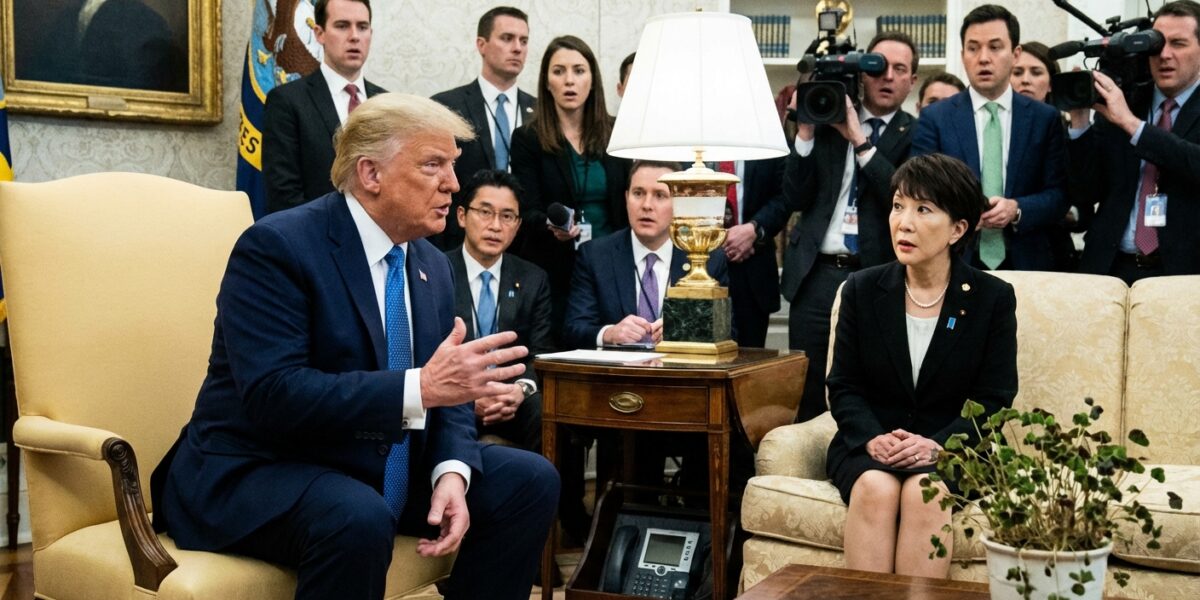
The question was reasonable. A reporter asked why the United States had not notified allies — including Japan — before launching strikes on Iran on February 28, the war now entering its twentieth day.
The answer began reasonably: “You don’t want to signal too much. We went in very hard and we didn’t tell anybody about it because we wanted surprise.”
This is a defensible position. Operational security in military planning is a real and documented concept. Some allies were briefed. Others were not. The decision not to pre-notify every ally before a surprise military strike has historical precedent and strategic logic. The press conference was going fine.
Then the president raised his voice.
“Who knows better about surprise than Japan?”
Some people in the room laughed. Prime Minister Sanae Takaichi, who was seated directly beside the president of the United States, having traveled from Japan to the White House specifically to strengthen the U.S.-Japan alliance at a critical moment, did not laugh. She shifted in her chair. Her eyes widened.
“Why didn’t you tell me about Pearl Harbor, OK?”
The room went quiet.
“You believe in surprise, I think, much more so than us,” Trump continued.
Takaichi’s demeanor stiffened. Japan’s surprise attack on Pearl Harbor on December 7, 1941 killed 2,335 Americans, wounded nearly 1,200 more, sank or damaged 19 naval vessels, and precipitated the United States’ entry into World War II, ultimately resulting in the atomic bombings of Hiroshima and Nagasaki, the deaths of approximately 200,000 Japanese civilians, Japan’s unconditional surrender, and a 1947 constitution imposed by the United States that to this day prohibits Japan from maintaining a military capable of offensive war — a constitution that was cited this week as a primary reason Japan cannot send warships to help secure the Strait of Hormuz, which was the thing Trump was asking Japan to help with when he made the Pearl Harbor joke, while sitting next to Japan.
The logical chain of this moment contains several links. Reginald P. Farnsworth has examined all of them. He is going to need a moment.
What The Moment Was Trying To Accomplish, Charitably Reconstructed
The president was, in context, attempting a joke. The structure of the joke was: you understand surprise tactics because you used one on us in 1941. This is, as comedy constructions go, a callback — a reference to shared history that acknowledges a prior event to make a contemporary point. The contemporary point was: operational security is important and the U.S. exercised it by not pre-notifying allies.
The problems with this particular callback, delivered to this particular audience, are as follows:
Problem One: The Japanese attack on Pearl Harbor was a surprise attack that killed 2,335 Americans. Invoking it as a lighthearted illustration of a military strategy point, while the person who represents the nation that conducted the attack sits next to you, is a tonal calibration that did not succeed in the room, as documented by the widened eyes, the shifted posture, the stiffened demeanor, and the subsequent silence.
Problem Two: The parallel being drawn — U.S. surprise strike on Iran, Japanese surprise strike on Pearl Harbor — is not a parallel that the U.S. side of the conversation would ordinarily want to make explicit. The U.S. has spent eighty-five years characterizing Pearl Harbor as a sneak attack that forced it into a war. Drawing a direct comparison between the U.S.’s own surprise military action and Pearl Harbor is either an act of unusual candor or a rhetorical miscalculation, and the room’s silence suggested the audience was processing which.
Problem Three: Japan’s constitution, which currently prevents it from contributing naval forces to the Strait of Hormuz — a thing Trump was actively requesting and frustrated about — was written by the United States after World War II, which Japan lost after Pearl Harbor, which the president just referenced. The constitutional limitation on Japanese military action that Trump is annoyed by is a direct consequence of the historical event Trump made a joke about while sitting next to Japan. This is a circle that closes very quickly and Reginald would prefer it open slightly but it does not.
The Prime Minister’s Schedule, Which Becomes More Uncomfortable In Retrospect
Prime Minister Takaichi had been warned before leaving Japan that the meeting would be “very difficult.” She had traveled to Washington to strengthen the alliance, manage the Iran war’s economic impact on Japan — which is significant, given Japan’s dependence on Persian Gulf energy — discuss a planned $40 billion nuclear reactor deal, and ideally redirect Trump’s public complaints that Japan was not doing enough to help with the Strait.
She sat next to the president for approximately thirty minutes. During that time, he was asked multiple questions about the Iran war, the Strait of Hormuz, and Japan’s alliance contributions. He noted that Japan was “stepping up to the plate,” which is a baseball metaphor that landed without apparent incident. He noted that Japan was doing more than NATO, which is a comparison he returns to with regularity. He said the defense budget request would be $200 billion, and that the world is “very volatile.”
And then a reporter asked about the element of surprise, and the president chose Pearl Harbor as the illustrative example, and Takaichi’s eyes did the thing they did, and the room went the way it went.
She was observed checking her watch at one point during the proceedings. This is also documented. Reginald notes it without commentary. The watch was checked. The time was noted. Whatever the time was, it was noted.
The Diplomatic Record, For Future Reference
The United States and Japan are treaty allies. The alliance has been a cornerstone of Pacific security for seventy-five years. Japan is one of the primary buyers of U.S. Treasury bonds. Japan is the third-largest economy in the world. The U.S.-Japan relationship is, by any diplomatic measure, among the most important bilateral relationships the United States maintains.
This is the relationship in which the president made the Pearl Harbor joke.
Senator Brian Schatz of Hawaii — where Pearl Harbor is located, where 2,335 Americans died, where the USS Arizona still rests on the harbor floor — issued swift backlash. His constituents live at the site the president used as a punchline. This is a specific form of political feedback that tends to be sharper than the general variety.
The prime minister flew home. The $40 billion nuclear reactor deal was announced. The alliance continues. Japan will consider “appropriate efforts” to help with the Strait of Hormuz, though what those efforts might look like given the pacifist constitution remains to be determined.
The shamrocks from the Irish Taoiseach’s visit on Monday are still somewhere in the White House. The crystal bowl is from the House of Waterford. Everyone is managing. The meeting is in the books. The joke is on the record. The room went quiet when it landed.
Reginald P. Farnsworth has covered a great many diplomatic moments. He has not previously covered one in which the U.S. president, in a press conference with Japan, invoked Pearl Harbor to explain a surprise military strike, while the Prime Minister of Japan was sitting next to him, and then noted that Japan believes in surprise “much more so than us.”
He did not have this one in his notes from the beginning of the year. He has it now. He will be keeping it.
Reginald P. Farnsworth, Senior Correspondent, filed this piece with a confidence level of 99% — one percent reserved for the possibility that there exists a diplomatic context in which the Pearl Harbor joke lands correctly, which Reginald acknowledges theoretically while being unable to identify it. Fake sources: 1, which is the diplomatic account of the room going quiet, because the cameras were present and the silence is documented and Reginald does not need a source for silence. Gerald the houseplant was told about the joke. Gerald’s eyes did the thing.