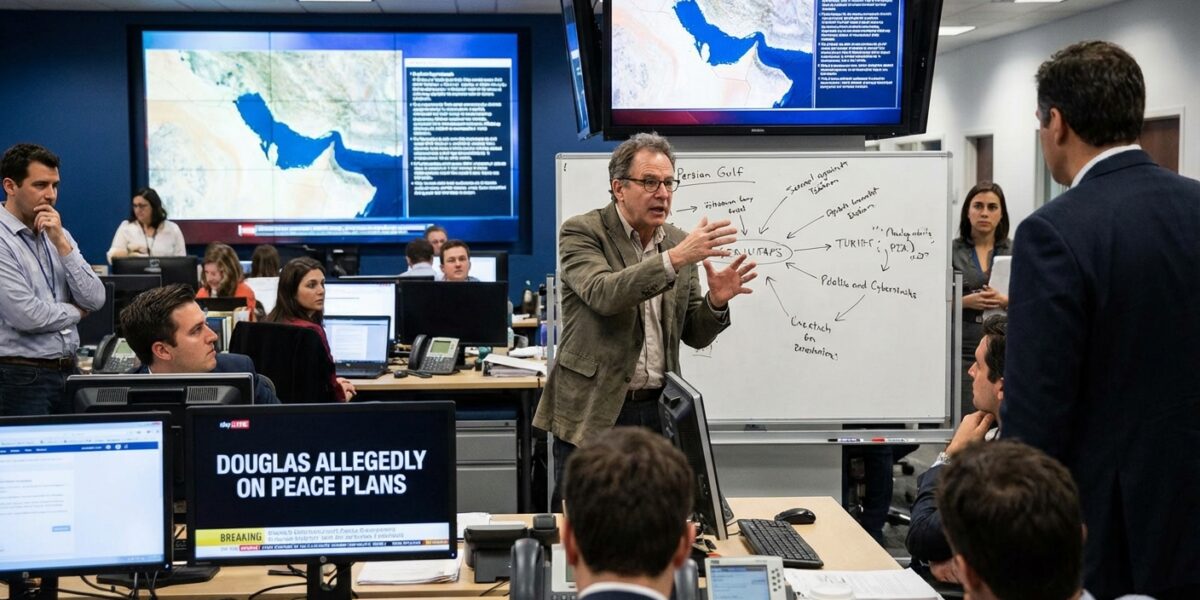
It takes approximately thirty days of active warfare to arrive at the point where two belligerent parties have each produced a formal written peace plan that the other side has described as unreasonable, excessive, or a cover for invasion. The United States and Iran have reached this point on schedule.
The U.S. plan has 15 points. The Iranian plan has 5 points. The plans do not appear to have been negotiated with each other in mind, which is technically how competing peace proposals work — each side describes what it wants and then a mediator locates the overlap. Pakistan is the mediator. The mediator has announced it is ready to host talks. Neither the United States nor Iran has confirmed it will attend those talks. Pakistan is therefore prepared to host a meeting between two parties who may or may not be coming, to discuss plans that each side has described as unacceptable, with the goal of finding overlap on a list of 20 total demands that currently share one item in common: the Strait of Hormuz, about which they disagree completely.
The Strait of Hormuz is approximately 21 miles wide at its narrowest point. Through it passes roughly 20% of global oil and gas. Both the U.S. peace plan and the Iranian peace plan include language about the Strait. The U.S. position is that Iran must open it. The Iranian position is that Iran maintains sovereignty over it. These are not positions that meet in the middle. The middle of a body of water that one party says it controls and the other party says it must relinquish control of is not a negotiable middle — it is a 21-mile strait with contested jurisdiction over every nautical mile.
The 15 Points, Which No One Has Published
No official text of the 15-point U.S. proposal has been released. NPR has not seen the 15 points. Reginald has not seen the 15 points. Patricia has not seen the 15 points. Douglas has not seen the 15 points. What is known: the plan includes opening the Strait, terminating Iran’s nuclear program, and sharp limits on Iran’s missile arsenal. Trump says Iran agreed to most of the points. Iran says the points are unrealistic. “Most” in this context appears to cover a range from 1 to 14, and given Iran’s characterization of all 15 as excessive, Douglas is inclined to locate “most” closer to 0 than to 14, though the official position remains “most.”
U.S. envoy Steve Witkoff confirmed the plan’s existence in a Cabinet meeting, describing it as “a 15-point action list that forms the framework for a peace deal.” He added: “If we can convince Iran that this is the inflection point with no good alternatives for them, other than more death and destruction, we have strong signs that this is a possibility.” Douglas would like to note that “strong signs that this is a possibility” is among the more cautious endorsements of a peace framework he has encountered in thirty years of reading diplomatic language, and that it contains within it approximately three separate conditional qualifiers that each need to resolve positively before the framework produces anything resembling a deal.
The 5 Points, Which Iran Has Published
Iran’s five points are available and include: an end to U.S. and Israeli aggression and assassinations, payment for war damages, a guarantee of Iran’s sovereignty over the Strait of Hormuz, and related conditions. The U.S. has not publicly responded to the five points. The five points and the fifteen points therefore exist simultaneously as the only two documents that could form the basis of a deal, with no official statement from either side about whether any of the other side’s points are acceptable.
Pakistan is in possession of both documents. Pakistan is ready to host. Pakistan has been described by multiple parties as constructive, cooperative, helpful, and an important regional voice. Pakistan is doing more diplomatic work in this situation than any party except the oil markets, which have processed the peace plan situation accurately and priced Brent crude at $116.
The Structural Problem, Which Douglas Is Identifying Because That Is His Job
A peace plan in which both sides’ primary demand is the opposite of the other side’s primary demand is not a peace plan — it is a documented list of incompatibilities with a cover page. The U.S. wants the Strait open. Iran wants sovereignty over the Strait. These cannot be simultaneously true in the way that, for example, nuclear de-escalation and improved trade relations can be simultaneously true. Sovereignty over a waterway and being required to open it to shipping are definitionally opposed.
This is the Strait problem. The Strait problem is the core of the 20 combined points. Everything else — nuclear program, missile arsenal, war damages, regional proxies — is negotiable in principle because both parties have expressed at various points a willingness to discuss it. The Strait has not been expressed as negotiable by Iran, because it is on their five-point plan as a guarantee of sovereignty, and the Strait has not been expressed as negotiable by the U.S., because it is on their 15-point plan as a requirement Iran must fulfill.
Pakistan is ready to host. The talks may or may not be direct. The 20 points may or may not include overlap. The Strait is 21 miles wide. Oil is at $116. The deadline is April 6. Douglas has the structural analysis. The structure is: two plans, one strait, zero overlap on the thing that matters most, and a mediator with a venue and a timeline and great optimism.
Gerald the houseplant reviewed both plans. Gerald had notes on neither. Gerald controls no waterways. Gerald is, therefore, the one party in this situation whose position on the Strait is genuinely neutral.
Douglas Allegedly, Opinion Editor, filed this structural analysis on day thirty. Confidence: 24%. Fake sources: 7. The 15-point plan exists per Witkoff’s Cabinet confirmation. The 5-point plan is documented by Time and the AP. No official 15-point text has been published — NPR confirmed this. The Strait is 21 miles wide at its narrowest — this is the documented figure. Pakistan is ready to host — documented. April 6 is the deadline — documented. Gerald controls no waterways.