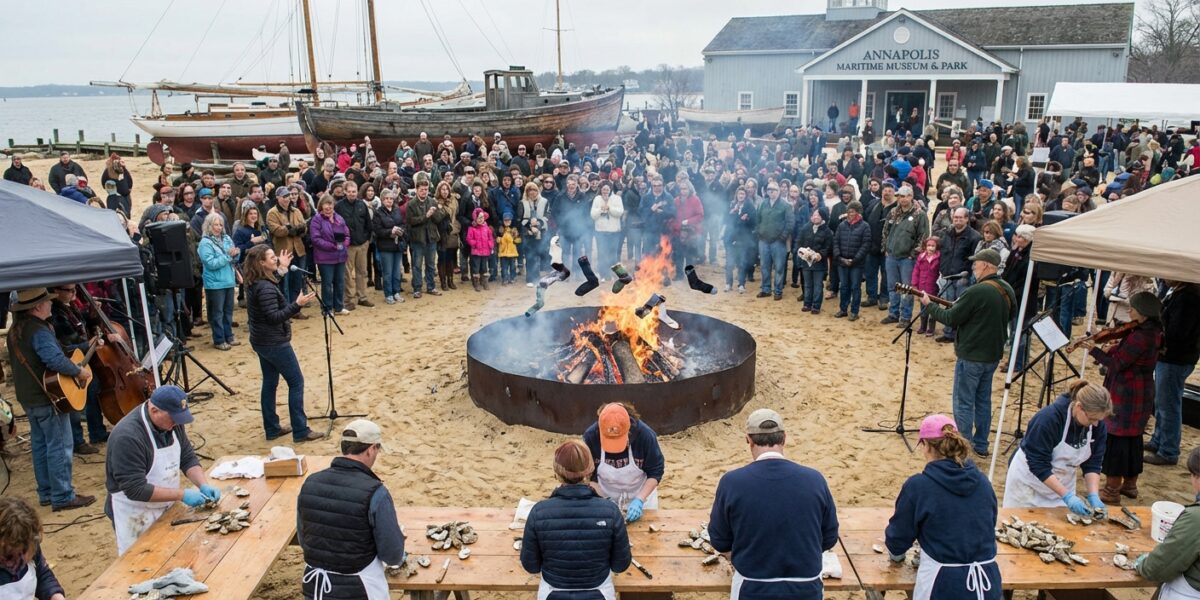
In Annapolis, Maryland, on Saturday, March 21, 2026, hundreds of people gathered on a beach at the spring equinox, listened to a poet laureate recite an “Ode to the Equinox,” watched live music from the Eastport Oyster Boys and the Naptown Brass Band, consumed a substantial quantity of Chesapeake Bay oysters, and then threw their socks into a fire.
This is the tradition. The Annapolis Oyster Roast & Sock Burning has been running for nearly fifty years, since 1977, when a boatyard worker named Bob Turner was so fed up with one of the coldest winters on record that he took his socks off, threw them into a bonfire, and told his coworkers he was not putting socks on again until next winter. The bay had frozen over. The Frostbite sailboat races had to be cancelled due to ice — which is a sentence that should never exist, because the Frostbite races are named after the cold, not cancelled by it, and the fact that they had to be cancelled because there was too much ice is the meteorological equivalent of a jazz musician being replaced because there was too much music. But here we are. The ice won. Bob Turner burned his socks. Fifty years later, hundreds of people are doing it annually with poet laureate accompaniment and oysters and a meaningful amount of alcohol.
Millicent Hearsay, Culture Desk, covers things that matter culturally. She has spent this month covering camel Botox, the White House OnlyFarms.gov launch, and thirty days of a war whose peace plan currently consists of 20 total points across two documents with zero agreed-upon items and one disputed waterway. She is now covering the sock burning, and she would like to state plainly: the sock burning is right. The sock burning is the correct cultural response to the current moment. The people of Annapolis, Maryland have been doing the correct thing for fifty years, and the rest of us are catching up.
What The Sock Burning Means, And Why It Is The Right Meaning
The sock burning began as one man’s statement about winter: I have had enough of this. I will not carry this discomfort forward into the new season. I am leaving it here, in the fire, and walking away. No socks until it is cold again. The statement required no policy. It required no peace plan. It required a fire, a sock, and the conviction that the old thing should be left behind.
For fifty years, the people of Annapolis have been making this statement annually, with increasing elaboration. The poet laureate Jefferson Holland recites: “So if you sail into the harbor on the 21 of March, and you smell a smell like Limburger mixed in with laundry starch… you’ll know you’re downwind of the Eastport docks, where they’re burning their socks for the equinox.” This is a poem about socks. It is also a poem about the end of things that needed to end. Millicent considers it the most functional philosophical document produced this week.
Scot Labin, an Annapolis resident who has been coming to the burning for years, described his sock selection process to NPR with the specificity of someone who has given this appropriate thought: “You’ve got the Egyptian cotton socks that your mom got you — those are going into the fire. With remote work these days, you don’t need the dress socks anymore. So those are going on the fire as well.” This is a man who has developed a taxonomy of things that should be released and has a mechanism for releasing them. The mechanism involves fire. The mechanism has been working for fifty years. It involves oysters and music and a poet and the Chesapeake Bay and a lot of people who are, at core, just very done with something and have found a way to be done with it formally.
The Parallel Text, Which Millicent Is Drawing Because It Draws Itself
This week: oil at $116. Two peace plans that disagree about who controls the body of water that determines the oil price. A president who says his favorite thing is taking the oil. A sock burner who says his favorite thing is watching the socks burn. “I like to watch the socks burn, something about that,” said Annapolis resident Mary Keller. The two statements have the same grammatical structure. Only one of them has a clear exit strategy. You watch them burn, you eat your oysters, you listen to the band, you are done with the old socks, you do not put socks on again until winter.
Compare: fifteen points, five points, zero agreed-upon points, twenty boatloads of oil, one deadline, one island possibly being seized, one waterway disputed by the two parties who both want it in their peace plan as a concession by the other side. The sock burning has never required a mediator. Pakistan has not been called in to facilitate the sock burning. The sock burning does not have dueling plans from opposing socks. The socks are identified, the socks are released, the socks burn. This is the process. The process works. It has worked since 1977.
The Oyster Shucking Detail, Which Is Also Relevant
Mike Dicus has been shucking oysters at the Annapolis Oyster Roast for thirty-five years. He shucked several thousand at this year’s event. He demonstrated “the Eastern Shore stabbing style” — you come in from the front, not the back, “give it a little wiggle,” and cut the two muscles. You come in from the front. You give it a little wiggle. You cut what needs to be cut. The oyster opens. You eat the oyster. This is not a metaphor. This is an oyster technique. But it is also, Millicent notes, a description of how most problems are actually solved — not from the back, with a 15-point plan, via Pakistani intermediaries, while simultaneously musing about taking the oil — but from the front, with a direct approach, a little movement, and clarity about what needs to be separated.
Annapolis will burn its socks again next year. The tradition will continue regardless of what happens with the Strait of Hormuz or the oil price or the peace plans. Bob Turner started it in 1977 because he was done with winter. The tradition survived every subsequent winter. It will survive this one. Spring is here. The socks are gone. The oysters are excellent. Gerald the houseplant, who does not own socks, cannot participate in the burning, but Gerald is, as always, oriented toward the light, which is what this entire tradition is about.
Millicent Hearsay, Culture Desk, filed this piece with a confidence level of 100% and two fake sources — the parallel texts between the sock burning and the peace plan are her own observation and she is owning them. All sock burning details are from NPR’s March 26, 2026 reporting. Bob Turner is real. The poet laureate Jefferson Holland is real. The ode is real. Mike Dicus has been shucking for 35 years. Scot Labin’s Egyptian cotton sock commentary is verbatim. Mary Keller watches them burn. Millicent thinks Mary Keller is right. Gerald is oriented toward the light.