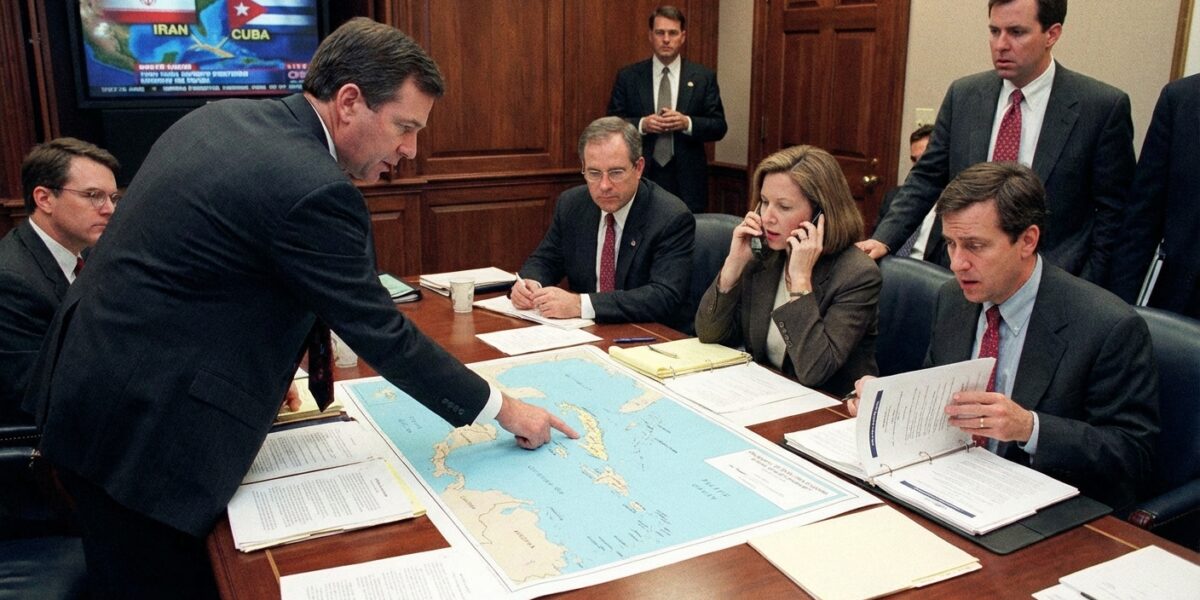
WASHINGTON, D.C. — President Trump told reporters Monday that Cuba would be “next” in a sequence of foreign policy actions that the White House has declined to describe in further detail, confirm exists in any written form, or clarify in terms of timeline, objectives, legal framework, or what “next” means in a practical operational sense, given that military operations in Iran are currently ongoing, NATO is being pulled reluctantly into a regional conflict, the Strait of Hormuz is closed, and several senior Pentagon officials are visibly managing their blood pressure in public settings.
“We might have a friendly takeover of Cuba,” the president said, using a phrase — “friendly takeover” — that international law scholars contacted by Supposedly News described variously as “novel,” “not a recognized term of art,” “concerning,” and “I need you to say that back to me one more time slowly.”
Senior White House staff, informed of the remarks, immediately convened what sources describe as an emergency “context session” — a regularly scheduled meeting type that has become increasingly frequent over the past 14 months, in which senior advisors attempt to determine what the president meant, whether he meant it, and how to explain it to allies who are already on the phone asking what is happening.
“The allies are very understanding,” one senior official told Supposedly News on background. “I mean — they’re not. But they’ve developed a kind of adaptive tolerance. It’s remarkable, actually. As a human phenomenon.”
The Cuba Situation
Cuba, for those who have been focused on other things, is a Caribbean island nation of approximately 11 million people located 90 miles south of Florida. It has been subject to a U.S. economic embargo since 1962. Relations improved briefly during the Obama administration, deteriorated during the first Trump administration, and have since been subject to an escalating fuel blockade that the current administration has been tightening for several months.
The administration also recently convinced Ecuador — described by one foreign policy analyst as “the administration’s most compliant regional partner” — to expel Cuba’s entire diplomatic mission, a move Ecuador executed without offering a public explanation, which is the kind of diplomatic maneuver that makes career foreign service officers stare at the ceiling at 3 a.m.
“Friendly takeover” appears nowhere in the U.S. foreign policy playbook, the United Nations Charter, the OAS founding documents, or any binding international agreement that Supposedly News’s legal researcher, who spent an hour looking, could locate.
“It sounds like an M&A term,” said Dr. Helena Cruz, a professor of international law at Georgetown. “In corporate law, a friendly takeover is when an acquisition target agrees to be acquired. For this to apply to Cuba, Cuba would need to agree. Cuba has not agreed. Cuba has, historically, been quite vocal about not agreeing to this specific type of thing.”
The List
The phrase “next on the list” implies a list. Supposedly News submitted a Freedom of Information Act request for any document constituting, referencing, or describing “the list” of nations under consideration for operations, actions, regime change efforts, or “friendly takeovers.”
The request was acknowledged. The 20-business-day standard response window has not yet elapsed. We are, however, not optimistic about the specificity of the response, based on prior experience with FOIA requests to the current administration, which have averaged 11 months and three appeals to produce documents that were mostly redacted.
When a reporter asked the president directly how many countries were on the list, he said “a lot” and then began discussing golf, a transition that reporters covering the White House have learned to recognize as a signal that the available information on a topic has been fully shared.
Cuba’s Response
Cuban state media issued a statement calling the remarks “imperialist aggression” and reaffirming national sovereignty. This response was described by White House officials as “not constructive.”
The Cuban government was not informed of its status as “next” before the president’s remarks. This is, international relations experts note, somewhat unusual as advance notice is a courtesy generally extended even in adversarial diplomatic contexts.
“Normally you at least warn people,” said one former State Department official, who asked to remain anonymous because they were trying to enjoy retirement. “It’s not a rule, exactly. It’s more of a… vibe.”
Supposedly News has submitted a FOIA request for the list. We have also submitted a separate FOIA request for a list of FOIA requests that have been denied. We contain multitudes.