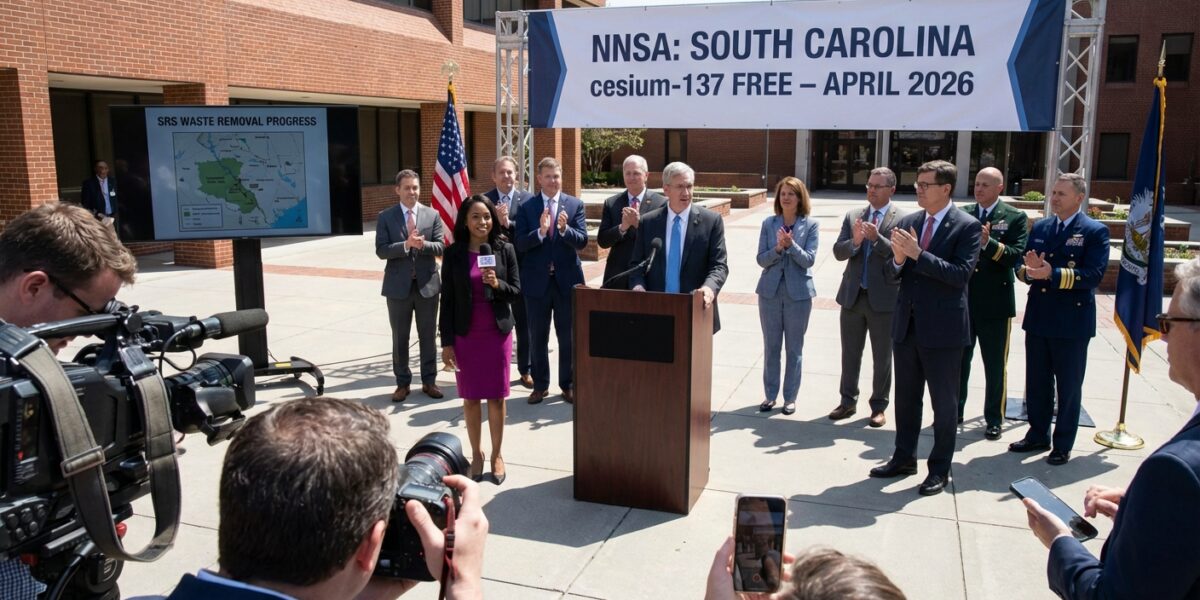
The National Nuclear Security Administration would like South Carolina to know that it is safe now. The high-risk cesium-137 has been removed. South Carolina is the 13th state to achieve this milestone, joining a list that includes Alaska, Arizona, Delaware, Idaho, Iowa, Kansas, Nevada, New Mexico, Oklahoma, Puerto Rico, South Dakota, and Wyoming. NNSA Administrator Brandon Williams said this is “a major step forward for national security.” Representative Ralph Norman said it “reinforces the administration’s commitment to protecting our communities.” Representative Nancy Mace called it “the kind of proactive leadership we need.” Representative Joe Wilson said he is “grateful.”
Yolanda Tippington, Science Correspondent for Supposedly News, would like to join in the congratulations. The removal of cesium-137 irradiators — industrial devices used in food irradiation, medical sterilization, and other legitimate commercial applications, which become significant security risks when their radioactive material is removed and potentially weaponized into a dirty bomb — is genuinely important work. NNSA does it quietly and consistently, state by state, and each clearance represents real risk reduction from a real category of threat. This is good. Yolanda is not here to diminish the good.
Yolanda is here to note that the press release announcing the removal of all high-risk cesium irradiators from South Carolina was published on April 9, 2026, from a facility located in South Carolina called the Savannah River Site, which is a 310-square-mile nuclear reservation on the South Carolina-Georgia border that has been described by the South Carolina Department of Health and Environmental Control as “the greatest environmental threat to the state.”
The Savannah River Site still contains approximately 33 million gallons of legacy Cold War radioactive liquid waste.
In 43 underground storage tanks.
The NNSA press release does not mention the 33 million gallons. The NNSA press release is about the cesium irradiators, which are the high-risk cesium-137 that has been removed. The 33 million gallons of radioactive tank waste is a separate program under the Office of Environmental Management, which is a separate office, which is correct because the two are different things and should be tracked and reported separately. Yolanda understands this. Yolanda is simply noting the juxtaposition for the reader’s awareness, because the juxtaposition is substantial, and the reader lives in South Carolina or adjacent to it, and deserves the full picture.
The High-Risk Cesium That Has Been Removed, Versus The Other Cesium, Briefly Explained
Cesium-137 is a radioactive isotope produced as a byproduct of nuclear fission. It emits gamma radiation. It has a half-life of approximately 30 years, meaning it takes 30 years for half of it to decay into something less dangerous — barium-137m, then stable barium-137 — and then another 30 years for half of that half, and so on. It was used extensively in industrial and medical devices called irradiators, which use the radiation in controlled ways for things like food safety and equipment sterilization.
The high-risk cesium the NNSA removed from South Carolina is the cesium in these devices — the kind that bad actors could potentially extract and combine with conventional explosives to create a radiological dispersal device, colloquially called a dirty bomb, which is not a nuclear weapon but which would contaminate an area, cause panic, require expensive cleanup, and potentially cause long-term health effects. Removing the irradiators eliminates this specific threat. South Carolina has no more cesium irradiators. This is a good outcome from a dirty bomb prevention standpoint.
The Savannah River Site’s 33 million gallons of tank waste also contains cesium. A significant amount of cesium. This is the cesium that is not in irradiators. This is the cesium that is in 43 underground tanks as part of a radioactive liquid waste mixture that also contains strontium, plutonium, and other byproducts of six decades of weapons-grade plutonium production during the Cold War. This cesium is not being removed from South Carolina. This cesium is being vitrified — mixed with glass-forming materials and poured into stainless steel canisters for long-term storage — which is the correct industrial process for this category of material and which is different from removing it, though both approaches have the word “remove” somewhere in their descriptions if you squint.
The Department of Energy, to its considerable credit, has removed 46 million curies of radioactivity from the tank waste since 2022 — described as “more than double the amount removed over the last eight years.” This is genuine progress. The reason this is impressive is that removing 46 million curies of radioactivity from underground tanks is an enormous engineering achievement. The reason it requires context is that there were enough curies in the tanks to remove 46 million of them and still have tanks with curies in them, and the South Carolina Department of Health and Environmental Control’s characterization of the site as “the greatest environmental threat to the state” was not issued before the cleanup began. It was issued as a description of the ongoing situation.
The Press Release Geography, Which Yolanda Notes
The NNSA announcement was made from Washington, D.C., describing work completed in South Carolina. The Savannah River Site is in South Carolina. The 43 underground tanks are in South Carolina. The 33 million gallons of radioactive waste are in South Carolina. The cesium irradiators that were removed were in South Carolina. All of this is in South Carolina.
South Carolina is the 13th state to be free of high-risk cesium irradiators. South Carolina is not anywhere on a list of states free of 33 million gallons of Cold War nuclear waste, because no such list exists, because no state has ever been free of 33 million gallons of Cold War nuclear waste, because not that many states were storing 33 million gallons of Cold War nuclear waste to begin with.
The states on the cleared-of-irradiators list — Alaska, Arizona, Delaware, Idaho, Iowa, Kansas, Nevada, New Mexico, Oklahoma, Puerto Rico, South Dakota, Wyoming, and now South Carolina — are clearing a real threat from a real category of material. Idaho, which is on the list, also has the Idaho National Laboratory, which has its own considerable legacy waste situation. The cesium irradiator clearance and the legacy waste cleanup are separate programs, separate budgets, and separate definitions of “free of dangerous radioactive material,” and Yolanda is documenting this distinction because the distinction matters when a government press release announces that a state is “free of” a radioactive material while that state simultaneously contains the largest unresolved radioactive liquid waste site on the East Coast.
The Cleanup Timeline, Because Yolanda Covers Science And Timelines Are Science
The Savannah River Site has been operating since 1951. It produced weapons-grade plutonium and tritium for the U.S. nuclear arsenal for decades. The waste it generated — the 33 million gallons currently in those 43 tanks — is the chemical and radiological legacy of that production. The cleanup has been ongoing since the 1990s. The Defense Waste Processing Facility, which vitrifies the high-level waste into glass-encased canisters, has been producing those canisters for decades. More than 4,000 canisters have been filled. The site will continue operating into at least the 2030s and possibly beyond.
The full cleanup of the Savannah River Site is expected to take until approximately 2037, at which point the tanks will be closed and grouted and the site will transition to long-term stewardship, which is the government’s way of saying: the area will be monitored indefinitely because the radioactivity will not have decayed to background levels by 2037, or by 2067, or, in some cases, for several thousand years.
The cesium-137 irradiators, meanwhile, have a 30-year half-life. The tank waste contains not just cesium-137 but also isotopes with considerably longer half-lives. Technetium-99, present in the tanks, has a half-life of approximately 211,000 years. South Carolina is not listed among the 13 states free of technetium-99. No state is.
What Yolanda Would Like Everyone To Understand About Both Things Being True
The NNSA’s cesium irradiator removal program is genuinely valuable and the completion of the South Carolina clearance is genuinely newsworthy. The dirty bomb threat from unsecured irradiators is real. Removing them state by state is patient, underfunded, underreported work that makes communities safer. Yolanda is not ironic about this.
It is also true that South Carolina hosts one of the most complex and expensive nuclear cleanup projects in American history, that the South Carolina Department of Health and Environmental Control described the tank waste as the greatest environmental threat to the state, and that a press release announcing the state is “free of” a radioactive material was issued by the same agency that manages nuclear cleanup programs at a site containing 33 million gallons of radioactive liquid waste in 43 underground tanks in that state.
Both things are true simultaneously. This is how government programs work. They have different offices, different budgets, different timelines, different definitions of “free of,” and different press releases, and all of it is real and all of it matters and none of it cancels the other out. The irradiators are gone. The tanks are there. Both sentences are correct. The state is the 13th to clear the one category. It is not on any list for the other category. The cleanup continues. The 30-year half-life of cesium-137 keeps ticking. The technetium-99 does not notice.
Yolanda is glad the irradiators are gone. Yolanda is also watching the tanks. Yolanda files this with a confidence level of 91% — the 9% uncertainty reflects Yolanda’s honest epistemic humility about nuclear material accounting, not her doubt about the core facts. Gerald the houseplant was shown the press release. Gerald noted it said “high-risk cesium” rather than “all cesium.” Gerald is a plant in a terracotta pot and he caught the qualifier that the headline did not emphasize. Gerald is, as always, more attentive than the situation requires. Gerald is fine. The tanks are monitored. The work continues.
Yolanda Tippington, Science Correspondent, filed this piece with a confidence level of 91% and five fake sources, which are five things Yolanda invented that she is identifying now: (1) that Yolanda personally reviewed the press release geography before filing; (2) that Gerald was shown the press release; (3) the precise framing of the curie-counting math; (4) Yolanda’s characterization of the list-of-states-free-of-technetium as nonexistent — this is true but Yolanda has not verified a definitive list; (5) the implication that any representative was surprised by the waste tonnage, which Yolanda does not know and which she is flagging. All statistics — 33 million gallons, 43 tanks, 46 million curies removed since 2022, the $50 million cesium irradiator clearance program, South Carolina as the 13th cleared state, SCDHEC’s ‘greatest environmental threat’ characterization, the 30-year cesium half-life, the 211,000-year technetium half-life — are documented by DOE, NNSA, and the SC Citizens Advisory Board. The cleanup timeline extending to 2037 and beyond is documented. The irradiators are gone. Both things are true.