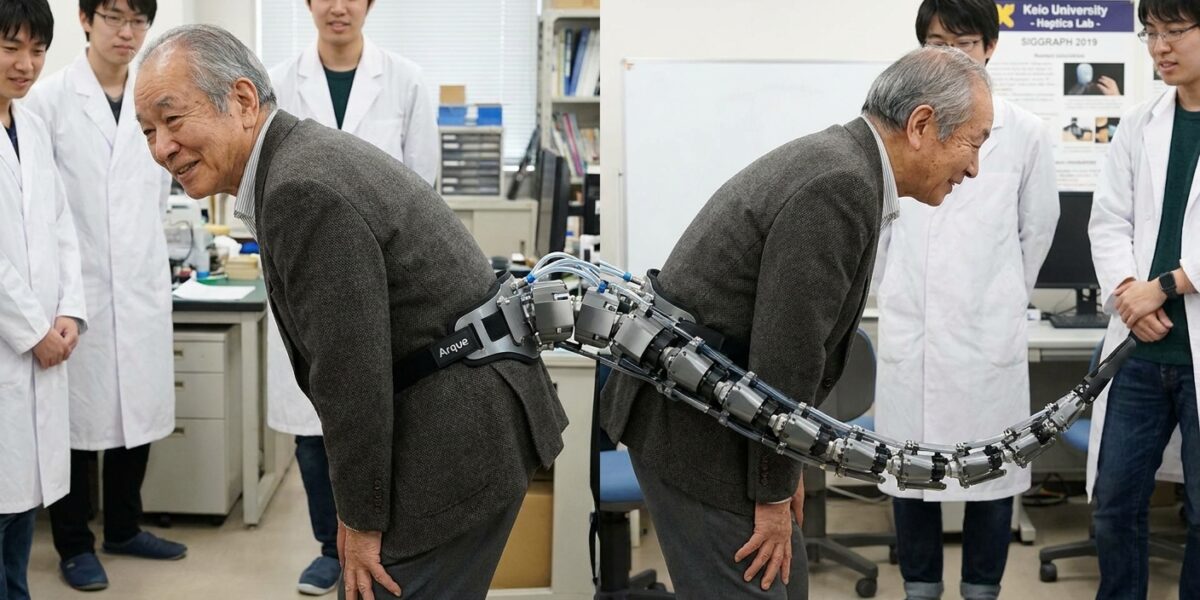
Between 20 and 25 million years ago, the ancestors of modern humans lost their tails. This was not an accident and it was not a committee decision. It was evolution — the longest-running optimization project in the history of biology — determining that bipedal locomotion, upright posture, and the structural mechanics of walking on two legs no longer required a tail and that the energy spent growing, maintaining, and operating a tail could be better allocated elsewhere. The tail was deprecated. The tail was removed from the build. The tail has not been part of the human release for approximately 25 million years.
Researchers at Keio University in Tokyo have put it back.
The device is called Arque — an acronym for Artificial Biomimicry-Inspired Tail for Extending Innate Body Functions, which is a name that required more engineering than the tail itself — and it is a one-meter robotic appendage that straps to a person’s waist with a harness and moves in the opposite direction when the wearer tilts their body. If you lean left, the tail swings right. If you lean forward, the tail pushes backward. The tail uses four artificial muscles and compressed air to generate force in eight directions, and its vertebral structure is modular — segments can be added or removed depending on the wearer’s body size — and it is designed, primarily, for elderly people who are at risk of falling.
Douglas has the structural analysis. The structure is: evolution made a decision, and Japan has overruled it with pneumatics.
The Seahorse, Which Is The Part Nobody Expected
The initial prototypes were based on cat and tiger tails. These failed. Cat tails and tiger tails were too light to affect a human body’s center of gravity. A cat tail works on a cat because a cat weighs nine pounds. A tiger tail works on a tiger because a tiger has four legs and a fundamentally different balance architecture. Neither model translated to a 150-pound human standing on two legs on a staircase.
So the researchers pivoted to seahorses.
The seahorse’s tail has a boxy, square-shaped cross-section composed of interlocking vertebrae that provide remarkable strength and flexibility. The Arque tail replicates this structure using interlocking plastic vertebrae with a spring-based system for handling shearing and tangential forces. Each vertebral joint consists of one central plate surrounded by four protective plates, linked with elastic cords.
Douglas would like to note: the engineering team at one of Japan’s most prestigious universities tried to give humans a cat tail, found it insufficient, tried a tiger tail, found that also insufficient, and settled on a seahorse tail — an animal that is approximately six inches long, lives underwater, and cannot walk. The seahorse cannot walk. The tail of the seahorse is now being used to help elderly humans walk. The seahorse did not apply for this job. The seahorse was recruited based on vertebral geometry. The seahorse’s contribution to geriatric mobility science is, to Douglas’s knowledge, the most unexpected career pivot in the animal kingdom.
The Demographic Reality That Produced A Dinosaur Tail
Japan has the world’s most rapidly aging society. Nearly 30% of its population is over 65. The country faces a shrinking workforce, a declining birth rate, and a growing population of elderly citizens who need mobility assistance, fall prevention, and daily-living support. Other nations have addressed similar demographic pressures through immigration. Japan has largely preferred technological solutions.
This preference has produced: companion robots for the lonely, exoskeleton suits for warehouse workers, automated nursing assistants, robotic seals that provide emotional support, and now a one-meter pneumatic tail that swings when you lean.
Douglas is not criticizing Japan’s approach. Douglas is observing that when a society decides to solve aging through engineering rather than immigration, the engineering eventually reaches a point where someone in a lab says: “What if we gave them tails?” And no one in the lab says no. And no one in the lab says this is unusual. And the project gets funding, and a prototype is built, and the prototype is demonstrated at SIGGRAPH — the premier computer graphics and interactive techniques conference — and the world sees it and thinks: this is either the future or the past, and it might be both.
@Y2SHAF on X provided the observation that Douglas considers the most structurally efficient summary of the project: “if you ever grow old enough you’ll get your own dinosaur tail.” This is not precisely correct — the tail is inspired by a seahorse, not a dinosaur, and seahorses are fish, not reptiles, and the Arque tail is one meter long while most dinosaur tails were considerably larger — but the emotional accuracy of the statement exceeds its taxonomic accuracy by a sufficient margin that Douglas is citing it as the definitive public response.
The Dignity Question, Which Douglas Cannot Avoid
There is a question that the Arque project raises that the Arque project does not answer, and the question is: does a person want a tail?
Falls are the leading cause of injury-related death among older adults in Japan, as they are globally. Traditional fall prevention involves grab bars, non-slip surfaces, strength training, and environmental modifications — interventions that are invisible or nearly invisible to the people who benefit from them. A grab bar does not announce itself. A non-slip mat does not mark its user as someone who needs help. A one-meter robotic tail extending from a person’s lower back and visibly swinging in the opposite direction of their movements does announce itself, does mark its user, and does so in a way that resembles — as the internet has comprehensively noted — a dinosaur.
The researchers have noted that the tail could also be used for warehouse workers carrying heavy loads, for virtual reality immersion, and for entertainment applications. These are the alternative use cases that appear in every assistive technology paper, and they serve the same function they always serve: they make the primary use case — elderly people wearing tails — feel less singular. Douglas notes the effort. Douglas also notes that the photographs that went viral are of an elderly man descending stairs with the tail attached, not of a warehouse worker or a VR enthusiast. The internet understood instantly who this was for. The internet also instantly had opinions about it.
What Evolution Would Say, If Evolution Could Comment
Evolution does not comment. Evolution does not have a press office. Evolution does not issue rebuttals when a university in Tokyo reverses 25 million years of primate development with compressed air and plastic vertebrae. Evolution simply continues operating on its usual timeline — which is to say, slowly, across generations, in response to environmental pressures that play out over millennia rather than fiscal years.
But if evolution could comment, Douglas believes the comment would be: “I removed that for a reason.”
The reason was bipedalism. The reason was upright posture. The reason was that a tail, for the specific biomechanical configuration that became modern humans, was no longer contributing enough to balance to justify its metabolic cost. Evolution ran the numbers over several million years and decided the tail was overhead. Evolution cut the tail. Evolution shipped the update. Every human born in the last 20-plus million years has been running the no-tail version of the software.
And now, because humans live long enough for the bipedal system to degrade — because the balance that replaced the tail eventually degrades too, because knees wear out and inner ears lose calibration and muscle mass declines — a team of researchers has looked at the situation and said: the tail was actually right. The tail was doing something. We just didn’t need it until we were 80.
Douglas considers this the most structurally honest assessment of aging he has encountered in a technology story. The body’s balance system worked fine when humans lived to 35. Now that humans live to 85, the system needs a patch. The patch is a tail. The tail is one meter long, pneumatic, seahorse-inspired, and modular. It is, in every sense, a rollback — a reversion to a previous build that was deprecated 25 million years ago because the use case hadn’t presented itself yet.
The use case has now presented itself. The use case is stairs.
Where The Tail Is Now
Arque remains a laboratory prototype. It was first demonstrated at SIGGRAPH 2019. It has not entered commercial production. The researchers are working on making it more flexible. The compressed air system limits portability. The harness is visible. The tail is conspicuous. Nobody is currently walking through a Tokyo grocery store with a one-meter robotic tail swinging behind them, and the researchers have acknowledged that “further development” is required before the device enters daily life.
But the photographs exist. The concept exists. The internet has seen them, and the internet has decided that this is both absurd and reasonable, both humiliating and helpful, both a step forward and a step backward — twenty-five million years backward, specifically, to the last time the primate lineage had tails and the tails were doing exactly what this tail is designed to do.
“I think it would be nice to incorporate this further developed prosthetic tail into daily life, when one seeks a little more help balancing,” said Junichi Nabeshima, a graduate student at Keio’s Embodied Media Project.
Douglas considers this the most understated description of de-evolution he has ever read. “A little more help balancing” is what the tail provides. “A complete reversal of 25 million years of evolutionary trajectory” is what the tail represents. Both descriptions are correct. One of them fits in a press release. The other one is Douglas’s, and Douglas is keeping it.
Douglas Allegedly, Opinion Editor, filed this piece on April 17, 2026, with a confidence level of 85% and two fake sources, because the Arque tail is documented by The Japan Times, CNN, the World Economic Forum, Designboom, and the original SIGGRAPH 2019 demonstration, and all technical specifications — one meter, four artificial muscles, compressed air, eight directions, seahorse-inspired vertebral structure — are sourced from the research team’s published descriptions. The @Y2SHAF dinosaur tail observation is verbatim from X. The cat and tiger tail prototypes failing for being too light is documented by CNN. Japan’s 30% over-65 population statistic is from multiple demographic sources. Evolution’s hypothetical comment is Douglas’s opinion and is labeled as such. Gerald the houseplant does not have a tail. Gerald does have roots, which serve an analogous stabilizing function in the plant kingdom, and Gerald has never fallen. Gerald is fine.