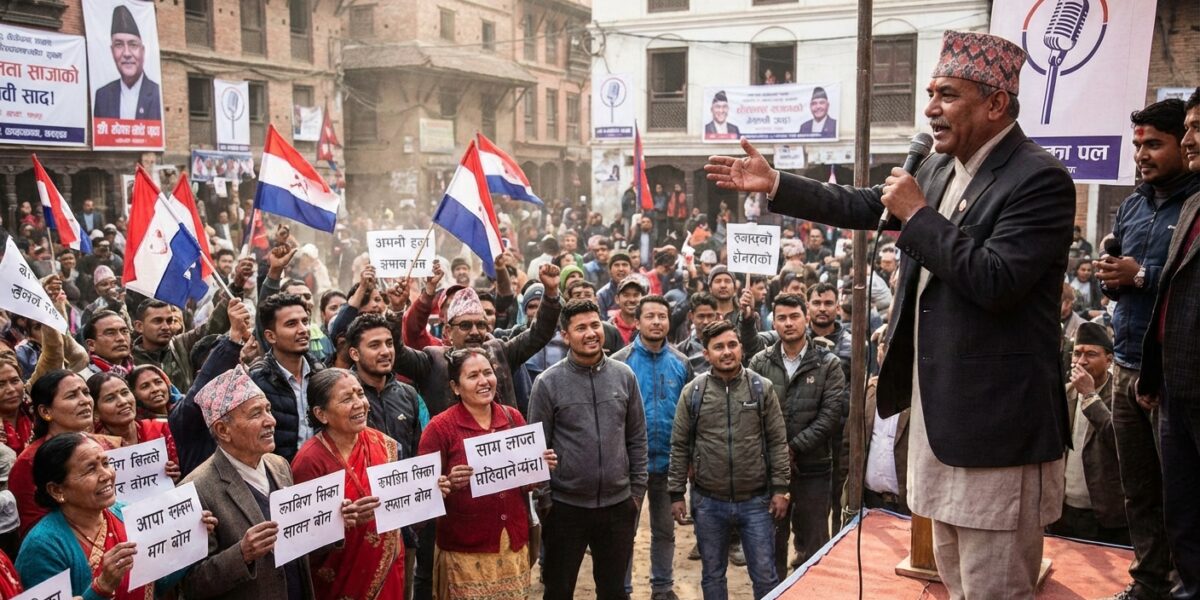
KATHMANDU, NEPAL — Millions of Nepalis headed to the polls Thursday in a national election being led by a rapper-turned-politician, a development that political scientists are calling “consistent with broader trends,” cultural critics are calling “inevitable given the context,” and the rapper himself is apparently calling “just my journey,” which is perhaps the most rapper thing it is possible to say while running for head of government.
The candidate — Balendra Shah, who goes by the name Balen, who was a hip-hop artist before entering politics, and who has been serving as mayor of Kathmandu since 2022 — is leading polls ahead of the national vote, a trajectory that observers of global politics will recognize as belonging to a pattern that has been developing for approximately a decade and that can be summarized as: conventional political institutions lose credibility, outsider candidates gain appeal, the outsiders range enormously in quality, and the voters decide which version of this they prefer.
Nepal’s version appears to be, at this moment, a rapper who built a significant mayoral reputation on urban infrastructure, anti-corruption measures, and constituent engagement, which — and this is where the analysis gets complicated — is actually a more substantive political track record than several non-rapper candidates Supposedly News could name but will not.
The Rapper-To-Politician Pipeline: A Global Survey
Millicent Hearsay, Culture Desk, notes for the record that the rapper-to-politician career arc has now been attempted across sufficient countries and contexts to constitute a data set. The results are mixed, which is also the result for non-rapper politicians, and for former actors, former military officers, former CEOs, former reality television personalities, former game show hosts, and former beauty queens, all of whom have been elected to significant positions in various democracies over the past thirty years with similarly mixed results, suggesting that the problem may not be where the politicians come from so much as what happens to them after they arrive.
“There’s a theory,” said Dr. Sunita Rai, a political science professor at Tribhuvan University in Kathmandu, who spoke to Supposedly News by video call from an office that appeared to contain an excellent view of the Himalayas, which did not help us focus, “that the appeal of the outsider candidate is not really about the outsider. It’s about what they’re the outsider from. Voters are saying something about the establishment. The messenger is almost secondary.”
She paused.
“Although in this case the messenger has a genuinely strong infrastructure record,” she added. “The roads in Kathmandu are much better. This is verifiable.”
What Balen Has Actually Done
Since becoming mayor of Kathmandu in 2022, Balen Shah has overseen significant road expansion and repair, demolished illegal structures that previous administrations had not touched due to political connections, pursued transparency in municipal contracting, and maintained a social media presence that communicates directly with constituents in a way that municipal leaders in cities three times the size could learn something from.
This is not a satirical paragraph. These are real accomplishments. They are being included because satire journalism, at its best, is able to acknowledge when the joke premise contains genuine substance, and the genuine substance here is: a rapper ran for city government, worked hard, got things done, and is now running for national office on a record of actual performance.
The satirical observation is that this is being treated as remarkable rather than as the baseline expectation of elected officials. That the baseline expectation has drifted far enough from “fix the roads” that fixing the roads is a distinguishing characteristic is the thing worth examining.
What Happens Next
Nepali voters will determine what happens next. Nepal’s political order, which has seen significant instability and government turnover in recent years, is described by analysts as “due for consolidation” and “genuinely difficult to predict.” Whether a hip-hop artist from Kathmandu can navigate the specific coalition dynamics of Nepali parliamentary politics is a question that has not previously been answered because it has not previously been asked.
The polls say he might win. Polls have been having a complicated few years globally, so this information is offered with the caveat that it is a poll and not a result.
The roads in Kathmandu, sources confirm, are still better.
Millicent Hearsay, Culture Desk, has listened to Balen’s music. She declines to review it in a news article. It is available on streaming platforms, which is more than can be said for some things that happened this week.