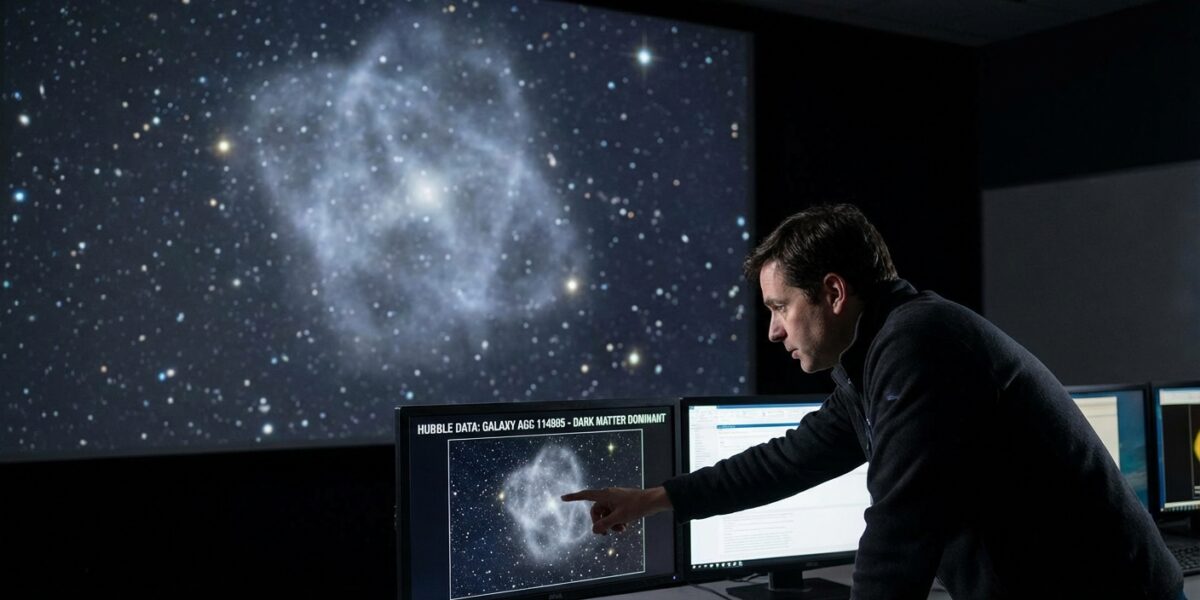
GREENBELT, MD — The Hubble Space Telescope has identified a galaxy located approximately 250 million light-years from Earth that is composed almost entirely of dark matter, according to research published this week that physicists describe as “a significant discovery” and that science communicators are struggling to explain to the general public because dark matter is one of those concepts that becomes less comprehensible the more clearly you explain it.
Dark matter, for those whose physics education ended at the point where things started being called “dark,” is a hypothetical form of matter that does not emit, absorb, or reflect light — meaning it cannot be directly observed — but whose gravitational effects can be inferred from the behavior of observable matter around it. It is thought to constitute approximately 27% of the total mass-energy of the universe. It is everywhere. It interacts with regular matter only through gravity. It has never been directly detected. Nobody knows what it is. Scientists have been looking for it for about 50 years. It is not cooperating.
The newly identified galaxy — designated Dragonfly-44-B in this publication because its actual catalog name is a string of numbers that does not aid comprehension — is essentially a galaxy-sized blob of dark matter with a smattering of visible stars spread thinly across it, like someone sprinkled a modest amount of regular matter onto a very large dark matter cake and called it a galaxy. The stars provide enough visible signal to detect the object. The dark matter provides essentially all of its mass. This is unusual. Most galaxies contain a more balanced ratio of dark to regular matter.
Why This Is Interesting
The existence of a galaxy with very little regular matter and an enormous amount of dark matter tells physicists something about how galaxies form, which dark matter models predict, and whether those predictions match observations — a process that sounds like academic bookkeeping but is actually how humanity incrementally builds its understanding of what the universe is made of and why anything exists in the form it does, which is, all things considered, a more worthwhile project than most of what else is happening this week.
“What’s exciting is that this object challenges our standard models of galaxy formation,” said Dr. James Okafor, an astrophysicist at the Space Telescope Science Institute who was involved in the study and who described the discovery with the specific controlled excitement of someone who has spent years conditioning themselves not to oversell results because science journalism will do that for them. “It’s asking us to refine our understanding of how dark matter halos collapse and retain gas in low-density environments.”
“In plain language,” Dr. Okafor added, reading our facial expression through the video call, “a galaxy mostly made of invisible stuff is weird and we want to understand why.”
The Dark Matter Problem, Briefly
Supposedly News feels it is important to note, for context, that dark matter has been the central unsolved problem in cosmology for half a century. Every candidate particle proposed to explain it has either been ruled out by experiments or remains undetected. The Large Hadron Collider, which is the most powerful particle accelerator ever built and which cost approximately $4.75 billion to construct, has not found dark matter. Underground detectors in mines around the world, waiting for a dark matter particle to interact with their sensors, have been waiting a long time. The universe is not explaining itself.
This galaxy is, in the context of that half-century of polite inquiry, something like the universe briefly making eye contact. It is not an explanation. It is a clue. Physicists will now spend considerable time and funding attempting to understand the clue, which will produce further questions, which will require further investigation, which is how science works and which is, on the scale of human intellectual achievement, genuinely magnificent even when it is also genuinely humbling.
What This Means For You
In the short term: nothing material. Dark matter does not affect your daily life in any way you can observe, which is rather the point.
In the medium term: scientific understanding of dark matter may eventually inform cosmological models that have downstream effects on our understanding of physics that could, over decades and centuries, influence technology in ways that are currently not predictable. This is how basic science works. The people who discovered electromagnetism did not know it would result in your phone.
In the long term: we are 250 million light-years from this galaxy. Whatever is happening there happened 250 million years ago. The universe is approximately 13.8 billion years old. We are very small. The invisible stuff is very large. The fact that we can detect it at all is, Supposedly News submits, one of the more remarkable things our species has managed.
We thought you should know about it. This week needed something like this.
Yolanda Tippington, Science Correspondent, finds the universe extremely interesting and slightly terrifying and would like to note that both reactions are appropriate.