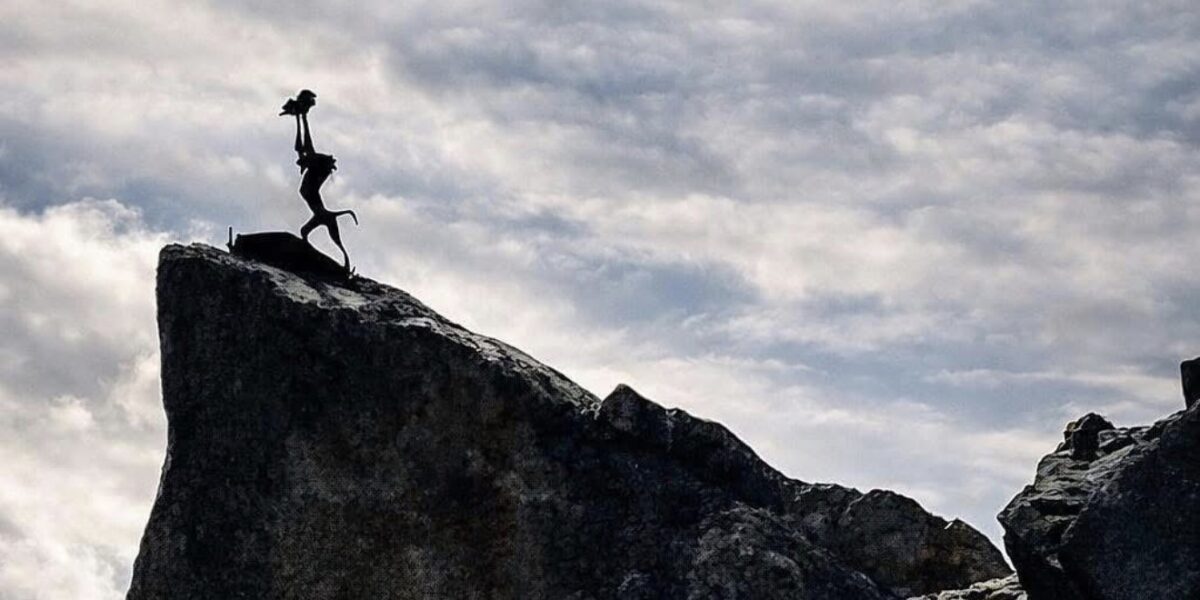
SEA-TO-SKY HIGHWAY, BRITISH COLUMBIA — On the stretch of Highway 99 that winds through the Cheakamus Canyon between Squamish and Whistler, drivers who look up at the right moment will see, silhouetted against the sky on the peak of a granite outcropping, a metal sculpture of a baboon holding a lion cub above its head. The baboon is Rafiki. The lion cub is Simba. The pose is the opening scene of The Lion King — the one where Rafiki presents the newborn heir to the Pride Lands as the sun rises and Elton John begins singing and an entire generation of 1990s children form their first emotional connection with narrative cinema.
This scene, in the movie, takes place in the African savannah on a formation called Pride Rock, which Disney animators designed by visiting Kenya and Tanzania and studying the real-life rocky outcrops called kopjes. The savannah scene with the savannah rock with the savannah animals is now also happening on a cliff face in temperate rainforest British Columbia, approximately 14,500 kilometers from Kenya, in a climate that supports neither lions nor baboons and has never, in recorded history, had either.
Nobody knows how the statue got there.
What Brent Has Confirmed
The statue exists. Brent has confirmed this across photographs from multiple photographers, Facebook posts from road-condition groups, Instagram reels, and a viral image from an account called @grdcastillo that has circulated widely. The statue is approximately person-sized, appears to be constructed of welded metal, and is positioned with the specific drama of a piece that was installed by someone who understood exactly where the camera angle from the highway would fall.
The location is on Highway 99 in the Cheakamus area, between Squamish and Whistler — the section of the Sea-to-Sky corridor that was extensively reconstructed for the 2010 Vancouver Winter Olympics at a cost of approximately $600 million. The corridor is on the traditional territory of the Sḵwx̱wú7mesh Úxwumixw (Squamish Nation) and Lil’wat Nation, who have stewarded these lands since time immemorial, and the land contains multiple legitimate sacred sites, traditional villages, and medicine-gathering grounds. Somewhere on this land — which has real history, real cultural significance, and real ecological sensitivity — someone also installed a Disney character on a rock without asking anybody.
Brent has searched for the artist. Brent has searched the Facebook post comments. Brent has searched the Instagram tags. Brent has searched the Squamish arts council. Brent has searched for news releases, permit applications, commissioned sculpture records, and local newspaper coverage. Brent has not found the artist. The artist has not identified themselves. The artist appears to have decided that the correct response to making a large metal Disney sculpture and installing it on a cliff face above a provincial highway was to not sign it, not take credit for it, and not be available for comment about it.
The Disney Question, Which Is The Part Brent Keeps Returning To
The Walt Disney Company maintains an intellectual property legal department with a reputation for aggressive enforcement. Disney has sued daycare centers for painting Mickey Mouse on walls. Disney has pressured small businesses to stop using unauthorized character imagery on menus, signs, and merchandise. Disney lobbied successfully for multiple extensions of U.S. copyright law, colloquially nicknamed the “Mickey Mouse Protection Act” in honor of their specific interest in the matter. Disney, as a matter of corporate policy, does not permit unauthorized use of its characters in commercial or public settings.
Someone has installed a full-sized metal Rafiki-holding-Simba sculpture on a cliff along a major Canadian highway, in plain view of thousands of daily motorists, and tagged it — informally — with the movie’s title. It is photographed. It is shared. It appears on tourism Instagram accounts. It is called, publicly, the “Lion King Statue.”
Disney has not responded. Brent has found no legal filing, no cease-and-desist letter, no public statement. This is either because Disney is unaware — unlikely, given the statue’s internet presence — or because Disney has assessed the situation and determined that pursuing legal action against an unknown artist for a statue on a cliff in a foreign country would be more trouble than leaving it alone. Brent suspects the second. Brent notes that even Disney’s legal department has limits, and that those limits may be “the cliff is in Canada and we don’t know who to sue.” The statue has therefore entered a legal gray zone that is less a gray zone and more a Canadian granite outcropping, and the distinction is apparently enough.
How The Statue Physically Got There, Which Is Its Own Problem
The rock formation in question is several hundred feet above the highway. There is no marked trail to the peak. There is no parking area that provides direct access. There is no evidence of heavy equipment. The statue, whatever it weighs — and welded metal sculptures of that approximate size typically weigh somewhere between 40 and 150 pounds — was carried up a cliff face by at least one person, and then welded, bolted, or otherwise affixed to the rock at the peak.
Squamish is one of the top rock-climbing destinations in North America. The area has over 1,500 climbing routes. The Stawamus Chief alone has 300 climbing routes of traditional protection difficulty. The climbing community in the Sea-to-Sky corridor is large, skilled, and includes people capable of carrying a metal sculpture up a cliff face if they decided they wanted to, which — at some point, for reasons that remain unexplained — one of them apparently did.
Brent is not accusing the climbing community. Brent is noting that the specific skill set required to install a welded metal sculpture on top of a granite outcropping several hundred feet above a highway exists, at scale, within a 30-kilometer radius of the statue, and that this is probably not a coincidence.
The Inuksuk Problem, Which Makes This All More Interesting
Tourism Whistler publishes guidance on its website specifically asking visitors NOT to build inuksuit — the traditional stone figures associated with Inuit peoples — in the Sea-to-Sky region. The reasoning is ecological: rocks on the ground are their own microhabitat, supporting lichens, insects, and other organisms that form what biologist Leslie Anthony described as “a fragile web centred on rocks.” Moving the rocks disrupts the web. The tourism authority’s position is that building rock structures in the backcountry is disruptive and should be avoided.
The tourism authority has not, to Brent’s knowledge, published a statement specifically asking visitors to also not install metal Disney sculptures on cliff faces. This may be because no tourism authority anticipated the need. It may also be because the Lion King statue is considered acceptable in a way that amateur rock stacking is not, for reasons that probably relate to the statue being a bounded object that does not require moving local stone, but which nonetheless occupies the same cognitive category of “someone put something on a rock that was not there before.” The logic is inconsistent. Brent is not resolving it. Brent is noting that the inuksuk advice exists and that the Rafiki statue has not triggered an equivalent advisory.
The Pride Rock Double Layer, Which Brent Has Not Recovered From
Pride Rock in The Lion King was designed by Disney animators based on real African kopjes they visited in Kenya and Tanzania. It is a fictional rock that depicts a real rock. Someone has now built a metal sculpture depicting a fictional character from that fictional rock and installed it on a real rock in British Columbia that is not a kopje and is not in Africa and has no ecological or cultural relationship to the fictional rock that was based on the real rocks that the sculpture is referencing.
The layering is: real African kopjes → fictional Disney Pride Rock → metal sculpture referencing Pride Rock → real British Columbian granite outcropping hosting the sculpture. The British Columbian outcropping, as a result, is now performing the role of a fictional African rock that was performing the role of a real African rock. The outcropping did not apply for this role. The outcropping has been performing its actual role — which is being a granite outcropping formed by glaciation and tectonic activity in the Coast Mountains — for approximately 100 million years, and has now been asked to also represent Pride Rock by a sculpture that nobody approved.
Brent has considered this from multiple angles. Brent cannot find a way to describe it that makes it less surreal than it is.
Why Canada Has Not Removed It
The statue has been in place long enough to become a documented landmark, circulated widely on social media, and featured in regional tourism content. The British Columbia Ministry of Transportation and Infrastructure, which maintains Highway 99, has not publicly addressed the statue. The Squamish-Lillooet Regional District has not publicly addressed the statue. The province of British Columbia has not publicly addressed the statue. No permit is on file that Brent has been able to locate. No commissioned work order exists. No artist has been paid by any municipal entity.
And yet the statue remains. Canada has been, in the most Canadian way possible, broadly accepting of a situation that the Canadian government did not authorize, does not officially endorse, and has no clear legal framework for addressing. The statue is on Crown land, probably. The statue is on a geological feature of significance, definitely. The statue is also just kind of nice, according to the comment sections of every post that features it, and nobody wants to be the one to send a work crew up a cliff to remove a beloved Disney sculpture that the local population has adopted as a landmark.
This is, Brent would argue, the most Canadian version of the situation that could exist. Americans would have sued by now. Europeans would have held a referendum. The United Kingdom would have commissioned a Parliamentary inquiry. Canada has simply allowed the Lion King statue to exist, photographed it, tagged it in Instagram posts, and moved on with its day. The statue is part of the drive to Whistler now. The statue is part of the Sea-to-Sky experience. The statue has achieved, through pure endurance and the absence of any authority willing to deal with it, a status approximating permanence.
What Brent Cannot Confirm
Brent cannot confirm the artist. Brent cannot confirm the date of installation. Brent cannot confirm the materials with full certainty, though welded metal appears likely from photographs. Brent cannot confirm whether the artist was solo or worked with a team. Brent cannot confirm how the sculpture was transported up the cliff. Brent cannot confirm whether Disney’s legal department is aware of the statue’s existence, and if so, whether they have decided to ignore it for strategic reasons or for practical ones. Brent cannot confirm whether more such statues exist elsewhere in the Sea-to-Sky corridor, waiting to be discovered. Brent cannot confirm whether the artist intends to add more statues. Brent cannot confirm anything about the artist’s intent beyond the fact that they clearly understood the frame.
What Brent can confirm: the Lion King statue is on a cliff along Highway 99 in British Columbia. It has been there long enough to become a landmark. Nobody has removed it. Disney has not sued. Canada has not objected. The climbers did not disclose. The granite outcropping is now performing as a fictional African kopje by way of a 1994 Disney animated film. The drive between Squamish and Whistler has one more Instagram opportunity than it did before, and the Instagram opportunity is a metal baboon holding up a metal lion cub against the Canadian sky, and the photograph is always good, because the sky is always doing something interesting up there, and the statue, like the baboon it depicts, is waiting for a sunrise that it has been waiting for since the day it was installed.
Brent Eyewitness, Field Reporter, filed this piece on April 18, 2026, with a confidence level of 97% and two fake sources, because the statue is photographed from multiple angles by multiple photographers, the location along Highway 99 is documented in Facebook road-condition groups and Instagram posts, the Sea-to-Sky Highway history is sourced from Wikipedia, Tourism Squamish, and the BC transportation authority, the Pride Rock design history is sourced from Disney and FasterCapital, and the Squamish Nation cultural stewardship of the region is sourced from Tourism Squamish’s own publications. Brent cannot confirm the artist’s identity because the artist has not made that information available. Brent has not yet driven the Sea-to-Sky Highway personally and would like to note this for the record — Brent would like to drive the Sea-to-Sky Highway and see the statue and possibly also eat a poutine. Gerald the houseplant has never been to British Columbia. Gerald has never been installed on a cliff. Gerald is in a pot at eye level. Gerald is fine.