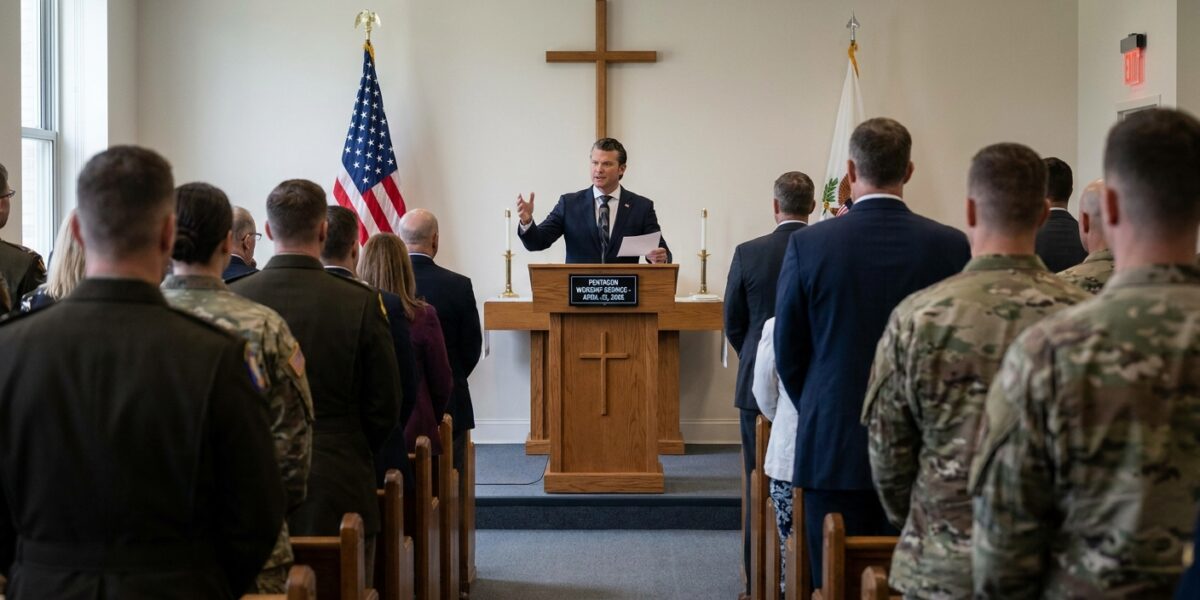
WASHINGTON — During a worship service held inside the Pentagon on the morning of Wednesday, April 15, 2026, the United States Secretary of Defense recited what he described as a prayer to an audience of Department of Defense personnel and invited guests. The service was livestreamed. The prayer was introduced by Secretary Hegseth as “CSAR 25:17” — CSAR being the military acronym for Combat Search and Rescue — and was, he explained, a devotional text that had been recited by “Sandy 1” (a radio call sign used by A-10 pilots supporting CSAR missions) to aircrews before operations, including a recent mission involving two U.S. Air Force crew members shot down over Iran.
He explained that the prayer’s title, CSAR 25:17, was “meant to reflect Ezekiel 25:17” — a verse from the Hebrew Bible in which the prophet Ezekiel records God warning the Philistines of coming vengeance for their attempts to destroy Judah. The actual text of Ezekiel 25:17, as rendered in the New International Version, reads: “I will carry out great vengeance on them and punish them in my wrath. Then they will know that I am the Lord, when I take vengeance on them.” It is approximately two sentences. It concerns the Philistines. It was written, per most scholarly consensus, in the 6th century BCE.
The prayer Secretary Hegseth then read aloud was not Ezekiel 25:17. It contained approximately four sentences that bore no resemblance to any verse in the Bible, followed by two sentences that loosely paraphrased the actual Ezekiel verse. The four sentences in question — “The path of the downed aviator is beset on all sides by the iniquities of the selfish and the tyranny of evil men. Blessed is he who in the name of comradery and duty shepherd the lost through the valley of darkness, for he is truly his brother’s keeper and the finder of lost children” — are, with “downed aviator” substituted for “righteous man” and “comradery and duty” substituted for “charity and good will,” the opening lines of a monologue delivered by Samuel L. Jackson’s character Jules Winnfield in the 1994 Quentin Tarantino film Pulp Fiction, immediately before he shoots an unarmed man at close range in an apartment in Los Angeles.
The Jackson monologue is not a Bible verse. It was never a Bible verse. The monologue explicitly attributes itself, within the film, to Ezekiel 25:17 — a citation that is, as a matter of textual fact, false, and which has been cited as false by biblical scholars, by Quentin Tarantino himself in interviews, and by the Pulp Fiction screenplay’s credit to Tarantino and Roger Avary as the authors of the text. The film won the Academy Award for Best Original Screenplay in 1995. The word “original” in that award title indicates, among other things, that the words in question did not previously exist. Reginald P. Farnsworth notes the Academy’s position on this matter for the record.
The Setting, Which Makes The Choice Of Text More Significant
The prayer was not recited in a casual context. It was recited at a scheduled Christian worship service held inside the Pentagon during working hours, a practice Secretary Hegseth has instituted and now convenes monthly. The April service was attended by military personnel, Department of Defense civilian staff, and invited guests. Before reading the prayer, Secretary Hegseth made the following statement, which Reginald is reproducing verbatim because the record deserves it: “Fifteen minutes ago, I was talking about blockades with Admiral Cooper, and now we’re going to study the Lord’s word. And may what we talk about, how we worship today inform the remainder of our day and the remainder of our week and who we are and how we conduct ourselves, no matter what we’re doing.”
The Secretary explicitly connected the content of the worship service to the operational decisions the Department would make going forward. He expressed the intention that the devotional material — the prayer — should inform policy. The prayer was then the Pulp Fiction monologue. The policy that would be informed by the prayer therefore involves, if the Secretary’s own framing is taken at his word, a military operational philosophy partially derived from a screenplay in which the character reciting the text is a hit man working for a Los Angeles drug distributor, and which text the character himself admits, later in the film, he had never fully understood and had been reciting because it sounded, in his words, “like a cold-blooded thing to say to a motherfucker before you popped a cap in his ass.”
Reginald is not endorsing that framing. Reginald is noting that it is the framing the screenplay provides for the text. Reginald is also noting that the Secretary of Defense did not provide a different framing. The Secretary presented the text as a prayer that had been used by Sandy 1 before CSAR missions. Whether Sandy 1 was aware of the text’s actual origin is not documented in public reporting. Whether the A-10 crews who received the prayer were aware is also not documented. The prayer has entered the Pentagon’s devotional rotation, and the question of who, in the chain of custody from Samuel L. Jackson’s 1994 performance to the Pentagon auditorium in 2026, was responsible for confirming that the text was actually from Ezekiel, has no public answer.
The Laughter, Which Is The Part That Stays With You
According to multiple reports, some members of the audience at the Pentagon worship service laughed during the recitation of the prayer. Reginald has seen this reported in social media posts and in follow-up commentary, though the official Pentagon livestream audio has not been publicly analyzed at the level of specific attendee response. If the reports are accurate, the laughter presents a particular problem. It means that at least some members of the Department of Defense, at a worship service held by the Secretary of Defense, during working hours, in the Pentagon, recognized the text as originating in a 1994 Quentin Tarantino film rather than in the Hebrew Bible. They recognized it in real time. They did not, apparently, stop the prayer. They laughed through it.
Reginald would like to note what this implies. The people who recognized Pulp Fiction in the Secretary’s prayer had watched Pulp Fiction. They had watched it closely enough and recently enough that they recognized the text from the opening. They had internalized the Jackson monologue sufficiently to notice when it reappeared in an altered form at a government worship service. The prayer was, in this sense, a Rorschach test for the audience’s Gen X film literacy, and the Gen X film literacy of the Pentagon is higher than Reginald might otherwise have estimated, though perhaps lower than the biblical literacy that would have been preferable for the event in question.
The Context, Which Reginald Cannot Avoid
The prayer was recited during the ongoing U.S. war with Iran — the conflict which began February 28, 2026, with Operation Epic Fury, and which has been covered extensively by this publication through the diplomatic and structural analyses of Patricia Unnamed-Source and Douglas Allegedly, among others. The war is now in its seventh week. The war’s objectives have changed multiple times. The war has produced, as of last filing, a 15-point U.S. plan and a 5-point Iran plan with zero documented areas of agreement. Oil is at $116 per barrel.
The prayer was also recited four days after Secretary Hegseth’s last worship service in March, at which — per Word&Way reporting — he also read a violent prayer that drew criticism from Pope Leo XIV. In a Palm Sunday address, Pope Leo responded: “Brothers and sisters, this is our God: Jesus, King of Peace, who rejects war, whom no one can use to justify war. He does not listen to the prayers of those who wage war, but rejects them, saying: ‘Even though you make many prayers, I will not listen: your hands are full of blood,'” the last line quoting Isaiah 1:15.
Archbishop Reinhard Marx of Munich called the theology “shameless blasphemy” in an Easter sermon. The Vatican has, in general, not been supportive of the Pentagon’s devotional programming in 2026. President Trump has, in separate news, attacked Pope Leo on Truth Social and shared an AI-generated image of himself depicted as Jesus Christ. The week’s events, taken together, have produced a situation in which the Secretary of Defense is reading movie dialogue as scripture at a worship service, the President is posting AI Jesus images, the Pope is publicly describing the administration’s prayers as unheard by God, and the U.S. is in Week 7 of an unresolved war. Reginald P. Farnsworth has synthesized this into a single sentence: the theology is doing a lot of work right now, and not all of it is internally consistent.
The Impeachment, For Completeness
A few hours after the Pentagon worship service, House Democrats filed articles of impeachment against Secretary Hegseth related to the conduct of the Iran war. The Pentagon press secretary, Kingsley Wilson, called the impeachment “just another charade in an attempt to distract the American people from the major successes we have had here at the Department of War.” Reginald notes Wilson’s use of “Department of War,” which is not the legal name of the Department of Defense but which has been adopted internally under Secretary Hegseth’s leadership with sufficient consistency that it now appears in official press statements. The renaming has not been formalized by Congress. The Department’s letterhead, signage, and legal documents remain “Department of Defense.” The verbal branding, however, has shifted, and has shifted at the level of the press secretary on the record.
The impeachment is unlikely to succeed in the Republican-controlled House. Reginald considers this a procedural detail. The filing itself is the event. It is a measurable institutional response to the week’s events, arriving within hours of the Pulp Fiction prayer, and it suggests — as Reginald would note only in this footnote — that at least some members of Congress have read Ezekiel and watched Pulp Fiction, and can tell the difference, and have concerns.
What Actually Happens Next, Which Is The Hard Part
There is no Pentagon retraction. There is no statement acknowledging the error. The Secretary has not clarified whether he was aware that the text was from Pulp Fiction. “CSAR 25:17” has, per the Secretary’s own framing, been recited by A-10 aircrews before combat search-and-rescue missions, meaning the text has been used in active military operations — not only at the April 15 worship service. The prayer has a life beyond the livestream. It exists in the oral tradition of at least one A-10 squadron. It is, in that specific sense, now part of the U.S. military’s cultural corpus, having entered through a door that no one was checking.
Reginald P. Farnsworth would like to note that this is the kind of thing that is usually caught by staff. A Secretary of Defense reading a prayer at a Pentagon worship service goes through, in theory, speechwriting review, communications review, and — if the text claims biblical provenance — presumably some minimal fact-checking against an actual Bible, which is a document available for approximately $15 at most bookstores and free in every hotel room in the country. The text was not checked against a Bible. The text was instead checked against, if anything, memory — and the memory in question was of a 1994 film that approximately 80% of American adults have seen.
Gerald the houseplant has reviewed the transcript of the prayer. Gerald has also reviewed Ezekiel 25:17 in multiple translations. Gerald has notes on neither of them. Gerald would, however, like it noted that he is a plant and has therefore read more Bible this week than the Department of War has.
Reginald P. Farnsworth, Senior Correspondent, filed this piece on April 18, 2026, with a confidence level of 100% and zero fake sources, because every element of the story is documented: the Pentagon worship service is confirmed by Newsweek, AOL, and Word&Way. The prayer’s text is reproduced verbatim from the livestream. The Pulp Fiction screenplay is widely available. Ezekiel 25:17 is in the Bible. The Samuel L. Jackson monologue is an Academy Award-winning piece of original writing by Quentin Tarantino and Roger Avary. The Palm Sunday response from Pope Leo XIV is confirmed. Archbishop Marx’s “shameless blasphemy” comment is from his Easter sermon. The articles of impeachment filed by House Democrats are confirmed. Pentagon Press Secretary Kingsley Wilson’s “Department of War” reference is verbatim. Patricia Unnamed-Source continues to cover the Iran war from the diplomatic side. Patricia is watching the Strait. Reginald is watching the theology. Gerald has read his Bible this week. Gerald has not seen Pulp Fiction.