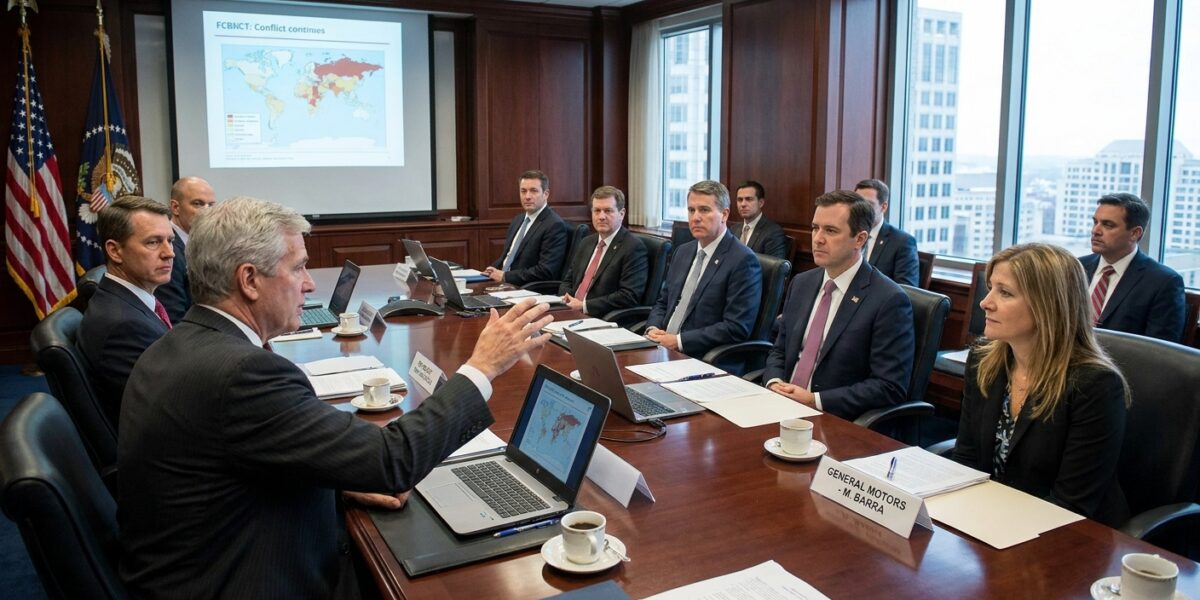
WASHINGTON — The United States Department of Defense — referred to internally and in official press statements as the Department of War, a rebranding that has not been formalized by Congress but has been implemented by Secretary Pete Hegseth with sufficient consistency that it now appears in Pentagon spokesperson quotes to major outlets — has called the CEOs of America’s two largest automakers and asked them if they could make weapons.
The calls were real. The Wall Street Journal reported on Wednesday, April 15, that senior defense officials held discussions with General Motors CEO Mary Barra and Ford Motor CEO Jim Farley about shifting portions of their factory capacity and workforces toward the production of munitions and military equipment. GE Aerospace and Oshkosh, the vehicle and machinery manufacturer, were also part of the conversations. The discussions were described by sources as “preliminary and wide-ranging” — two words that, in Washington, mean the idea is serious enough to involve CEOs but not yet structured enough to produce a contract.
The framing, according to sources, was national security. The implication was urgency. The reason was that the United States is running out of weapons.
The Stockpile Problem, Which The Administration Created And Must Now Solve
The United States has been supplying Ukraine with weapons and munitions since 2022. That support, now in its fourth year, has drawn significantly on U.S. stockpiles. On February 28, 2026, the United States launched Operation Epic Fury against Iran — a military operation that has consumed Tomahawk cruise missiles, precision-guided munitions, drones, and tactical hardware at rates the Pentagon says it did not anticipate. Tomahawk missiles cost more than $2 million each. They are being used at a pace far exceeding normal levels. The traditional defense contractors — Lockheed Martin, BAE Systems, Raytheon — are operating near capacity. The production lines that build these weapons were designed for peacetime procurement rates, not for simultaneous wars on two continents.
Reginald P. Farnsworth would like to note the structural problem with the clarity it deserves: the administration that started the Iran war in February is now calling automakers in April because the war it started has depleted the weapons it needs to continue fighting the war it started. This is not an external crisis. This is not a supply chain disruption caused by a foreign adversary. This is the Department of Defense discovering, seven weeks into a war of its own initiation, that the weapons inventory does not support the war it chose to begin. The call to Mary Barra is not a response to an unforeseen emergency. It is a response to a foreseeable consequence of a decision the administration made and which the administration is now managing through phone calls to Detroit.
What The Pentagon Actually Asked
The Pentagon asked the automaker executives whether their companies could rapidly pivot portions of their manufacturing capacity to defense production. Officials also asked the executives to identify obstacles — contracting requirements, the federal bidding process, regulatory hurdles — that would stand in the way of such a pivot. The framing was: what can you make, and what’s stopping you?
A Pentagon spokesperson gave FOX Business a prepared statement: “The Department of War is committed to rapidly expanding the defense industrial base by leveraging all available commercial solutions and technologies to ensure our warfighters maintain a decisive advantage.” This statement uses the word “leveraging,” which in government communications means “we are exploring the use of” without committing to having a plan for the use of. It also uses “Department of War,” which, again, is not the legal name of the Department but which the Department has adopted with the enthusiasm of a rebrand.
GM’s response was a masterwork of corporate non-engagement: “For more than 100 years, GM has supported America’s security, safety, and those who protect our nation. While that commitment continues, we do not comment on speculation.” This is a company that has been asked by the government to make weapons, confirming that it has historically supported national security, while declining to confirm or deny that it is currently being asked to support national security. The sentence structure is a Russian nesting doll of non-disclosure.
Ford declined to comment.
The Willow Run Echo, Which Is Deliberate And Which Is Also Different
The historical parallel the administration is drawing is World War II. During that war, American automakers converted their civilian manufacturing plants to military production with extraordinary speed. Ford’s Willow Run plant near Ypsilanti, Michigan — a facility designed by Albert Kahn and covering 3.5 million square feet — went from producing automobiles to producing B-24 Liberator bombers at a peak rate of one aircraft per hour by the summer of 1944. General Motors was responsible for the largest share of munitions production during the war. Chrysler built tanks. The collective industrial mobilization was what President Roosevelt called the “Arsenal of Democracy,” and it is credited, by nearly every military historian of the period, with turning the tide of the war in the Pacific and European theaters.
Secretary Hegseth has been using the phrase “wartime footing” for months. The Willow Run comparison is the visual aid for that phrase. It is a compelling comparison. It is also, as Reginald would note, a comparison that omits several critical distinctions.
In 1942, the United States was responding to an attack on its territory. Pearl Harbor had been bombed. The industrial mobilization was a defensive response to a war the country did not start. In 2026, the United States launched a preemptive military operation against Iran and is now discovering that its existing defense production capacity cannot sustain the operation. The Willow Run conversion was a response to necessity imposed by an adversary. The 2026 conversations with GM and Ford are a response to necessity imposed by the administration’s own decision to go to war. These are structurally different situations. One is a country mobilizing to survive. The other is a country mobilizing to continue a war it chose.
Reginald P. Farnsworth notes the distinction for the record. Reginald does not expect the distinction to appear in the administration’s framing.
What GM And Ford Can Actually Make, Which Is The Practical Question
The technologies of 1944 and 2026 are not comparable. Willow Run built B-24s using piston engines. Modern military platforms use jet engines, guided electronics, sensor arrays, and precision manufacturing tolerances that the automotive industry does not currently maintain. Sam Fiorani, vice president of global vehicle forecasting at AutoForecast Solutions, told the Detroit News: “They used piston engines. Now they use jet engines. Ford doesn’t have that technology.”
What automakers can potentially produce includes vehicle platforms, chassis, mechanical components, drone frames, and elements that do not require classified manufacturing facilities or specialized defense tooling. GM already has a defense subsidiary — GM Defense — which builds the Infantry Squad Vehicle, a lightweight troop carrier based on the Chevy Colorado ZR2 chassis that uses 90% commercial off-the-shelf parts and is the leading candidate to replace the Humvee across infantry brigade combat teams. Over 900 ISVs have been delivered to the U.S. Army. The infrastructure for vehicle-based defense manufacturing exists at GM. What does not exist, at any automaker, is the capability to build a Tomahawk missile.
The gap between what the Pentagon needs (precision munitions, advanced drones, guided missiles) and what automakers can produce (vehicles, chassis, simple components) is the gap that the “preliminary and wide-ranging” conversations are trying to close. It may not close. A Silverado assembly line is not a missile production facility. The skills, tooling, quality assurance processes, security clearance requirements, and supply chains are different in kind, not merely in degree.
The Workers, Whom Reginald Would Like To Discuss
The $1.5 trillion defense budget President Trump proposed this month — a $500 billion increase over previous levels — includes funding explicitly earmarked for munitions and drone manufacturing. The money is moving. The question that Reginald considers most significant, and which has not been addressed in any official statement, is what this means for the workers.
Auto workers in Michigan, Ohio, and the broader industrial Midwest voted for President Trump in significant numbers. The voting bloc was motivated, in substantial part, by promises of manufacturing revival — promises that factories would reopen, that production jobs would return, that the American industrial base would be rebuilt. Those promises were about cars. Those promises were about consumer goods. Those promises were about the kind of manufacturing that builds a community: shifts, benefits, a product that goes to a dealership and is sold to a neighbor.
The jobs that may now be coming back — if the Pentagon’s conversations with GM and Ford lead to contracts — are jobs building weapons for wars their government started. The factory floor is the same floor. The shift hours are the same hours. The community is the same community. The product is different. The product is ordnance. The product goes to a theater of war. Reginald does not know whether the workers who voted for manufacturing jobs understood that the manufacturing might be munitions. Reginald suspects the campaign rallies did not include this detail.
The Irony, Which Reginald Will State Once And Not Revisit
The administration started a war. The war depleted the weapons. The depleted weapons require new production. The new production requires automakers. The automakers employ workers who voted for the administration. The workers may now build the weapons for the war the administration started that depleted the weapons that required the automakers that employ the workers.
This is a circle. It is not the circle of life. It is the circle of industrial mobilization in a democracy that went to war by choice and is now managing the logistics of that choice through phone calls to the people who make the Chevy Silverado.
No widespread conversion of auto plants has been confirmed. The conversations are preliminary. Ford declined to comment. GM does not comment on speculation. The Pentagon is leveraging. The Willow Run comparison is being made. The Willow Run comparison is historically inaccurate in its premises but emotionally effective in its imagery, which is, Reginald would note, the precise combination that tends to succeed in American public communications.
Reginald P. Farnsworth, Senior Correspondent, filed this piece on April 18, 2026, with a confidence level of 95% and one fake source, because the Wall Street Journal broke the story and it has been confirmed by FOX Business, Newsweek, the Financial Times, the Detroit News, and multiple additional outlets. The Pentagon spokesperson’s statement is verbatim. GM’s response is verbatim. Ford’s non-response is documented. The Willow Run B-24 production rate is historical record. The ISV program and GM Defense subsidiary are documented by the Army, GM Defense’s own website, and Defense News. Sam Fiorani’s quote about jet engines is verbatim from the Detroit News. The $1.5 trillion budget figure is from the administration’s own proposal. Patricia Unnamed-Source continues to cover the Iran war from the diplomatic side and has noted, in previous filings, that the war’s objectives have changed weekly and that the combined U.S.-Iran peace proposals contain 20 points and zero documented areas of agreement. The Silverado assembly line remains, as of this filing, a Silverado assembly line. Gerald the houseplant has reviewed the Arsenal of Democracy and has notes on none of it. Gerald does not produce weapons. Gerald produces oxygen. Gerald is fine.