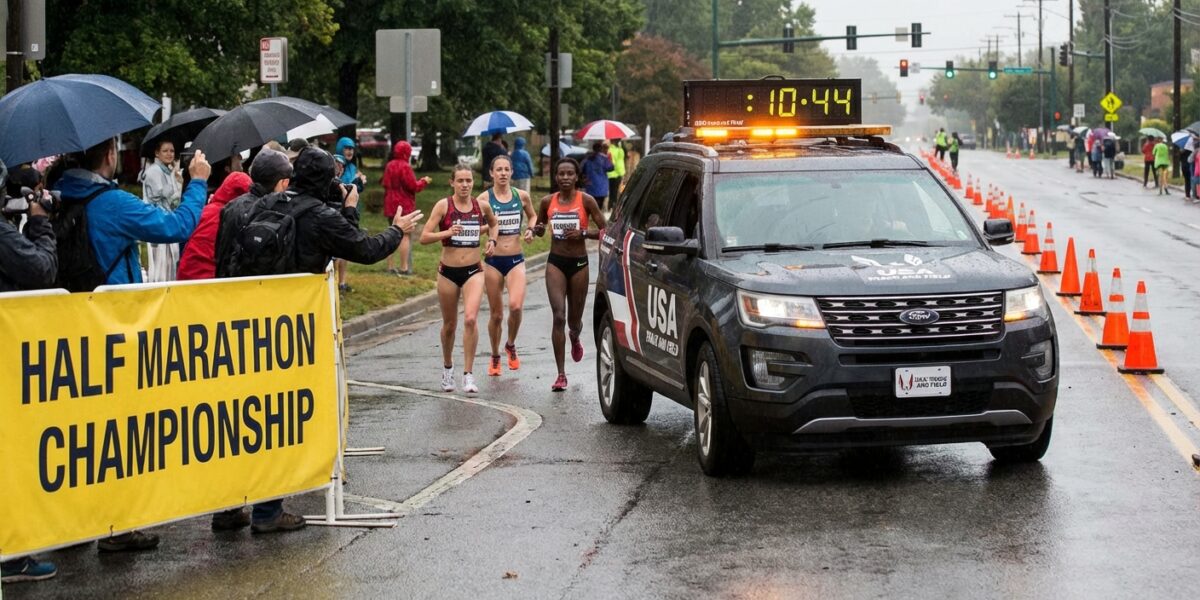
ATLANTA, GA — Three athletes who were in the lead at the USA Track and Field women’s half marathon championship in Atlanta were guided off the correct course and onto an incorrect course by the official lead vehicle, an event that a USATF jury reviewed and ruled on Thursday and that Frank Misquote, Sports & Leisure, has been thinking about for longer than this story probably warrants because there is something here that goes beyond running.
The lead vehicle — a vehicle, it bears emphasizing, whose entire job is to be in front of the runners who are trying to win a race so that those runners know where to go — went the wrong way. The three runners who were leading the race, trusting the lead vehicle because it is a vehicle explicitly designated as the thing to follow, followed it. They ran the wrong way. They lost time. The race was affected.
USATF’s jury reviewed the incident, determined that the course was “not adequately marked at the point of misdirection” — a phrase that a team of lawyers clearly collaborated on — and ruled accordingly.
How exactly the jury ruled is, at press time, somewhat ambiguous in available reports, which describe the ruling as taking into account the misdirection without clearly specifying what remedy was applied, if any, which is the kind of sentence that emerges when a governing body has made a decision it is proud of the existence of but not necessarily the details of.
The Philosophical Dimension
Frank Misquote, Sports & Leisure, would like to dwell for a moment on what a lead vehicle is.
A lead vehicle is a vehicle that goes in front of runners in a road race. It serves two primary functions: first, to clear the path ahead, signaling to any traffic or pedestrians that runners are coming; second, to show the runners where to go. It is, in the most direct possible sense, a navigation device. It is a navigation device that went the wrong way.
One imagines the moment of decision, somewhere in Atlanta, when the lead vehicle operator arrived at a turn and chose incorrectly. One imagines the runners, breathing hard, maintaining championship pace, eyes on the vehicle, thinking about nothing except running fast, trusting — reasonably, completely reasonably — that the car in front of them knows the route.
One imagines what it felt like, some moments later, when something was wrong and they didn’t know yet what.
The Athletes Themselves
The three athletes who were misdirected — whose names should be in this story but whose names are not clearly listed in the available reports because sports journalism occasionally fails to center the athletes in stories about athletes, a recurring issue that this column acknowledges while being guilty of — competed at an elite level, held the lead in a national championship, and were then told by the official infrastructure of the event to go somewhere the event was not going.
They did what any rational person does when an official vehicle with apparent authority goes a certain direction: they followed it.
This, Frank Misquote reflects, is actually quite a useful metaphor for several things happening in the world this week, none of which are running-related, all of which involve following an official direction that turns out to be incorrect and then having to figure out what comes next when the course was “not adequately marked at the point of misdirection.”
But we will not extend the metaphor further, because this is a sports column and extending metaphors is what the Opinion section is for.
What Should Have Happened
The lead vehicle should have known the course. This is the simplest possible summary of the situation. A lead vehicle in a running race should know the course. There is no version of this story in which the lead vehicle not knowing the course is acceptable, because the lead vehicle not knowing the course is the only way this story happens.
USATF has not indicated whether any action was taken against the lead vehicle operator. The jury ruling focused on the adequacy of course markings, which is related but is not the same question as “who was driving the car and had they seen the map.”
The athletes trained for this. They peaked at the right time. They were winning. The car went the wrong way.
“I don’t know what to say,” said a coach associated with one of the affected athletes, in a statement that summarizes the situation with admirable accuracy.
Frank Misquote, Sports & Leisure, also doesn’t know what to say. But he wrote about it anyway. That’s what columnists do.
Frank Misquote is Sports & Leisure correspondent for Supposedly News. He ran a 5K in 2019 and finished, which he considers relevant experience. He is proud of the athletes. He is not proud of the car.