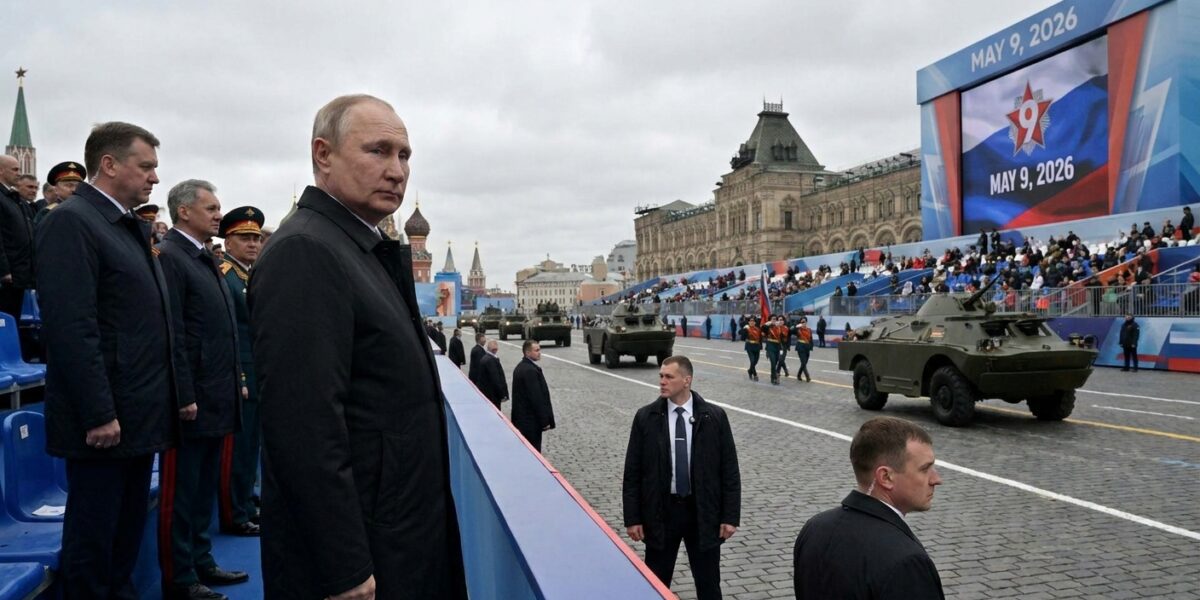
MOSCOW — On Saturday, May 9, 2026, the city of Moscow conducted its annual Victory Day parade in Red Square. The parade commemorates the 81st anniversary of the Soviet Union’s victory over Nazi Germany in the Second World War — a victory that took 27 million Soviet lives and which has been, for eight decades, the central organizing event of Russian national identity. The parade typically features tanks, missiles, aircraft flyovers, and thousands of marching soldiers. The parade is broadcast nationally. The parade is attended by foreign dignitaries. The parade is, in normal years, the largest single demonstration of conventional military power that the Russian state stages annually.
This year, the parade was scaled back. Reginald would like to be specific about the reason for the scaling back, because the reason is the story. The parade was scaled back because Russian officials were afraid Ukraine would attack it.
An NPR correspondent in Moscow reported that the move was “a symbol of Russians’ growing frustrations with the war.” Reginald considers this a diplomatic phrasing of what the move actually symbolizes, which is: the country that is conducting a war is now afraid that the country it is conducting the war against will use its own holiday to demonstrate that the war is not going the way the war was supposed to go. The annual celebration of Russian military supremacy was reduced in size because Russian military supremacy could not be guaranteed during the celebration.
The Guests, Which Reginald Would Like To Note
Among the foreign attendees at the scaled-back parade: North Korean servicemen. Photographs from the AP show North Korean troops in formation, waiting for the start of the parade in front of the State History Museum. North Korea has, over the past two years, sent troops to fight alongside Russian forces in Ukraine. The arrangement has been confirmed by multiple Western intelligence agencies. The arrangement was acknowledged by Pyongyang in 2024. The arrangement is now ceremonial enough that the Hermit Kingdom’s soldiers attended a Russian holiday parade in Red Square in full uniform.
This is, structurally, a coalition. The coalition is Russia and North Korea. North Korea is the country whose leader Kim Jong Un, per a separate AP photograph released the same week, was inspecting his new destroyer Choe Hyon and announcing the deployment of new long-range artillery systems capable of striking Seoul. Russia’s allies, in 2026, include the country building new artillery to strike a U.S. ally. This is what the coalition looks like. This is who showed up at the scaled-back parade. Reginald is documenting this for the record.
The Three-Day Ceasefire, Which Was Three-Day Only In Name
President Volodymyr Zelenskyy and Yuri Ushakov — Putin’s foreign affairs adviser — both confirmed a three-day ceasefire between Russia and Ukraine over the Victory Day weekend, along with an exchange of prisoners. The ceasefire was announced as a goodwill gesture timed to the holiday.
During the first day of the ceasefire, Kharkiv Oblast Governor Oleh Syniehubov reported that a Russian drone had struck a residential building in Kharkiv. The strike occurred during the beginning of the ceasefire that Russia had agreed to and announced. The ceasefire was, by the time the strike was confirmed, a ceasefire that had been violated by one of the two parties who had announced it, and the party that violated it was Russia, and the violation occurred on day one.
Reginald would like to note that this is a structural pattern. A three-day ceasefire that is violated on day one is not a three-day ceasefire. It is a one-day ceasefire that the parties announced as a three-day ceasefire for the diplomatic value of the announcement. The diplomatic value has now been collected. The actual ceasefire has not. The diplomatic value is in the headlines. The actual ceasefire is in Kharkiv, where it is no longer in effect.
Putin Said The War May End Soon, Which Reginald Has Heard Before
The same weekend, Putin told Reuters that he thinks the Russo-Ukrainian war “may come to an end soon.” This is notable because Putin has, over the past four years, repeatedly stated that Russia would achieve total victory over Ukraine — a position consistent with his initial framing of the invasion in February 2022 as a “special military operation” that would be completed within days. The position has shifted over time. The position has shifted in proportion to the failure of the invasion to be completed within days. The position has now arrived at: the war may come to an end soon.
Reginald has, in his prior reporting, declined to predict the conclusion of armed conflicts. Reginald is going to maintain that practice. Reginald is, however, going to note that Putin saying the war may end soon while simultaneously scaling back the Victory Day parade out of fear of Ukrainian drone attacks and while ordering a strike on Kharkiv during day one of a Russian-announced ceasefire is a position that contains internal contradictions. The contradictions are: the war may end (peaceful framing) and the parade is unsafe (military weakness framing) and Kharkiv was struck (ongoing aggression framing) and all of these are simultaneously true and all of these were communicated by the same government during the same weekend.
The contradictions are not Reginald’s editorial position. The contradictions are the Russian government’s position. Reginald is documenting them. The documentation is the timeline. The timeline begins with a parade that was not large because the country running the parade was afraid the war was not going well. The timeline ends with a strike on a residential building during a ceasefire. The middle of the timeline is Putin telling reporters that the war may end soon. The middle is not the middle of a peace process. The middle is the middle of a weekend. Weekends end. Wars end on different timelines, and the Russian government’s timeline has been wrong since February 2022.
Reginald P. Farnsworth, Senior Correspondent, filed this piece on May 11, 2026, with a confidence level of 100% and zero fake sources, because every element is documented. The Victory Day parade scaling back is documented by NPR (whose correspondent characterized it as a symbol of Russian frustration with the war). Putin’s ‘may come to an end soon’ statement is from Reuters and The Moscow Times. The three-day ceasefire and the prisoner exchange were confirmed by Zelenskyy and Ushakov, per Wikipedia’s Portal:Current Events. The Russian drone strike on Kharkiv during the ceasefire was reported by Governor Oleh Syniehubov. The North Korean troops attendance at the parade is from AP photography. Kim Jong Un’s destroyer Choe Hyon and the long-range artillery announcement are from KCNA via AP. Russia’s invasion of Ukraine began February 24, 2022. Patricia Unnamed-Source is watching the Strait of Hormuz. Reginald is watching Red Square. Gerald the houseplant is watching the room from his pot. Gerald is fine.