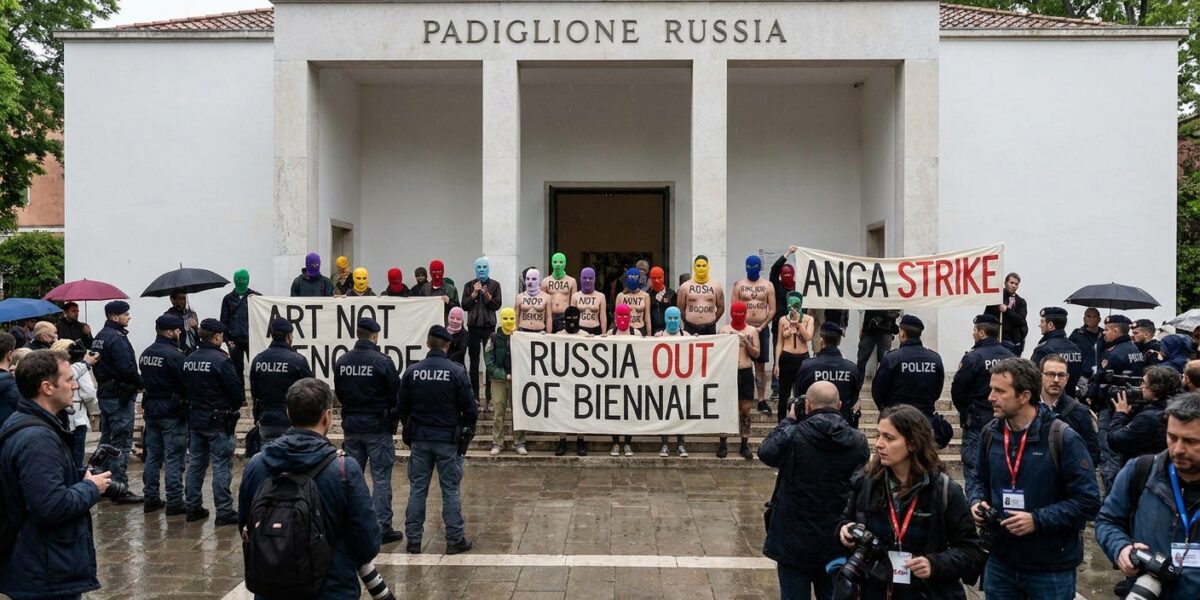
VENICE, ITALY — The Venice Biennale operates on a system that is, structurally, the same system used by the Olympics: a host city, an international cultural event, and a series of national pavilions in which each participating country sends its best (in the Biennale’s case, contemporary art; in the Olympics’ case, athletes) to compete for international recognition. The system was designed in 1895, when the world had fewer countries and fewer political crises that intersected with the visual arts. The system has been updated, but the structure has not. The structure is: each country gets a pavilion. Each pavilion presents what the country has decided to present. The pavilions are, collectively, a snapshot of the world’s official self-presentation through art at a given moment.
The moment, in 2026, is complicated. The structure is now being tested by the moment. Millicent has been waiting for this test. Millicent has been waiting since the Biennale’s announced lineup included Israel and Russia — two countries currently engaged in armed conflicts that international bodies have, in various capacities, criticized — and Millicent suspected, when the lineup was published, that the opening weekend would produce news. The opening weekend produced news. Millicent’s suspicion is now documented.
The Art Strike, Which Was The Story
By Saturday evening, pavilions had closed. The closures were not technical closures — power outages, weather, scheduling. The closures were organized. The organization was the Art Not Genocide Alliance — ANGA — a coalition of artists, curators, and cultural workers that has been calling for Israel’s exclusion from international art events over Israel’s conduct in the Gaza war. The Alliance called for a strike on the Biennale’s opening day. Artists responded. Pavilions closed.
Millicent would like to note that an art strike is a category of labor action that does not exist in most cultural sectors. Painters do not generally unionize. Sculptors do not generally walk out. Installation artists do not generally observe picket lines. The Biennale’s pavilion system, however, depends on artists agreeing to install their work, agreeing to be present at openings, agreeing to participate in the public-facing rituals of the exhibition. When artists withdraw participation, the pavilion is closed. The pavilion being closed is the political statement. The statement is: I will not be in this room while another room in this same exhibition is occupied by a country whose conduct I am protesting.
This is not a boycott of the Biennale. The artists did not refuse to send work. The artists sent the work, installed the work, and then closed the pavilions in solidarity with the protest against Israel’s participation. The work remained in the rooms. The rooms were closed. The structure was used against itself. The Biennale’s pavilion system, designed to showcase national presentation, became — for one weekend — a system for documenting which countries the participating artists believe should not be at the Biennale. The system did not break. The system produced exactly what the system was designed to produce: a snapshot of the world’s official self-presentation through art at a given moment. The moment, in this snapshot, included artists closing their own pavilions to protest another country’s pavilion. Millicent considers this the most coherent political crisis the Biennale has ever produced.
The Russian Pavilion, Which Is Open Again And Which Pussy Riot And FEMEN Attended
The Russian pavilion was closed during the 2024 Biennale. Russia did not participate. The pavilion was empty. The emptiness was understood, in the international cultural community, as a passive form of acknowledgment of the 2022 invasion of Ukraine. Russia did not formally withdraw — Russia simply did not show up. The pavilion sat in the Giardini, unoccupied, for the duration of the 2024 exhibition. Visitors walked past it. Many took photographs.
In 2026, Russia came back. The pavilion is open. The Russian curators selected the work. The work is installed. The pavilion functions as a pavilion again. The structure has resumed.
The resumption did not go unprotested. On Saturday, members of Pussy Riot — the Russian feminist protest collective known for its 2012 cathedral performance and subsequent imprisonment — and FEMEN — the Ukrainian-founded radical feminist protest movement known for topless demonstrations against authoritarianism — appeared at the Russian pavilion. AP photography captured them protesting Russia’s presence at the Biennale. The protest was visible. The protest was photographed. The protest was distributed internationally. The pavilion remained open. The protest occurred in front of it.
Millicent considers this an artistically perfect arrangement: a Russian art pavilion is open for the first time since the Russian invasion of Ukraine; Russian and Ukrainian protest collectives are outside it, jointly demonstrating against the country whose pavilion has reopened; the protest is documented by international press; the documentation is part of the Biennale’s cultural record now, alongside the official Russian curatorial selection. The pavilion exists. The protest of the pavilion exists. Both are now in the historical record of the 61st Venice Biennale. The Biennale has not chosen between them. The Biennale does not have to. The Biennale is the structure that holds them both.
What This Tells Us About National Pavilions, Which Millicent Has Been Thinking About For A Long Time
The national pavilion structure was invented in 1895 to celebrate the cultural achievements of European nation-states at a moment when the European nation-state was the dominant unit of geopolitical organization. The structure assumed that art was, fundamentally, a national product — that the work of artists could be meaningfully grouped by passport. The structure has been criticized for decades by curators, artists, and theorists who have argued that contemporary art operates on transnational lines, that artist identity is not coterminous with national citizenship, and that the pavilion system therefore mismatches the actual geography of contemporary creative practice.
The 61st Biennale has, in its opening weekend, produced a different argument: the pavilion system works fine; the pavilion system works precisely because national identity remains contested; the pavilion system is, in fact, the most efficient available mechanism for staging contested national identity in a single physical space and watching the contests play out in real time. The Israeli pavilion is contested. The Russian pavilion is contested. The contestation is happening in front of the pavilions. The contestation is being photographed, documented, and distributed. The Biennale is doing what the Biennale was designed to do: showing the world to itself. The world, in the showing, has chosen to argue. The argument is the show.
Millicent considers the 61st Venice Biennale’s opening weekend the most successful demonstration of the Biennale’s continued cultural relevance in a generation. The pavilions are not just art rooms. The pavilions are now the visible architecture of how international politics is being conducted by people who do not have access to national militaries but do have access to the international cultural calendar. The artists closed their own pavilions. Pussy Riot showed up at someone else’s. The Biennale absorbed all of it. The Biennale will absorb the next one too. The Biennale has been doing this since 1895. The Biennale knows how this works.
Millicent Hearsay, Culture Desk, filed this piece on May 11, 2026, with a confidence level of 100% and zero fake sources, because every element is documented. The 61st Venice Biennale opened on May 9, 2026, per Wikipedia’s Portal:Current Events. The pavilion closures due to the Art Not Genocide Alliance strike over Israel’s participation are documented by the Times of Israel and NPR. Pussy Riot and FEMEN’s protest at the Russian pavilion on May 6, 2026, is documented by AP photography via NPR. Russia’s absence from the 2024 Biennale and return for 2026 is historical record. The Biennale’s founding date (1895) and biennial structure are historical record. The 2012 Pussy Riot cathedral performance and FEMEN’s origins are historical record. All structural analysis of the pavilion system as a 131-year-old architecture for contested national identity is the editorial work of Millicent Hearsay. Gerald the houseplant has not been to Venice. Gerald’s pavilion is his pot. Gerald is fine.