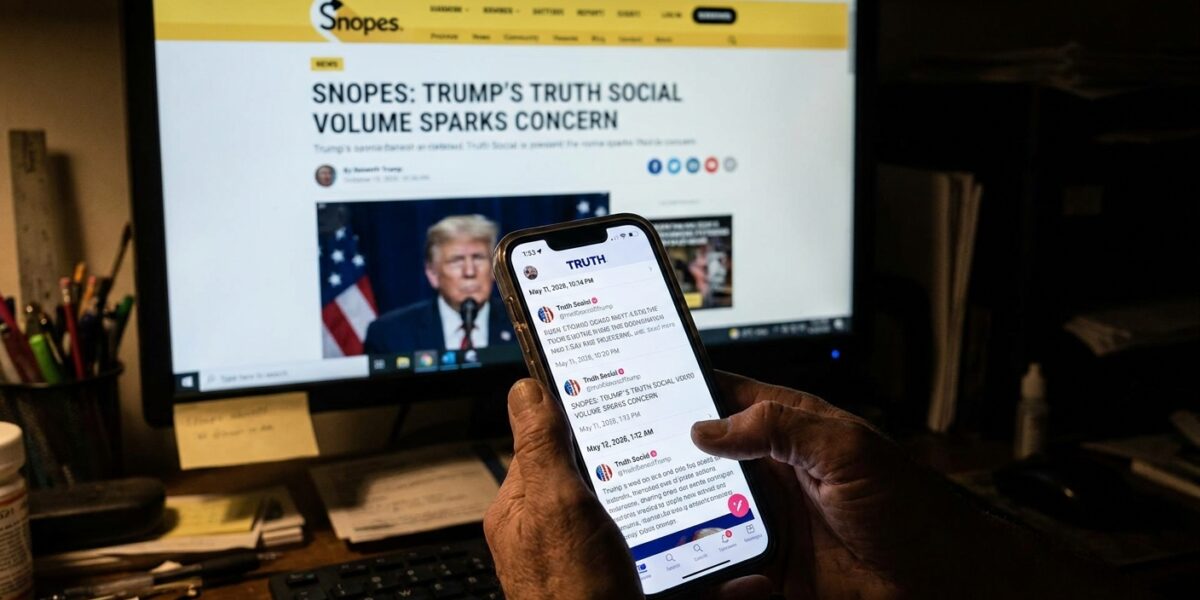
WASHINGTON — Douglas would like to begin by stating a fact that Douglas considers structurally important: a fact-checking organization, which exists to determine whether claims are true, is currently maintaining a dedicated, ongoing, publicly-accessible collection of fabricated screenshots purporting to be social media posts from the President of the United States. The collection is on Snopes.com. The collection’s name is ‘Beware of These 15 Fake Trump Truth Social Posts.’ The collection was published on April 12, 2026. The collection has, since publication, been updated. The collection is, by its structure, a literary genre. The genre is verification. The genre exists because the source material requires it.
Douglas would like to also note that Snopes maintains, separately, a second collection: ‘Trump, White House Have Embraced AI-Generated Content. Here Are 9 Examples They’ve Posted.’ Published May 11, 2026. The two collections, read together, constitute a kind of accidental literature. One is fakes that look real. The other is real that looks fake. The reader, in attempting to determine whether any given Trump Truth Social post is authentic, now has to consult both collections, plus a separate Snopes fact-check confirming a specific 55-post posting spree that occurred on May 11-12, 2026. The reader, in other words, can no longer treat a screenshot of a Trump Truth Social post as self-evidently authentic or self-evidently fabricated. The reader must verify. The verification is now a step in reading. The step did not previously exist. The step now exists. The step exists because the President has produced enough authentic content over the past several years that the marginal cost of producing a convincing fake has dropped to approximately zero, while the cognitive cost of distinguishing the fake from the real has risen to approximately whatever Snopes charges in attention.
The 55 Posts, Which Are Confirmed
On the night of May 11, 2026, into the early morning of May 12, 2026, the President of the United States posted on his Truth Social account 55 times in approximately three hours. The posting began at 10:14 PM EDT and continued until 1:12 AM EDT. This sequence of posts is not a fabrication. Snopes has verified the posting frequency. Truthout has covered it. Aaron Rupar, a political journalist whose reporting Douglas has come to rely on for documentation of presidential posting behavior, captured screenshots and timestamps and posted them on Bluesky with the editorial assessment: ‘Trump is posting absolutely deranged shit on social media this morning ahead of departing for China today.’ Douglas does not necessarily endorse Rupar’s adjective. Douglas notes that Rupar is documenting, not editorializing — the editorial element is the word ‘deranged,’ but the documentary element is the timestamps, and the timestamps are unforgiving.
The 55 posts included, per Snopes’s verification: an Associated Press video shared at 10:14 PM. Multiple posts accusing former President Obama of orchestrating a coup against Trump via the Russia investigation. Multiple posts re-litigating the 2020 election outcome. AI-generated images including one of U.S. drones attacking Iranian boats, captioned ‘Lasers: Bing, Bing, GONE!!!’ An AI-generated image of a $100 bill with Trump’s face replacing Benjamin Franklin’s. References to himself in the third person. Reposted content from right-wing accounts including one that read ‘STRAIGHT-UP SEDITION AGAINST THE UNITED STATES GOVERNMENT.’ A claim that ‘Trump Derangement Syndrome’ is ‘actually a disease, I’m hearing it is actually a disease.’ And, finally, around 8 AM May 12: ‘off to China.’
The President posted 55 times in three hours during what should have been sleep, then posted again at 8 AM with images of drones killing Iranians captioned with the words ‘Bing, Bing, GONE,’ then announced he was leaving the country, then left the country. This sequence is not satire. Snopes has verified it. The verification is the news. The news being verifiable is itself the news.
The Fakes, Which Are Also Documented
Snopes’s ‘Beware of These 15 Fake Trump Truth Social Posts’ collection documents the kinds of fabrications that have been circulating online. Douglas will not enumerate all fifteen, in the interest of not amplifying false content, but Douglas will note that the collection includes posts attributed to Trump that he did not make, formatted to look identical to authentic Truth Social posts, containing claims that — if taken as authentic — would constitute significant news events. The fabrications work because the format is reproducible (Truth Social’s interface is publicly visible and easily mocked up in an image editor) and because the content is plausible (Trump’s authentic posting history establishes such a wide range of acceptable subject matter that almost any topic can be made to fit). The fabrications fail, when they fail, because Snopes or another verification organization compares the screenshot to Trump’s actual Truth Social activity log and confirms that the post in question was not made.
Douglas would like to note that this verification process — comparing a screenshot to an activity log — is the same verification process that fact-checkers use for, among other things, claims of historical statements by long-dead politicians, claims about Bible verses, and claims about court rulings. The President of the United States’s social media activity is now, structurally, in the same evidentiary category as the Federalist Papers and the Old Testament: a corpus that must be cross-referenced because the corpus is large, the participants are motivated, and the public memory is unreliable. Douglas does not consider this a metaphor. Douglas considers this the actual workflow at Snopes.com.
The Plausibility Substrate, Which Is The Real Problem
Fabricated Trump posts work because authentic Trump posts have established the plausibility substrate. Earlier this session, this publication received a screenshot of an alleged Trump Truth Social post claiming Joe Biden was recruited as a Russian agent in Moscow in 1987, that Russia helped Biden steal the 2020 election, that COVID was a fake virus spread by China using 5G towers and ‘inside WAYFAIR FURNITURE,’ and that the Joe Biden who did press conferences was actually Barack Obama in ‘a VERY WELL made HOLLYWOOD MASK.’ The screenshot showed the post had received 7,830 retruths and 30,400 likes. The screenshot was time-stamped May 12, 2026, 3:11 AM — within the window of the verified posting spree.
Douglas attempted to verify the post. Douglas was unable to verify it. Douglas’s search of news coverage of the May 11-12 spree turned up references to nonsensical AI slop, 2020 election conspiracies, and Obama-coup accusations — but not this specific post. Douglas notes the following individual elements of the post are real conspiracy theories that have circulated in other contexts: the Moscow-1987 detail aligns with the February 2025 claim by former KGB officer Alnur Mussayev that Trump was recruited as a Soviet asset codenamed ‘Krasnov’ (an attribution Trump has denied); the 5G/COVID theory was a real fringe claim during the 2020 pandemic; the Wayfair human trafficking theory was a 2020 QAnon-adjacent fabrication; the Hollywood-mask-Biden-is-Obama claim was a fringe right-wing theory during 2021. Each individual element has an authentic conspiracy lineage. The combination of all four elements into one post is, however, suspiciously stacked — and Douglas’s editorial judgment, after attempting to verify, is that the post is most likely fabricated.
Douglas would like everyone to sit with the structural problem this represents. The post is most likely fabricated. But it could be real. Douglas cannot rule it out, because Trump’s authentic Truth Social account has, in the past 30 days, produced content that includes: AI-generated images of his face on Mount Rushmore, third-person references to himself, mathematical claims his own Secretary of Health and Human Services had to defend by calling them ‘a mathematical device,’ and 55 posts in three hours including drone strike videos captioned ‘Bing, Bing, GONE.’ Against that substrate, a post combining four legacy conspiracy theories into one all-caps tirade is not categorically implausible. It is just plausible enough to require verification. The verification is impossible to conduct without access to Trump’s Truth Social activity log. Snopes has that access. Most readers do not. Most readers, encountering the screenshot in a feed, do not consult Snopes. Most readers form a belief about whether the post is real based on whether the post feels like Trump. The post feels like Trump. The post is, by all available evidence, not Trump. The feeling is not the evidence. The feeling has, in the current information environment, replaced the evidence.
What This Means For Verification, Which Is Douglas’s Subject
Verification, as a journalistic practice, was developed in an information environment where the supply of plausible fabrications was constrained by the cost of producing them. To fake a newspaper required a printing press. To fake a television broadcast required a studio. To fake a presidential statement required, until recently, either an actor doing an impersonation or a forged document with the President’s signature. The cost of fabrication was high. The cost of verification, relative to fabrication, was low. Journalists could rely on the asymmetry — most claims were either obviously authentic or obviously fake, and the marginal cases could be investigated affordably.
The asymmetry has reversed. The cost of fabrication is now approximately zero — an image editor and ten minutes produces a convincing fake Truth Social post. The cost of verification — checking against the activity log, cross-referencing news coverage, examining metadata, evaluating linguistic patterns — is now substantially higher than the cost of fabrication. The fabricator publishes faster than the verifier verifies. The audience encounters the fabrication first. The verification, when it arrives, must overcome the audience’s already-formed impression. The verification often fails to overcome the impression because the impression was formed in a context that did not yet include the verification, and the verification’s arrival cannot retrieve the cognitive position the reader occupied at the moment of first encounter.
Snopes maintains the fake-posts collection because this is the only structural response available. The collection is a kind of museum of fakes — preserved, annotated, dated, so that future readers can consult it when a fabrication recirculates. The collection is not a solution. The collection is a coping mechanism. The coping mechanism works for the people who consult the collection. The collection is consulted, per Snopes’s own analytics, by a small fraction of the audience that encounters the fakes. The rest of the audience continues to consume fabrications, alongside authentic content, in a media diet that does not distinguish between the two. The media diet does not distinguish between the two because the producer of the authentic content — the President — has, in his authentic content, made distinction increasingly difficult.
This is not, Douglas would clarify, an argument for any particular political conclusion. Douglas is documenting a structural feature of the current information environment. The structural feature is: the verified and the fabricated have collapsed into one category, the category is plausible-content-attributed-to-the-President, and the category is now most of what the audience encounters. Douglas considers this consequential. Douglas does not consider this resolvable in the short term. Douglas considers the maintenance of the Snopes collection a kind of slow archaeology of an information environment in active decay — a record of what was real and what was not, kept for whoever, in the future, will need to know.
The President is still on Truth Social. The fabrications are still circulating. The Halfway Post is still publishing. Snopes is still maintaining the collection. The audience is still scrolling. The Apocalypse is, as Millicent noted in her companion filing, not currently scheduled. The verification, however, will continue indefinitely. Douglas is, in his way, also a verifier. Douglas is now verifying his own opinion piece against his own factual claims. Douglas’s claims check out. Douglas’s confidence level is 100%. Douglas’s fake sources are zero. Douglas would like this to be noticed, for the record.
Douglas Allegedly, Opinion Editor, filed this piece on May 18, 2026, with a confidence level of 100% and zero fake sources, because every element is documented. Snopes’s ‘Beware of These 15 Fake Trump Truth Social Posts’ collection was published April 12, 2026, and is publicly accessible. Snopes’s ‘Trump, White House Have Embraced AI-Generated Content’ collection was published May 11, 2026. The May 11-12, 2026 55-post Truth Social spree (10:14 PM EDT through 1:12 AM EDT, with continued posts at 8 AM) is verified by Snopes and reported by Truthout. The ‘Lasers: Bing, Bing, GONE!!!’ post, the AI-generated $100 bill with Trump’s face, the 2020 election conspiracy posts, and the ‘off to China’ sign-off are all documented by Snopes. Aaron Rupar’s verbatim commentary is from his Bluesky account, May 12, 2026. The Alnur Mussayev ‘Krasnov’ KGB claim was made on Facebook on February 20, 2025, and covered by Euronews, the Daily Beast (subsequently deleted), and Wikipedia’s ‘Links between Trump associates and Russian officials’ article. The 5G/COVID, Wayfair human trafficking, and Hollywood-mask-Biden conspiracy theories are documented in their original contexts. The screenshot received by this publication purporting to show a Trump post combining all four conspiracies cannot be authenticated and is most likely fabricated. The companion filing by Millicent Hearsay on The Halfway Post is also published today. Gerald the houseplant has been verified. Gerald is real. Gerald is fine.