ATLANTA / WASHINGTON — Yolanda would like to begin with the definition, because the definition is precise, and because the precision of the definition is the entire reason this article exists.
‘Measles elimination,’ as a technical term, has a specific meaning, set through the Pan American Health Organization in coordination with neighboring countries, using thresholds that U.S. scientists themselves helped write. A country has eliminated measles when there is no continuous transmission of the virus within its borders for 12 months or longer. A country loses elimination status when continuous domestic transmission resumes and persists past that 12-month threshold. Imported cases — a traveler who catches measles abroad and is diagnosed at home — do not count against the status, unless that traveler transmits the virus onward into a domestic chain that then sustains itself. The definition is not vague. The definition is a clock. The clock starts when continuous domestic transmission begins. When the clock passes 12 months, the status is, by the definition, lost.
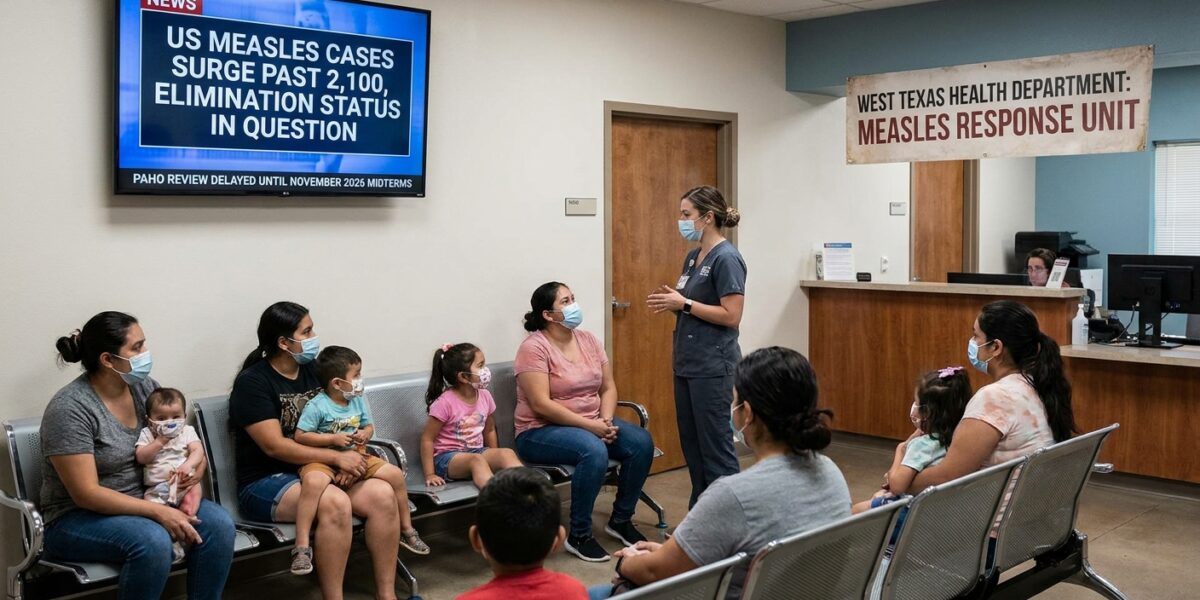
Yolanda would now like to apply the definition to the documented facts. The major West Texas outbreak began on January 20, 2025. When that outbreak was declared ‘over’ seven months later, measles cases in the United States did not stop; per the CIDRAP analysis Yolanda has read, the outbreaks relocated — to other parts of Texas, to South Carolina (where the 2025-2026 outbreak reached 997 cases, the largest single outbreak since elimination was declared), to Utah (now the center of active transmission, having spread to 22 of the state’s 29 counties), and across more than 40 jurisdictions in total. The imported share of cases — the signature of a country catching measles from elsewhere rather than growing its own — has fallen from roughly 40% in the 2001-2011 era to approximately 6% in early 2026. Six percent imported means 94% homegrown. Ninety-four percent homegrown, sustained continuously since January 2025, is — measured against the definition the country signed onto — continuous domestic transmission well past the 12-month mark.
The Conditional Tense, Which Is Yolanda’s Subject
Here is where Yolanda’s interest sharpens. The official and semi-official public messaging about the U.S. measles situation is, almost universally, in the conditional tense. The country ‘may lose’ its elimination status. The status is ‘at risk.’ A review panel ‘will determine’ whether elimination should be retained. Yolanda would like to draw attention to what the conditional tense is doing, because the CIDRAP epidemiologist whose op-ed Yolanda read drew attention to it first, and drew it well. The conditional tense frames the loss of elimination status as a future possibility contingent on a forthcoming determination. The definition, however, describes the loss of elimination status as a present condition contingent on the virus’s behavior over a defined past window — and the virus’s behavior over that window is already, on the documented data, the behavior that the definition says costs a country its status. The determination in November is not, in this reading, a decision about whether the status will be lost. It is a reading-out of whether the status has already been lost, based on what the virus did during a window that has already closed.
The CIDRAP author put it in the plainest possible terms: there is an old rule that if it walks like a duck and quacks like a duck, you stop debating taxonomy and call it a duck — and that, when it comes to measles, the country has collectively decided not to do that, sliding from appropriate scientific caution into what the author characterized as a false comfort that, at its worst, reads as crisis PR. Yolanda would like to be fair to the cautious instinct here, because the cautious instinct is, in part, legitimate. Genomic analysis genuinely is being done — the Broad Institute has reportedly sequenced around a thousand measles virus genomes — and the genotyping resolution is genuinely limited, because global immunization has reduced the circulating measles genotypes to only two, which makes it harder to definitively distinguish one continuous domestic chain from multiple separate imported ones. The scientific caution is not entirely manufactured. Some of it is real methodological humility about a genuinely hard measurement problem.
But Yolanda would also like to note the detail that the CIDRAP author flagged and that Yolanda cannot un-see: the review was originally scheduled for April 2026, and it has been postponed to November 2026, at the request of U.S. health officials. November 2026 is when the midterm elections are. The one-year analysis window is fixed — it runs from January 20, 2025 — so moving the review changes when the verdict is read, not what the virus did during the window under review. Yolanda is not in a position to assert that the postponement was motivated by the election calendar. Yolanda is in a position to note that an internationally visible public-health judgment about a vaccine-preventable disease was moved off the spring calendar and onto the same month as a national election, and that the movement does not change the underlying data, and that the conditional tense (‘may lose’) is doing the work of holding open, rhetorically, a question that the data may have already closed.
The Reason This Matters, Which Is Not Rhetorical
Yolanda would like to step out of the analysis of tense and into the reason the tense matters, because the reason is not academic. Measles is among the most contagious diseases known to medicine: per the CDC, if one infected person enters a room, up to nine of ten unprotected people present will contract the virus, and the virus remains viable in the air for up to two hours after the infected person leaves. The surge is driven by declining vaccination: MMR coverage among kindergartners has fallen from 95.2% in the 2019-2020 school year to 92.5% in 2024-2025, and roughly 92% of 2026 cases are in people who were unvaccinated or whose status is unknown. Herd immunity against measles requires approximately 95% coverage; below that threshold, transmission sustains itself. The country is below the threshold and falling. A modeling estimate cited by the Common Health Coalition holds that just a 1% further decline in childhood MMR coverage could produce 17,000 measles cases, 4,000 hospitalizations, and 36 preventable deaths per year. The conditional tense does not change any of these numbers. The conditional tense changes only how urgent the situation sounds to a member of the public reading a headline.
Yolanda would like to close by holding the human reality away from the analysis, because it deserves to be held separately and held with care. Three people have died of measles in the United States since the combined 2025-2026 outbreak began — two of them young children in Texas, and one an adult in New Mexico. All three were unvaccinated. They were the first measles deaths in the United States since 2015. Yolanda does not know their names; the public reporting Yolanda has read does not provide them, and Yolanda will not invent them. Yolanda would like the record simply to reflect that they were real people, that two of them were children, that measles is a vaccine-preventable disease, and that their deaths are the part of this story that no amount of conditional tense can soften, because death is not conditional. Measles elimination is a status that can be debated in the future tense. The three people are not a status. They are the reason the status was worth achieving in 2000, and the reason it is worth grieving if it is, as the duck appears to suggest, already gone. Yolanda will read the November determination when it is released. Yolanda hopes to be proven too pessimistic. Yolanda is not, on the current data, expecting to be.
Yolanda Tippington, Science Correspondent, filed this piece on June 29, 2026, with a confidence level of 100% and zero fake sources, because every element is documented. The 2026 measles figures (2,134 confirmed cases as of June 25, 41 jurisdictions, 30 outbreaks, 93% outbreak-associated) are from the CDC’s official measles tracker, U.S. News & World Report, and Medical Daily. The elimination-status definition, the January 20, 2025 West Texas outbreak start, the 997-case South Carolina outbreak, the Utah outbreak (22 of 29 counties), and the decline of the imported case share from ~40% (2001-2011) to ~6% (early 2026) are from the CIDRAP op-ed, the CDC, and Johns Hopkins. The PAHO review postponement from April to November 2026 is from CIDRAP and Johns Hopkins. The ‘walks like a duck’ framing is from the CIDRAP op-ed. The MMR coverage decline (95.2% to 92.5%), the ~95% herd immunity threshold, the ~92% unvaccinated-or-unknown case share, the CDC’s nine-of-ten contagiousness figure, and the Common Health Coalition modeling estimate are from U.S. News, the CDC, and the Common Health Coalition. The three deaths (two unvaccinated children in Texas, one unvaccinated adult in New Mexico, the first U.S. measles deaths since 2015) are from Medical Daily. This is a sensitive public-health topic; readers with questions about measles or MMR vaccination should consult the CDC or a licensed physician. Gerald the houseplant has reviewed this article. Gerald cannot contract measles, because Gerald is a plant. Gerald is vaccinated against nothing and immune to everything in this particular category. Gerald is fine. Gerald hopes you and your children are vaccinated.