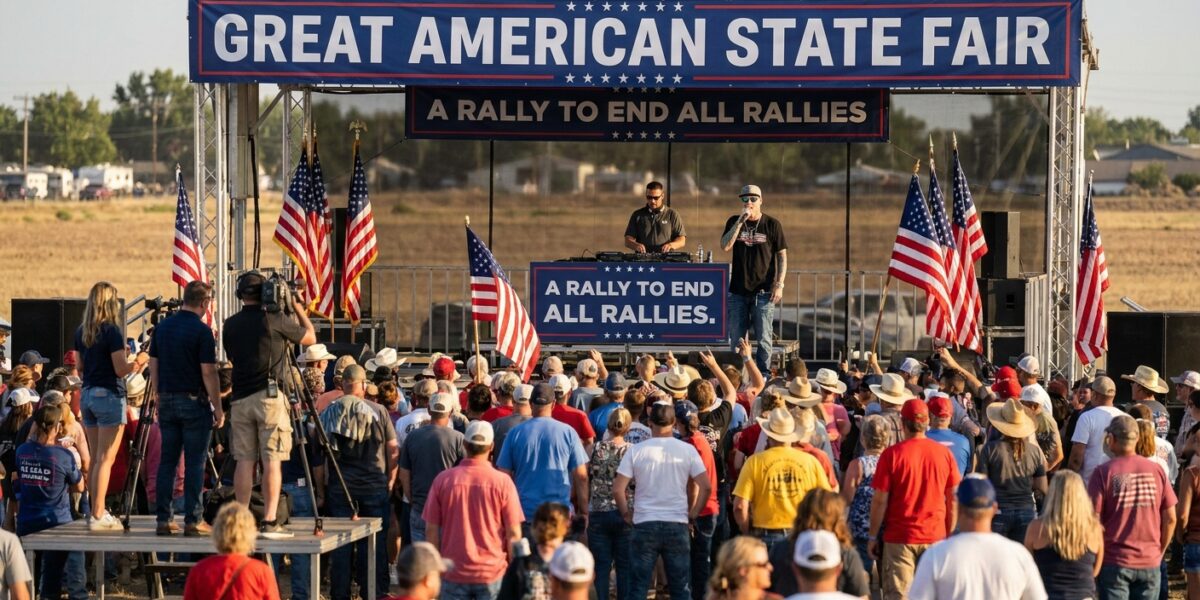
WASHINGTON — Millicent would like to study a collapse. Lineups collapse all the time, for ordinary reasons: scheduling conflicts, illness, contract disputes, a headliner’s private jet developing a mechanical fault. The collapse of the Great American State Fair’s musical lineup was not one of those collapses. It was a collapse with a stated cause, repeated by multiple acts in nearly identical language, and the language is what makes it worth a Culture Desk filing rather than a one-line entertainment brief.
The lineup, as announced, was a respectable cross-section of recognizable American popular music across several decades: Martina McBride (country), Bret Michaels (the Poison frontman, hair-metal), The Commodores (R&B/funk), Young MC (hip-hop), Morris Day and The Time (funk), C+C Music Factory (dance-pop), Vanilla Ice (hip-hop), and Flo Rida (hip-hop). It was, Millicent would note, a lineup assembled for broad nostalgic appeal — the kind of bill you book when you want a crowd that spans generations and regions to find at least one act they remember fondly. It was, in concept, a nonpartisan lineup, because nostalgia is nonpartisan, and the acts were chosen for their nostalgic reach rather than their politics.
The Pattern Of Withdrawal, Which Millicent Will Now Trace
The withdrawals came fast — within roughly 48 hours of the lineup’s announcement — and they came with statements, and the statements rhymed. Millicent would like to lay the statements side by side, because the rhyme is the evidence.
Martina McBride: ‘I was presented with an opportunity to perform at a nonpartisan event but that turned out to be misleading. I asked lots of questions and was assured this was a nonpartisan event that was meant to celebrate ALL 50 states. Yesterday things started changing and what we were told is, in fact, not what is happening.’
The Commodores: ‘Our music has always been our voice and we choose not to publicly affiliate with any single political party. We support the betterment of all Americans.’
Bret Michaels: ‘Unfortunately, what was presented to us as a celebration of our country has evolved into something much more divisive than what I agreed to be a’ — and the public statement Millicent has continues from there in the same register.
Millicent would like to register the common structure. In each case, the artist describes having agreed to perform at an event they understood to be nonpartisan, and having withdrawn upon concluding that the event was, in fact, partisan. The artists are not, in these statements, expressing opposition to the President as such. They are expressing that they were told one thing and then perceived another, and that the gap between the two was their reason for leaving. This is a specific kind of collapse: not a boycott, but a withdrawal-for-cause, in which the stated cause is a perceived misrepresentation of the event’s nature. The artists are not saying ‘we refuse to celebrate America’s 250th.’ They are saying ‘we agreed to celebrate America’s 250th and then concluded we had been booked for something else.’ The distinction matters, and the artists were careful to draw it.
The Rebrand, Which Millicent Considers The Tell
The President’s response to the lineup collapse was not to dispute the artists’ characterization, or to reassure them of the event’s nonpartisan nature, or to recruit replacement acts of comparable stature. The response was to rebrand the event around the collapse: to convert the opening from a concert into ‘A Rally to end all Rallies,’ headlined by the President himself, and to recast the departed artists as undesirable. ‘We don’t want singers with no talent, but big fees to put you to sleep,’ the President wrote on Truth Social, ‘we’ve told them all to stay home. All we want is you, me, a few speakers, and the Greatest Music ever played, the same Music you have listened to for years!’
Millicent considers this the tell, in the poker sense — the involuntary signal that reveals the hand. The artists’ stated reason for leaving was that the event had become partisan. The President’s response converted the event explicitly into a rally headlined by himself. The conversion did not refute the artists’ concern; it confirmed it. An event that responds to ‘this has become too partisan’ by becoming a presidential rally has, in the act of responding, validated the premise of the complaint. Millicent is not editorializing about whether the event should have been a rally. Millicent is observing that the sequence — artists leave citing partisanship, event responds by becoming more explicitly a vehicle for one political figure — is a sequence in which the response confirms the diagnosis. The artists said it had become about one person. The event then became, formally, about one person. The artists, in this reading, were not wrong; they were early.
The Two Who Stayed, Whom Millicent Will Honor Without Judgment
Two acts stayed, and Millicent would like to treat both with the respect their choices deserve, because both choices are defensible and neither is Millicent’s to second-guess. Vanilla Ice stayed; his management said he was ‘proud to help celebrate America’s 250th Anniversary’ and that ‘everyone is welcome to attend and celebrate USA’s Birthday and our Freedom.’ That is a coherent position: the 250th belongs to everyone, and an artist may choose to celebrate it regardless of the surrounding politics. And C+C Music Factory’s Freedom Williams stayed while explicitly stating that he does not support the President — posting, in a lengthy video, that although he does not back the administration, he still planned to perform. Millicent finds the Freedom Williams position the most interesting of all the responses, because it threads a needle the others did not attempt: it separates the performance from the politics, asserting that one can play music at a national birthday without endorsing the person who has attached himself to it. Whether that needle can actually be threaded — whether a performance at a rebranded rally can remain apolitical by the performer’s intent alone — is a genuinely open cultural question, and Millicent does not pretend to know the answer. Millicent notes only that Freedom Williams, whose first name is Freedom, chose to perform at an event called Freedom 250 while publicly disclaiming the politics of the man headlining it, and that the symmetry of that is the kind of thing Millicent’s beat exists to notice.
The lineup collapsed. The collapse had a stated cause. The cause was repeated, in rhyming language, by act after act. The response to the collapse confirmed the cause. Two acts stayed, for two different and individually coherent reasons. And the 250th anniversary of American independence — an occasion that, in principle, belongs to every American and to no party — opened on the National Mall with a presidential rally, a Ferris wheel, a fifth of the states absent, and a music lineup reduced to the performers willing to either embrace the politics or perform in spite of them. Millicent has watched a lot of lineups collapse. This one collapsed cleanly, legibly, and in a way that documented its own cause. Millicent merely transcribed the statements. The statements said what they said.
Millicent Hearsay, Culture Desk, filed this piece on June 29, 2026, with a confidence level of 100% and zero fake sources, because every element is documented. The Great American State Fair lineup and the withdrawals of Martina McBride, Bret Michaels, The Commodores, Young MC, and Morris Day and The Time are confirmed by CBS News, ABC News, Newsweek, and U.S. News & World Report. McBride’s, The Commodores’, and Michaels’s verbatim withdrawal statements are from CBS News and ABC News. The President’s ‘A Rally to end all Rallies’ and ‘singers with no talent’ Truth Social quotes are from U.S. News and CNN. Vanilla Ice’s management statement and Freedom Williams’s video statement are from CBS News and ABC News. Freedom 250’s role and the Ferris wheel are from CNN, NPR, and U.S. News. The roughly ten states declining to participate are from Newsweek. Gerald the houseplant has reviewed this article. Gerald was not booked to perform. Gerald has no fee, big or small, and would put no one to sleep, because Gerald does not sing. Gerald is fine.