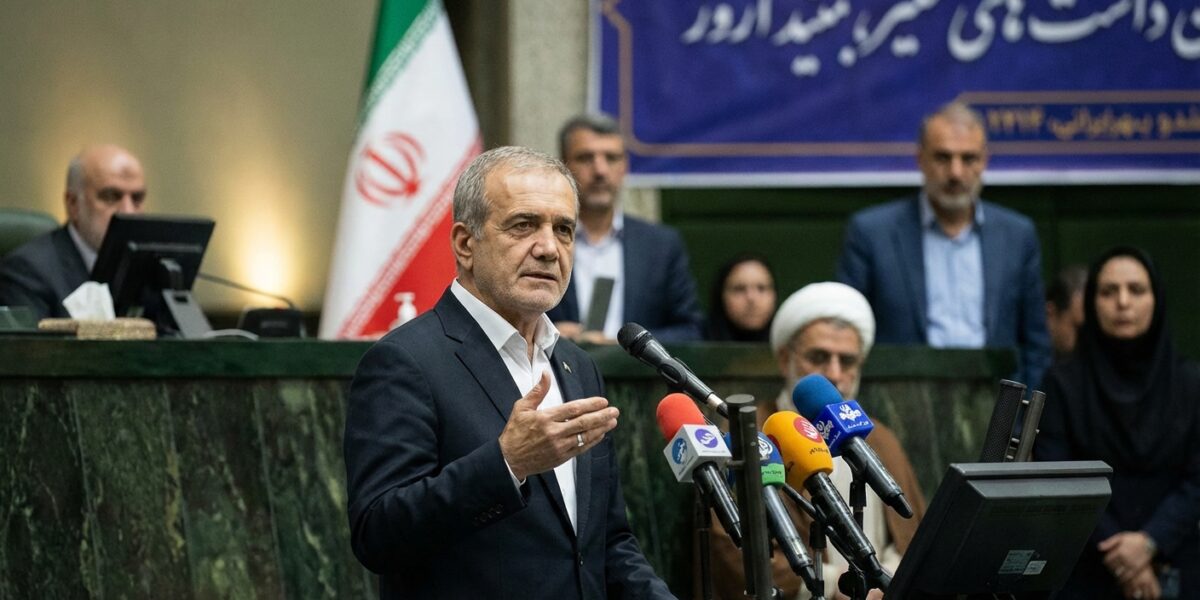
TEHRAN / WASHINGTON — Iranian President Masoud Pezeshkian responded Saturday to the United States’ demand for Iran’s unconditional surrender by describing that demand as “a dream that they should take to their grave,” a statement that the Iranian government characterized as a declaration of resolve, that the Trump administration characterized as “unhelpful,” and that linguists characterize as a grammatically unambiguous rejection of the thing being demanded, which was unconditional surrender.
The exchange — demand, counteroffer of no — represents what diplomatic historians are calling “the clearest example of two parties having different expectations about the outcome of a conversation since at least 2003,” and what the Trump administration’s communications team is calling “a further indication that Iran is not serious about peace,” a framing that Iran would likely characterize differently if asked, which nobody appears to have done.
“Unconditional surrender” is a phrase with a specific historical weight. It was famously demanded of Japan and Germany at the end of World War II, nations that had been comprehensively defeated militarily over a period of years, had lost significant territory, and were facing the total collapse of their governmental and military structures. Iran, by contrast, is in the eighth day of a conflict, has an operational government, an intact military chain of command, is receiving Russian satellite intelligence, and has a president who is giving press interviews.
“The framing gap is notable,” said Dr. Eleanor Stroud, a professor of international conflict resolution at Johns Hopkins School of Advanced International Studies, speaking carefully. “Unconditional surrender is a terminus. You demand it when you’ve already won. Demanding it before you’ve won is… a communication strategy. A bold one.”
The Messaging Question
The Trump administration’s stated objectives for the conflict have, over the course of eight days, included: neutralizing Iran’s nuclear program, regime change, preventing Iran from ever threatening regional stability, ensuring Iran can never again threaten U.S. forces, and unconditional surrender — a list that a classified U.S. intelligence report, cited by the Washington Post, describes as potentially inconsistent with each other and with current military realities.
The same report, according to the Post, expresses doubt that Iran’s opposition would successfully take power following either a short or extended U.S. military campaign — a finding that would seem relevant to the regime change objective, and that the administration has neither confirmed, denied, nor appeared to have fully integrated into its public messaging.
“The range of cited motivations are sometimes at odds with each other,” noted one NPR analysis with the careful phrasing of an organization that has learned to say alarming things very precisely.
White House spokesperson Dana Merrill told reporters that the administration was “laser focused” and “mission driven,” two phrases that describe intensity of commitment without specifying the mission’s content, which Supposedly News observes is a rhetorical choice that laser focus and mission drive do not, by themselves, resolve.
Iran’s Position
Iran’s foreign minister Abbas Araghchi, in a Thursday NBC interview, rejected ceasefire talks, denied behind-the-scenes contact with U.S. officials, and said Iran was not asking for a ceasefire, a statement that Iran’s president then followed Saturday by calling unconditional surrender a grave-bound dream.
Together, these statements constitute a negotiating position that could be summarized as: no. Iran’s position is no. The position is not ambiguous. It is no.
Iran also, notably, apologized Saturday for attacks on regional countries — Gulf nations whose infrastructure has been struck by Iranian drones during the conflict. This apology, which is an unusual move during active hostilities, was interpreted by regional analysts as Iran attempting to preserve relationships with neighbors it may need after the conflict, and by the Trump administration as not being mentioned in the same press conference as the unconditional surrender rejection.
What Happens Next
President Trump said Saturday he planned to honor fallen U.S. service members at Dover Air Force Base and threatened to widen U.S. targets in response to Iran’s president’s remarks. Iran said it was prepared for that. Russia said it was in dialogue. The price of oil reached $94 a barrel. NATO issued a statement that contained the word “solidarity” twice and the word “Article 5” zero times.
The demand for unconditional surrender remains outstanding. The surrender remains, based on available evidence, unconditioned by anything approaching imminent.
Supposedly News will continue to monitor the gap between demand and reality. It is, at current rates, a large gap. We are monitoring it from a distance.
Deborah Shill is Supposedly News’s Political Analyst. She has covered diplomatic communications for fourteen years. She rates this particular diplomatic exchange a two out of ten on the constructive dialogue scale. The scale goes to ten. She wanted that noted.