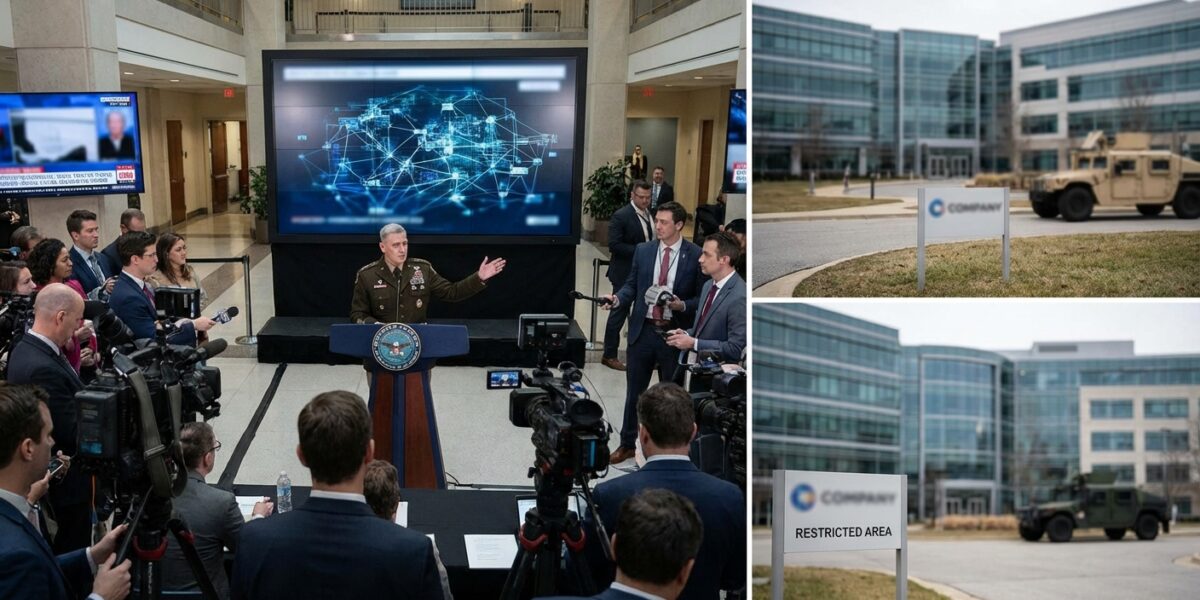
WASHINGTON, D.C. — The Pentagon officially declared a major AI company a “supply chain risk, effective immediately” on Thursday, banning its products from Defense Department use following the company’s public refusal to allow its AI models to be used for autonomous weapons systems or mass domestic surveillance — a refusal that the company described as an ethical commitment and that the Pentagon described as a problem, in a conflict of values that technology ethicists are calling “clarifying” and defense contractors are calling “an opportunity.”
The declaration, which came shortly after President Trump separately ordered all federal agencies to stop using the company’s products, represents the federal government’s most direct action against a commercial AI company to date — and has created what the Government Accountability Office might describe, in more energetic language than it typically uses, as a situation.
The situation is this: the AI company whose products have been banned is one of several major AI developers whose models, APIs, and infrastructure are woven throughout the federal technology ecosystem in ways that a ban on one company’s products does not fully address, because the underlying question — which AI systems are appropriate for which military applications, and who decides — was never formally resolved before the systems were deployed.
“You can ban the brand,” said Dr. Susan Park, a defense technology policy researcher at Georgetown, speaking with the measured calm of someone watching a situation develop in a direction she had written several papers about. “What you can’t easily do, post-ban, is un-integrate the infrastructure. The question of which AI is acceptable and which isn’t is a good question. It’s just a question that would have been better to answer before everything was already running on AI.”
What The Company Did
The company at the center of the dispute published a policy document last week explicitly stating that it would not allow its AI models to be used for mass domestic surveillance or in fully autonomous weapons systems — the kind of weapons that identify and engage targets without direct human authorization in the loop.
This policy, the company said, reflected its commitment to “responsible AI development” and what it described as non-negotiable ethical limits on the technology’s deployment.
The Pentagon, which had reportedly been using the company’s AI tools for intelligence analysis and target selection support — not autonomous weapons, the Pentagon said, but intelligence purposes and target selection support, which the company’s policy document covers — responded by declaring the company a supply chain risk.
The company did not rescind the policy.
The president called the company “Radical Left.”
The company’s products are now banned from federal use.
The underlying ethical questions about autonomous weapons and AI-assisted targeting remain unresolved and will now be addressed by whichever AI company does not have a policy against addressing them, which is several companies.
The Market Response
Shares of three defense-adjacent AI companies rose Thursday following the ban announcement, as investors calculated — correctly, most analysts agreed — that the Pentagon’s AI requirements do not decrease because one vendor is removed, they simply redistribute to other vendors who have not announced policies that make procurement uncomfortable.
“There are companies that will do this,” said one defense technology investor, speaking on background, with the tone of a person stating a fact rather than endorsing it. “There have always been companies that will do this. The ban doesn’t change the underlying demand. It changes the vendor.”
The Irony Filing
Supposedly News would like to note, for the record, the specific shape of the irony in play:
A company said: we will not help build systems that kill people without a human deciding to kill them. The government said: that position is a supply chain risk. The government will now source the same capability from companies that did not make that statement.
The humans who will or will not be in the loop remain, in either scenario, the humans who will or will not be in the loop.
The company has not commented further since the ban. Its policy document remains on its website. Its products remain banned from federal use. The questions its policy was trying to answer remain, for the moment, unanswered by anyone with the authority to answer them.
Several of those questions, Supposedly News understands, are currently being addressed by a different AI company’s products, running on servers in Virginia, processing intelligence data in a conflict that is now in its eighth day.
Chad Exposé, Investigative Reporter, notes for the record that this article was not written by the company in question, nor by any of the companies that replaced it. It was written by a human. For now.