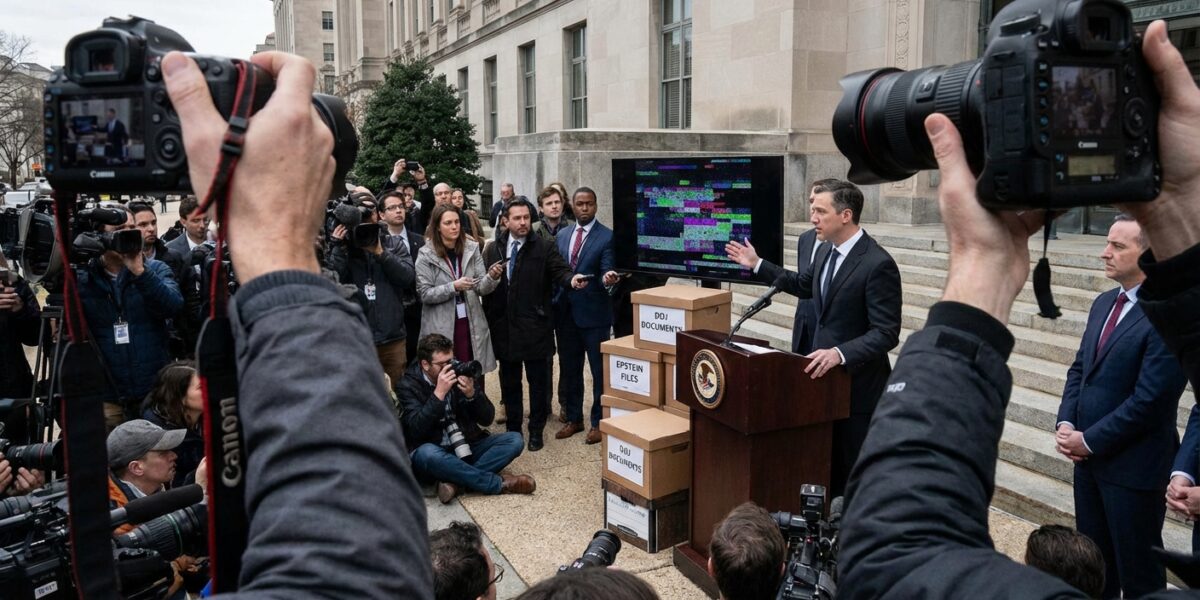
WASHINGTON, D.C. — The Department of Justice released additional Epstein files Thursday that had been absent from its public disclosure database since January — files that were supposed to be released under the Epstein Files Transparency Act, a law passed overwhelmingly by Congress compelling the full release of all Justice Department documents related to Jeffrey Epstein, and which were not released because they had been, the DOJ explained, “incorrectly coded as duplicative.”
The coding error, the DOJ said, was a mistake. An honest mistake. A technical mistake made by a department that manages millions of pages of sensitive federal documents for a living, in a database that was created specifically for the purpose of making those documents available to the public, during a process that had been underway for months, involving files that multiple members of Congress had specifically requested, about a case that approximately everyone was watching.
“Incorrectly coded as duplicative,” the statement said.
Coding error.
The files were released Thursday, partially. The handwritten notes from the interviews are still not available. Thirty-seven additional pages remain unaccounted for in the public database. The DOJ has not yet identified whether those 37 pages are also incorrectly coded, correctly coded but withheld, incorrectly coded and also withheld, or whether a new and as-yet unnamed coding category has been developed to describe their status.
Supposedly News will continue monitoring for the emergence of new coding categories.
A Brief History Of This Particular Transparency Exercise
Congress passed the Epstein Files Transparency Act in November 2025 by an overwhelming bipartisan margin, requiring the Justice Department to release all documents in its possession related to Jeffrey Epstein within 30 days. The law was notable for its specificity, its bipartisan support, and the general understanding that “all documents” and “within 30 days” were chosen as the operative phrases because previous attempts at voluntary disclosure had produced results that document transparency advocates described as “selective” and that a dictionary would describe as “not all documents.”
The DOJ released approximately 3.5 million pages in January. The total collection is approximately 6 million pages. The gap between 3.5 million and 6 million is 2.5 million, a number that the DOJ has described using various explanations including privilege claims, ongoing investigation sensitivities, victim privacy protections, and now, coding errors.
NPR’s investigation found that specific documents — FBI interview summaries, case notes, and related materials — appeared in the DOJ’s own cataloguing systems but not in the public database. The documents were there. They were logged. They had serial numbers. They existed in the system. They were simply not shared with the system’s intended audience, which was the public, pursuant to a law requiring their sharing with the public.
Coding error.
The Attorney General’s Position
Attorney General Pam Bondi, in a February letter to Congress co-signed by Deputy Attorney General Todd Blanche, assured lawmakers that no records had been withheld “on the basis of embarrassment, reputational harm, or political sensitivity, including to any government official, public figure, or foreign dignitary” — a sentence that is notable for the comprehensiveness of its denial and for the fact that it required a fairly specific list of things to deny.
The statement did not say the records had not been withheld. It said they had not been withheld for those specific reasons. These are different statements. The distinction is the kind of thing that lawyers notice, and there are a significant number of lawyers currently paying attention to this situation.
Attorney General Bondi has since been subpoenaed to testify before the House Oversight Committee, a development that emerged after the committee voted on a motion supported by members of both parties, making it the second bipartisan act in this story and suggesting that the Epstein files have achieved the rare feat of producing consensus in a legislative environment that produces almost none.
The subpoena, it should be noted, was necessary because the Attorney General had not appeared before the committee voluntarily, which is a choice a person makes when appearing voluntarily seems worse than being subpoenaed, a calculation that itself contains information.
The Surveillance Subplot, Which Emerged While Everyone Was Watching The Coding Error
In a development that arrived while the coding error was being processed by the news cycle, it emerged that the DOJ had been monitoring the search histories of members of Congress who accessed the “unredacted” version of the Epstein files at the Justice Department — a process set up specifically so lawmakers could review materials not available to the general public.
The monitoring of congressional search histories while members review sensitive documents at the Justice Department’s own facility was described by Rep. Robert Garcia (D-CA) as “spying on Congress” and by the DOJ as a security protocol, and by constitutional law scholars contacted by Supposedly News as “a thing that is going to be in a lot of law review articles.”
“You invite members of Congress to view documents at your facility,” said Dr. Helena Park, a constitutional law professor at Georgetown, reviewing the situation. “You then monitor what they look at while they are there. You then argue that the monitoring is a security measure. I want to note that ‘security measure’ and ‘chilling effect on congressional oversight’ are not mutually exclusive categories. You can have both. This appears to be both.”
The Victim Identification Incident, Also
In a separate development from the coding error and the congressional surveillance, the DOJ’s most recent document release inadvertently exposed the identities of dozens of survivors of Jeffrey Epstein’s sexual abuse — people whose identities were supposed to be protected, whose trauma was supposed to be handled with care, and who instead found their names in a public database because the document review process that was supposed to catch such things did not catch such things.
The DOJ subsequently took 47,635 files offline for further review and redaction to address what it called “victim privacy concerns” — a phrase that would carry more weight as a commitment to victim privacy if the victim privacy breach had not occurred in the first place, as a result of the document release process the DOJ conducted, in the database the DOJ manages, under oversight the DOJ provides.
Coding error.
The Scoreboard
For readers who would like a summary of where the Epstein Files Transparency Act stands, approximately two months after the law’s mandatory disclosure deadline:
Documents required by law to be released: all of them. Documents released: approximately 3.5 million of an estimated 6 million pages. Documents confirmed missing from public database: previously 53 pages, now 37 pages, with 16 released Thursday. Documents whose absence is explained by coding errors: some. Documents whose absence is explained by privilege claims: some. Documents whose absence remains unexplained: some. Victims whose identities were accidentally exposed: dozens. Congressional members whose reading habits were monitored: some. Attorneys general subpoenaed: one. Hearings held: several. Accountability achieved: forthcoming.
The database is available at justice.gov/epstein. The handwritten notes are not in it. The 37 pages are not in it. The coding error has been acknowledged. The remaining coding errors are, per the DOJ, being reviewed.
Congress passed a law. The law said release everything. Everything has not been released. The explanation is coding.
Supposedly News has requested clarification on the coding system. The DOJ has not responded. We suspect our request may have been incorrectly coded as duplicative. We will follow up.
Chad Exposé, Investigative Reporter, has been covering document transparency issues for nine years. He has never seen a coding error quite this specific, quite this convenient, or quite this extensively investigated by NPR before the code got fixed. He is setting his confidence level at 12% — not because he doubts the facts, but because the facts keep changing, which is its own kind of confidence level.