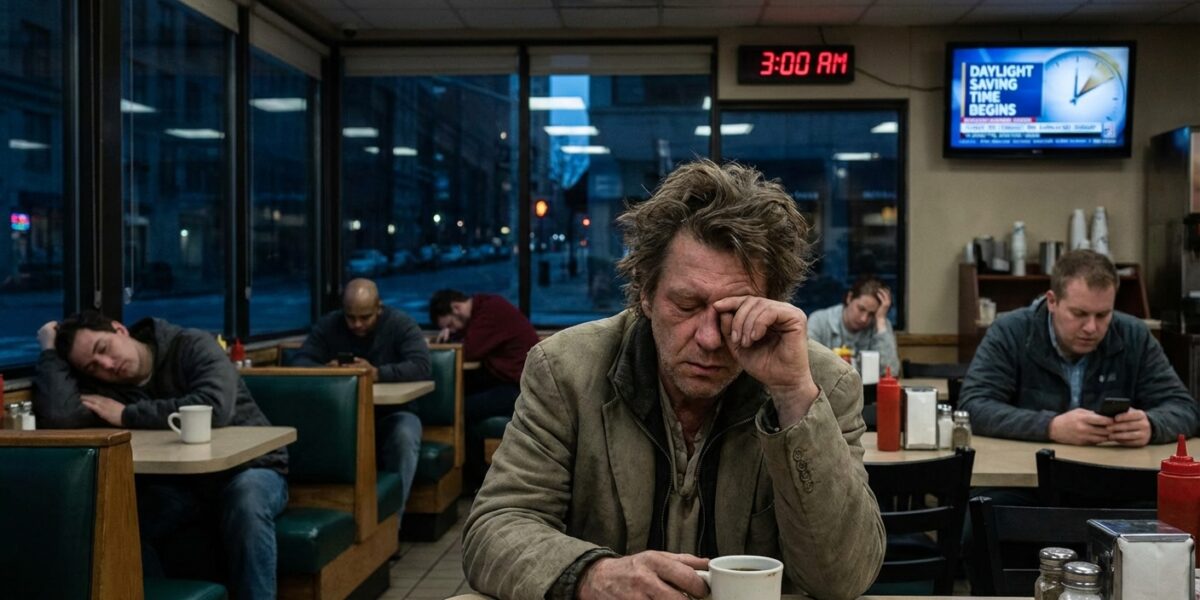
EVERYWHERE, USA — At precisely 2:00 a.m. Sunday, Daylight Saving Time began in the United States, advancing clocks one hour forward and removing sixty minutes from the sleep schedules of approximately 335 million Americans who were, by every available metric, already not getting sufficient sleep and who now have one less hour in which to not get it.
The transition, known colloquially as “spring forward” and known less colloquially as “the biannual reminder that we are doing something that the American Medical Association, the American Academy of Sleep Medicine, the American Academy of Pediatrics, the Society for Research on Biological Rhythms, and approximately every sleep scientist who has published anything in the last twenty years has formally recommended we stop doing,” proceeded on schedule.
Clocks moved. The hour was lost. People woke up one hour earlier than their bodies understood themselves to be waking up. Coffee consumption spiked. The nation attempted to function.
It is doing okay. It has looked better.
What Happened Sunday Morning, Documented In Real Time By This Reporter Who Also Lost The Hour
6:47 a.m.: The alarm goes off. The alarm is set for 7:47 a.m. by the body’s understanding of time. The phone has already updated. The phone says 7:47. The body says this is incorrect. The body is not wrong but is also not in charge of the phone.
7:12 a.m.: A man named Dennis, 54, of Columbus, Ohio, arrives at his regular diner for breakfast at what he believes is his usual time of 8:12. The diner is full. Every table is taken by people who also arrived at what they believe is their usual time. They are all there simultaneously for reasons that Dennis understands intellectually but that his body is processing as a personal affront.
7:45 a.m.: Churches across America begin services. The parking lots contain fewer cars than usual. The cars that are there contain people who woke up on time by the clock and are now sitting in pews with the specific thousand-yard stare of individuals who know where they are but cannot fully explain why.
8:30 a.m.: The first wave of people who forgot entirely reaches the internet and begins posting. The posts say things like “I just realized” and “who decided this” and “every year” and “I hate this.” The posts receive immediate, enthusiastic engagement from people who have been awake since 5:30 a.m. for reasons they cannot explain and who are coping through community.
9:00 a.m.: The New York Times publishes its annual Daylight Saving Time explainer. It has published a version of this explainer every year since at least 2012. People read it. People share it. People learn that farmers did not actually request Daylight Saving Time — it was a wartime energy measure — and are briefly outraged at the farmers before being told this again next year.
The Congressional Situation
The Sunshine Protection Act — a bill that would make Daylight Saving Time permanent, eliminating the twice-annual clock change — passed the United States Senate unanimously in 2022. Unanimously. Every senator voted for it. It went to the House. The House did not pass it. The bill expired. A new version was introduced. It did not pass. Another version was introduced. It did not pass.
Congress has now failed to pass permanent Daylight Saving Time legislation through four consecutive sessions despite unanimous Senate support, consistent public polling showing 63% of Americans want the time changes eliminated, bipartisan sponsorship in both chambers, and no organized opposition beyond the vague institutional inertia of a legislative body that is very busy with other things, some of which are also not getting done.
“It’s genuinely one of the easier things we could do,” said a congressional staffer who asked not to be named because they work there and would prefer to keep doing so. “There are no real opponents. Everyone agrees. We just haven’t done it. I don’t have a better explanation than that.”
They were reached at 7:15 a.m. They sounded tired.
The Medical Position, Summarized
Sleep scientists and medical associations would like the following on the record: the one-hour shift caused by Daylight Saving Time is not trivial. In the week following the spring transition, research documents increases in heart attacks, strokes, workplace accidents, car crashes, and medical errors. Pediatric emergency room visits spike. Productivity measurably declines. The immune system is affected. Mood is affected. The body’s circadian rhythm, which is a finely calibrated biological system and not a setting you can just change like a phone, requires approximately one week to fully adjust.
“We do this every year,” said Dr. Patricia Wren, a sleep medicine specialist at the University of Michigan, in a statement that contained significantly more frustration than her previous three annual statements on the same subject. “We know what it does. We have known for decades. The science is not ambiguous. And yet here we are.”
Here we are indeed. The clocks have moved. The hour is gone. The nation is tired in a way that is simultaneously the most relatable and most preventable form of national tiredness currently available.
The One Person Who Is Fine
Somewhere in every Daylight Saving Time story there is a person who is fine. This year that person is Margaret Stull, 71, of Flagstaff, Arizona, which does not observe Daylight Saving Time and therefore changed nothing about its clocks Sunday morning.
Margaret went to bed at her normal time. She woke up at her normal time. She had her normal amount of sleep. She is having a normal Sunday.
“I don’t think about it much,” Margaret said, when reached by phone. “We just don’t do it here.”
She sounded rested. It was infuriating.
Also not observing Daylight Saving Time: Hawaii. Also also not observing it: most of the rest of the world, which tried it, assessed it, and moved on with their lives.
The United States will fall back in November. We will discuss it then. Everyone will be briefly outraged. The Sunshine Protection Act will be reintroduced. The Senate will pass it unanimously. The House will not pass it. We will do this again in March.
Supposedly News’s confidence level on this prediction is 100%. We did not need sources. We have lived this before. We are living it now. We are tired.
Brent Eyewitness filed this report at what his phone says is 9:30 a.m. and what his body says is 8:30 a.m. Both are correct. Neither is helping.