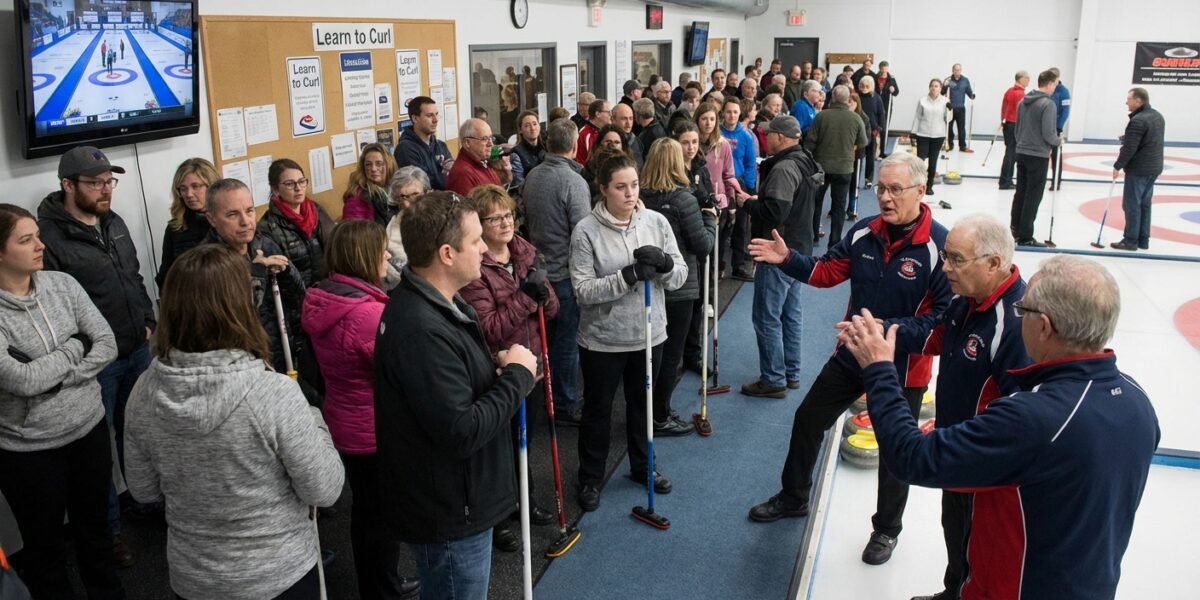
LAUREL, MD — The Potomac Curling Club, like curling clubs in every city with a curling club, which is fewer cities than you’d think until you start looking and then it’s more cities than you’d expect, is having what members describe as “a moment” — the predictable, welcome, slightly exhausting surge of interest that follows every Winter Olympics broadcast, in which hundreds of newly converted curling enthusiasts arrive at clubs nationwide filled with enthusiasm, good intentions, and a set of foundational misunderstandings about the sport that veteran members have now explained enough times to have developed a brochure.
The brochure is called “Welcome To Curling: Some Things To Know Before You Get On The Ice.” It is four pages long. It addresses, in order: what the brooms are for, why the person is yelling, what “the house” is (not a building), what “the hack” is (not a computer thing), and the difference between a “draw” and a “takeout,” which is not the same as the difference between a draw and a takeout in any other context in which those words appear together.
“We love new members,” said Potomac Curling Club membership coordinator Janet Yee, with the specific warmth of a person who has been saying something for a long time and means it and is also exhausted. “Genuinely. Every Olympics we get this wave and a lot of them stay and become wonderful curlers. We just ask that they read the brochure. We ask it very specifically. In the confirmation email. In bold.”
She paused.
“Most of them do not read the brochure,” she added.
What New Members Think Curling Is
Frank Misquote, Sports & Leisure, spent a Saturday morning at the Potomac Curling Club speaking with new arrivals, all of whom had watched the Winter Olympics and all of whom had arrived with a specific version of curling in their heads that veteran members gently describe as “a starting point.”
Common misconceptions encountered, in descending order of frequency:
That the sweeping is decorative. It is not decorative. The sweeping is one of the most technically demanding elements of the sport, affecting the speed and direction of the stone in real time through friction management, and the decision about when and how hard to sweep is made in split seconds based on the skip’s read of the ice and the stone’s rotation. “It’s just for fun though, right?” asked one new arrival named Kevin. Kevin was incorrect.
That the yelling is recreational. The skip — the team’s strategist and shot-caller — yells “hurry” or “hard” or “whoa” to direct the sweepers. These are instructions. They contain information. They are not expressions of enthusiasm. “I thought they were just getting into it,” said a woman named Brianna who had brought her entire book club. Brianna’s book club has since split: three stayed, three left after the first session, and one is now the most dedicated curler the club has seen in a decade, which the club notes is also a pattern that repeats every four years.
That the ice is the same as hockey ice. It is not. Curling ice is “pebbled” — sprayed with droplets of water that create a textured surface over which the stone travels differently than it would on flat ice. Managing the pebble is a significant part of competitive ice preparation. “It feels weird,” said a man named Todd, who had worn hockey skates. Curling uses special shoes with one slippery sole and one gripper sole. Todd had not read the brochure.
The Four-Year Cycle
Curling’s Olympic boost is one of the most reliable phenomena in recreational sports. Every four years, the sport captures a television audience with its combination of visible strategy, accessible scoring, and the specific tension of watching a 44-pound granite stone travel 150 feet and stop within inches of a target — a combination that produces, in viewers, an immediate desire to do it themselves.
The clubs welcome it. The surge reliably produces lasting members — people who discover that the sport rewards practice, strategy, and the particular social ecosystem of a curling club, which tends toward the warm, self-deprecating, and deeply specific. There are curling jokes that are only funny if you curl. They are very funny if you curl.
“The ones who stay,” said veteran curler David Park, who has been at Potomac for nineteen years and whose calm on the ice is the calm of a person who has thrown approximately 40,000 stones, “are the ones who come for the Olympics and stay for the community. Once you understand what’s actually happening out there — the strategy, the reads, the ice — it gets in your head. In the best way.”
He considered this.
“Tell Kevin to read the brochure,” he added. “The sweeping matters.”
Kevin, reached for comment, said he was planning to come back next week. He had not yet read the brochure. He said he would read it. He seemed like he might read it.
The 2030 Winter Olympics will be held in the French Alps. The Potomac Curling Club is already updating the brochure.
Frank Misquote tried curling Saturday morning at the Potomac Curling Club. He fell once, swept incorrectly twice, and threw a stone that the skip described as “a learning experience.” He is going back next week. He has read the brochure.